So since I start work on sunday, and I have a 60 mile highway commute, I thought I should do everything I can to get better gas mileage. So far I'm on my 2nd tank of Techron. I also checked the tire pressure today. I got 28 in the fronts and 25 in the rear (30/30 according to the sticker inside the fuel door). I pumped them up to 34 all around. Wondering to see how my mileage goes up, and if the ride is affected at all. Also, I was curious if treadlife would be severely reduced by running that low.

You are using an out of date browser. It may not display this or other websites correctly.
You should upgrade or use an alternative browser.
You should upgrade or use an alternative browser.
Tire pressure effect on life and mpg?
- Thread starter Nick R
- Start date
- Status
- Not open for further replies.
Originally Posted By: rudolphna
So since I start work on sunday, and I have a 60 mile highway commute, I thought I should do everything I can to get better gas mileage. So far I'm on my 2nd tank of Techron. I also checked the tire pressure today. I got 28 in the fronts and 25 in the rear (30/30 according to the sticker inside the fuel door). I pumped them up to 34 all around. Wondering to see how my mileage goes up,
statistically it will
and if the ride is affected at all
Likely it's a hair firmer.
Also, I was curious if treadlife would be severely reduced by running that low.
It will. Also it increases the risk for a blowout since the sidewall heats up more at less than recommended pressure due to increased flexing, and weakens faster.
So since I start work on sunday, and I have a 60 mile highway commute, I thought I should do everything I can to get better gas mileage. So far I'm on my 2nd tank of Techron. I also checked the tire pressure today. I got 28 in the fronts and 25 in the rear (30/30 according to the sticker inside the fuel door). I pumped them up to 34 all around. Wondering to see how my mileage goes up,
statistically it will
and if the ride is affected at all
Likely it's a hair firmer.
Also, I was curious if treadlife would be severely reduced by running that low.
It will. Also it increases the risk for a blowout since the sidewall heats up more at less than recommended pressure due to increased flexing, and weakens faster.
Low tire pressure will cause the outside edges of the tires wear faster, High tire pressure will make the center of the thread to wear faster. Higher pressure should give you better MPG. The pressure listed on the cars sticker is for max loaded vehicle so you very likely had the right pressure in them to begin with.
You should never let any tire drops below placard number on cold pressure.
I found that usually most cars have best MPG, tread life, ride smoothness, handling, performance, stopping distance ... with 4-6 PSI above recommended pressures on placard.
I found that usually most cars have best MPG, tread life, ride smoothness, handling, performance, stopping distance ... with 4-6 PSI above recommended pressures on placard.
I too would run 34 pounds in the tires and check them in the morning before the vehicle is driven to get an accurate reading.
Dodge calls for 35 psi front and rear on my Dakota. About a month ago I increased it to 40 psi front and rear and got an increase of about 1 to 1.25 MPG. The ride quality is a bit more firm (a good thing and I like the improvement) and the handling is better too.
So far I have noticed no detrimental effects on my tires at all. I read on BITOG and other forums too that a few more psi wouldn't hurt anything and would help on MPG and I am trying to get every mile I can from the gas I buy because it sure isn't getting any cheaper around here.
So far I have noticed no detrimental effects on my tires at all. I read on BITOG and other forums too that a few more psi wouldn't hurt anything and would help on MPG and I am trying to get every mile I can from the gas I buy because it sure isn't getting any cheaper around here.

There a common mistake that the pressure on a tire should be the one recommended by the car manufacture .There only one way to truly determine the proper pressure, do a chalk test, quite simple draw a chalk line on your tire drive for a couple minute, if the mark is gone in the middle they are under pressure, same if the outside mark is gone over pressure, when the mark wear is even you are on the spot.
Kestas
Staff member
In my 35 years of driving and overinflating tires above the manufacturer's recommended pressures, I've never experienced center wear on my tires... but I still regularly experience edge wear.

Originally Posted By: virtual
There a common mistake that the pressure on a tire should be the one recommended by the car manufacture .There only one way to truly determine the proper pressure, do a chalk test, quite simple draw a chalk line on your tire drive for a couple minute, if the mark is gone in the middle they are under pressure, same if the outside mark is gone over pressure, when the mark wear is even you are on the spot.
Here's the problem with the "Chalk Test".
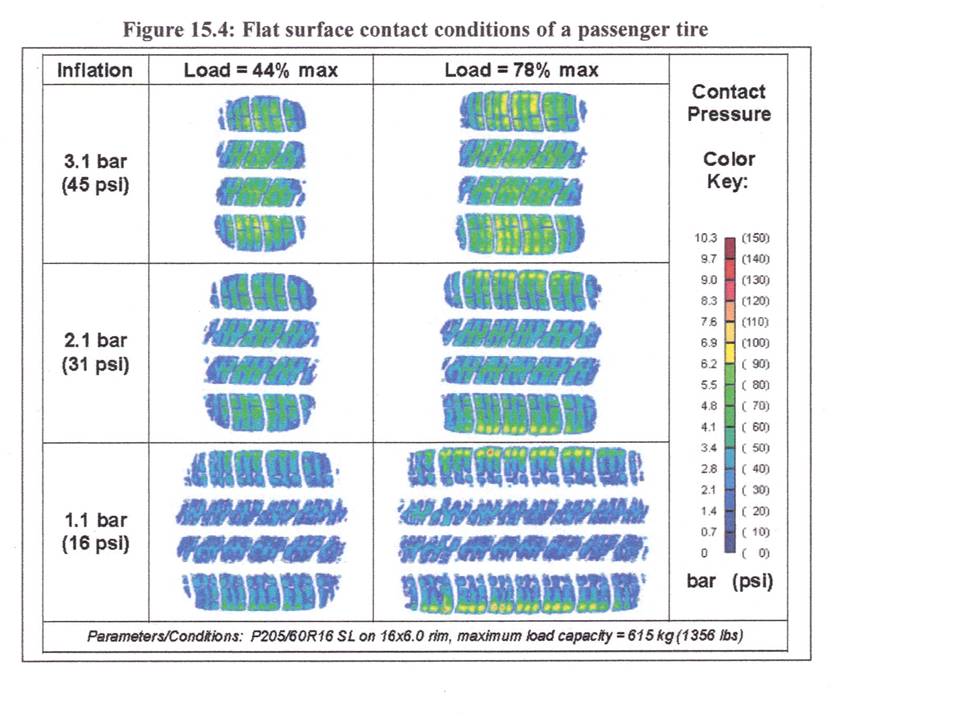
There are 3 different pressures for 2 different loadings.
Notice that in all cases the tread is 100% in contact with the ground - meaning that no matter what inflation pressure you used, the result would always be the same.
There a common mistake that the pressure on a tire should be the one recommended by the car manufacture .There only one way to truly determine the proper pressure, do a chalk test, quite simple draw a chalk line on your tire drive for a couple minute, if the mark is gone in the middle they are under pressure, same if the outside mark is gone over pressure, when the mark wear is even you are on the spot.
Here's the problem with the "Chalk Test".
There are 3 different pressures for 2 different loadings.
Notice that in all cases the tread is 100% in contact with the ground - meaning that no matter what inflation pressure you used, the result would always be the same.
But the chalk would wear faster where there is more contact pressure right?
Originally Posted By: rudolphna
I also checked the tire pressure today. I got 28 in the fronts and 25 in the rear (30/30 according to the sticker inside the fuel door). I pumped them up to 34 all around. Wondering to see how my mileage goes up, and if the ride is affected at all. Also, I was curious if treadlife would be severely reduced by running that low.
Generally speaking the higher the pressure up to the point where the safe design limit of the tire is reached or abnormal wear is encountered the better when it comes to both tire wear and mileage.
Low pressure means more flex, which is energy lost and generates heat in the tire.
Back in the days of the MobilGas Economy Run the factory teams regularly used 80 psi all around. Of course, tire wear was not a concern.
I also checked the tire pressure today. I got 28 in the fronts and 25 in the rear (30/30 according to the sticker inside the fuel door). I pumped them up to 34 all around. Wondering to see how my mileage goes up, and if the ride is affected at all. Also, I was curious if treadlife would be severely reduced by running that low.
Generally speaking the higher the pressure up to the point where the safe design limit of the tire is reached or abnormal wear is encountered the better when it comes to both tire wear and mileage.
Low pressure means more flex, which is energy lost and generates heat in the tire.
Back in the days of the MobilGas Economy Run the factory teams regularly used 80 psi all around. Of course, tire wear was not a concern.
Yep too much pressure reduces the contact patch of the tire though higher pressure reduces flex so the tire potentially runs cooler. The correct pressure gives the best traction. It is all a compromise.
I've always set my tires 5-7psi above what the door placard recommends, for my trucks; for cars, I typically only go 3-5psi above.
Done this for years, I actually believe the tires handle better, last longer, etc.
Done this for years, I actually believe the tires handle better, last longer, etc.
3 of mine have a max PSI of 44 and I keep those at 42 PSI and the one I have with a Max of 51 I keep around 44 PSI. this keeps the front tires from wearing on the outside and just gives me better tire mileage, slightly harsher ride but much better tire wear. The sticker on the door well, that went with the tires that came with the cars where the Max PSi may have been 35 plus manufacturers go for all around service with ride comfort being their biggest objective, not tire longevity
- Status
- Not open for further replies.
Similar threads
- Replies
- 2
- Views
- 357
- Replies
- 15
- Views
- 602