Theoretical horsepower

Status
Not open for further replies.
They haven't become more "efficient"...BSFC numbers commit to that.

Sir Harry's engine was 200hp, had BSFC rivalling just about anything modern, however, it used 6 186c.i. cylinders to get to 200hp.
 
Originally Posted By: Shannow
They haven't become more "efficient"...BSFC numbers commit to that.

Sir Harry's engine was 200hp, had BSFC rivalling just about anything modern, however, it used 6 186c.i. cylinders to get to 200hp.


Modern engines are way more efficient than older engines, there is no doubt about that. A BSFC number of .45 is not that impressive considering modern engines can get it down into the .3's.

But that's not really the thing that makes them efficient. It's the control of fuel mixture in transient conditions that sets modern engines apart. With a carburetor, if you are decelerating with the throttle closed, there is still fuel being delivered to the engine. With fuel injection, it is shut off. Carburetors supply wildly fluctuating mixtures in real world operation, while modern fuel injection controls them well - and it is getting better.

Getting a low BSFC on a dyno under a steady load only tells you about the condition under which it is tested. The real test is how it performs in real world conditions, and the modern engine has old technology beat by a huge margin.
 
On the topic of BSFC vs. overall vehicle miles-per-gallon, I've been wondering whether it would make sense to have a small engine running at optimal BSFC powering a generator to charge a battery pack, which would then power an electric motor to move the car.

Here are some approximate numbers I've found through googling:
AC generator efficiency: 75%-90%, mean of 85%
AC/DC converter efficiency: 96%-98%
Li-Ion battery charging/discharging efficency: 97%-99%
I'm going to assume the motor has the same efficiency as the generator.

The overall efficiency then is 67%.

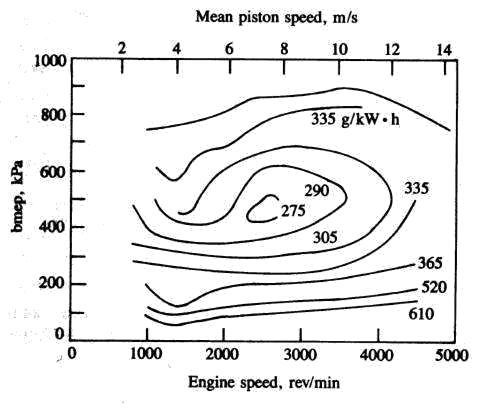
If we look at this random BSFC graph I found,
10_graph_2.gif

The peak BSFC is 275g/kWh (around 0.45lb/hp*hr), so if the inefficiency above is factored in, that's adjusted to 413G/kWh (0.68 lb/hp*hr).

I'm not 100% sure, but it looks like that's probably less efficient than just driving the wheels directly.

 
Every time you convert the power you lose a bit no matter what.

So your conclusion is correct.

I once read some promising stuff on fuel cells, if they run on hydrogen they are quite efficient. But good luck running big oil out of biz.
 
Problem there is that there are no hydrogen mines.

Coal Power is 40-50% efficient, and the energy conversion of electrolytic cells is pretty woefull.
 
Status
Not open for further replies.
Back
Top Bottom