The gambler who beat roulette

I was TDY to Nellis AFB in Las Vegas around 1977 to a not particularly difficult training class. Picked up a book on counting cards and went to town with a deck. I did not particularly find it difficult, although I did not completely master the hit/stand table variance depending on the card count.
During the 80s I made multiple trips to Nellis, with some visits to the blackjack tables. While I did not play at a high level, I noticed a number of counters the casinos employed. The worst was to adjust the point of shuffle. With a 2 deck table, I noticed the dealer would sometimes deal the deck all the way down, requiring a reshuffle before completing a hand. Other times, the dealer would reshuffle after only one or two hands. With a multi-deck shoe, the dealer would sometimes deal to the burn card, other times he or she would reshuffle before that point. There seemed to be two types of these dealers. One would reshuffle when a player who well could have been counting raised his bet. The other type of dealer (the cheating one, in my opinion) adjusted his shuffle point based on the card count, shuffling early if the deck was not in the house favor (ratio of 10s to non-10s), dealing all the way down if the deck favored house odds. This last method of countering card counters was cheating IMO because it improved house odds against all players.
Another method was based upon my fear and superstition rather than science. Whenever one of the seedier downtown casinos got tired of me taking up a seat and not losing sufficiently fast enough, they would move in an Asian Female dealer, who would beat me 9 out of 10 hands, 2 of those 9 drawing a multi-card 21 to beat my pat 20. Try as I could, I could never hold my own against one of those ladies.
 
  • Wow
Reactions: GON
It doesn’t matter how many decks are in a shoe.
That's not true. Taking it to the limit, if the shoe was an infinite stack of shuffled cards, the probability of drawing a high card would be constant throughout the game. It would not depend at all on the count of previously drawn cards.
 
Other than card counting, the only way I think most people can win is controlling when to leave the table and cash out. When you start the first several rounds you may win and you may lose, and if you play long enough you are guaranteed to lose, so this is how my dad played back when he did it once a year:

1) Get to a table playing black jack, start with some small to medium amount bet
2) If he win, leave the table right away
3) If he lost, play a couple more time till he win as a whole in general, then leave the table right away
4) Spend the next several hours watching others play, and don't gamble afterward.
 
Casinos are like insurance cos.

They sure love collecting, but if they have to pay they won’t stop until they get all of their money back.

Imagine if you don’t throw the dice the way they want you’re a criminal 😂
 
Casinos are like insurance cos.

They sure love collecting, but if they have to pay they won’t stop until they get all of their money back.

Imagine if you don’t throw the dice the way they want you’re a criminal 😂
Yes, that is correct. Casino gambling is a losing proposition. It is a mathematical formula to make sure the casino wins. Insurance companies wish they had the same model as a casino.
 
This criminal team "won" 225k in a few days cheating on electronic craps in Las Vegas. Had no idea craps had gone automated.

https://www.8newsnow.com/investigat...-sliding-cheating-scheme-at-las-vegas-casino/

I looked up what it was. They use real dice. But the betting is automated. If you've ever seen real table games it can get confusing who placed which chips, but I believe they often have different colors for each player so as to not be as confusing if two players opt to be the same. I think the idea is that it helps the player understand the rules and the payouts better. It seems more like playing on a slot machine with playslips. And the surface isn't felt but glass where it's on top of a video display.


I couldn't imagine sliding dice across a felt table without them snagging the fabric and then rolling over. But apparently this has been done before on traditional felt surfaces.


I guess it doesn't need to be perfect. But they just have to be able to get that specific outcome more often than it would normally be and then do it enough times. Hitting a specific "roll" pays out a lot and I guess if they could manage that half the time they would do really well.
 
  • Helpful
Reactions: GON
YPW,

Thanks for posting those articles. Very interesting story. And the Foxwood situation gets even more interesting:

""Thus, Ms. Sun premised her lawsuit on a few creative theories. The two most pertinent were that Foxwoods’ use of a Connecticut police officer gave rise to a civil rights violation, and that the Mashantucket Pequot is not a genuine tribe in the first place but, rather, is the byproduct of a massive fraud, as alleged in a book by Jack Benedict entitled Without Reservation: The Making of America’s Most Powerful Indian Tribe and Foxwoods the World’s Largest Casino.

Service of Process​

Unfortunately for Ms. Sun, her suit hit an ironic, if logically circuitous, snag almost immediately. When you sue someone in federal court, the onus is on you to legally notify them of the lawsuit, and a simple phone call or e-mail will not nearly suffice; a complex array of federal rules, some of which incorporate state and foreign laws, govern the way in which notice is to be given. Familiarly, individual citizens are often put on notice by having a process server locate them and hand them official notice of the suit, alongside myriad other documents.

However, the Mashantucket Pequot tribe is not an individual citizen, and trying to serve a Native American entity – or its citizenry – can potentially involve adhering to tribal law, which creates something of a Catch 22 since Ms. Sun’s suit is premised upon the inapplicability of tribal law. Thus it appears Ms. Sun’s legal team struggled to secure proper notice, creating a multitude of issues.

Even odder, however, there is no question but that the Mashantucket Pequot tribe and its fellow defendants knew of the lawsuit, since every one of them had a lawyer appear on their behalf in court. Indeed, it can be best described as something of a Kafkaesque scenario, the various defendants filed a motion to dismiss the litigation on the theory that they had not been properly served under laws meant to ensure they are aware of the litigation, and, of course, they also argued that they are entitled to sovereign immunity.

As Mr. Vining, Ms. Sun’s counsel, shared with PokerNews exclusively, “the court ruled we didn't have proper service of process over the tribal defendants because we didn't follow tribal law. But it is our position that when the individual tribal defendants violated our clients' civil rights they lost their sovereign immunity, hence tribal law should be irrelevant.”

""

Came across this from ESPN. Phil Ivey refused to be interviewed, but Kelly Sun talked. Apparently banned at MGM worldwide, which is where she started out trying to get revenge for previous losses. Not sure when this was, but it notes she still gambles in Vegas. Not sure if she still can get away with sorting.

https://30for30podcasts.com/episodes/a-queen-of-sorts/
 
  • Like
Reactions: GON
Came across this from ESPN. Phil Ivey refused to be interviewed, but Kelly Sun talked. Apparently banned at MGM worldwide, which is where she started out trying to get revenge for previous losses. Not sure when this was, but it notes she still gambles in Vegas. Not sure if she still can get away with sorting.

https://30for30podcasts.com/episodes/a-queen-of-sorts/
Just listened to the podcast.

Fascinating- will be interesting if Ivey and Kelly are awarded the monies on appeal.

On a side note--- no reasons to ever place a bet at a casino (or any other manner), felt dirty just listening to the podcast. Dirty business, dirty motives by all parties all the way around.
 
IIRC there are 18 red, 18 black and there used to be two green. I’ve heard the newer roulett wheels went to four green to increase the house advantage. If a person just picked black or red, you could go quite a ways before you lost all your money. I did witness a person make seven correct calls, randomly making bets on either black or red. She took some money off the table as she went before losing the rest on the 8th spin. I also saw a lady use a note pad to record what numbers were hit as if it couldn’t hit the same number twice. :rolleyes:
 
Last edited:
Just listened to the podcast.

Fascinating- will be interesting if Ivey and Kelly are awarded the monies on appeal.

On a side note--- no reasons to ever place a bet at a casino (or any other manner), felt dirty just listening to the podcast. Dirty business, dirty motives by all parties all the way around.

No. She lost her case against Foxwoods in 2015 where the federal court said they had no authority to intervene because the tribe had sovereign immunity. The Crockfords case was lost on final appeal in 2017 and I noted that he and Sun settled with the Borgata (the terms were confidential). As far as I know, those were the only cases that made it to court. In the Foxwoods case, they didn’t just deny the winnings, but kept the initial stake. Crockfords gave back whatever they put in. Borgata paid out, then went to court to try and claw back the winnings. Previously I wasn’t sure what the relationship was between Ivey and Sun, but it was that he had a lot of money that he could use to stake Kelly Sun and a friend put them in touch.

One court ruled Gemaco was liable for the $27 cost of the playing cards that the Borgata used.
U.S. District Court Judge Noel Hillman dealt the Borgata casino a truly bad hand on Monday, ruling that the most the casino could win at trial from card manufacturer Gemaco was the cost of replacing the cards: about $27.​

Here’s some of the stuff on the assorted cases. Ivey was interviewed by 60 Minutes Sports on Showtime, by sports host James Brown.

https://en.wikipedia.org/wiki/Ivey_v_Genting_Casinos


https://journals.law.harvard.edu/jsel/wp-content/uploads/sites/78/2021/02/Carr.pdf
 
A casino that lets players bring their own cards really deserves what they get. Of course there will be cheating.

There is only one legit bet in all the table games that actually has a tiny odds advantage to the player. While someone else is throwing the dice in craps, there is a way to bet that they will lose. This bet isn't really marked on the table because the casino doesn't want you to do it. Also it's rude to the other player.
 
I’ve heard the newer roulett wheels went to four green to increase the house advantage.
That's crazy. The traditional wheel with two greens (0 and 00) is already one of the best games for the house. Years ago there were some casinos with billboards advertising their wheels only had one green zero.

Also there is usually an electronic board next to the wheel showing a history of 10 or 20 numbers previously spun, in case a player wants to note those as especially lucky or unlucky.
 
Last edited:
Imho, the only casino game one can be successful in is poker. In poker players get to see cards but don't have to pay towards pot unless they are either a small blind or a big blind, thus the player can decide whether the hand they have have high chance of taking the pot and whether they wanna play and pay towards the pot. Also, it's the game of luck AND skill where at times one with worst hand can still win if they play the hand right and can pull off a bluff.
Casinos allow this since they take rake from each pot regardless which player wins or loses. Casinos benefit from greater number of hands played per hour and greater pot sizes. Players play against each other, not the house.
 
A casino that lets players bring their own cards really deserves what they get. Of course there will be cheating.

There is only one legit bet in all the table games that actually has a tiny odds advantage to the player. While someone else is throwing the dice in craps, there is a way to bet that they will lose. This bet isn't really marked on the table because the casino doesn't want you to do it. Also it's rude to the other player.

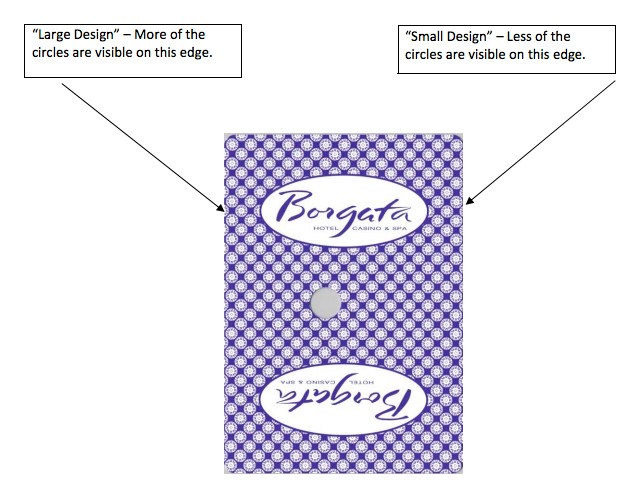
That's not what happened. The cards were provided by the house. I linked to an image of an example of cards (with a diamond pattern like Bee cards) that could be edge sorted, but those weren't exactly the same as the Gemaco cards that were used.

There were images of the cards in one of the rulings. But this gives an idea of what they were doing. They were supposed to be cut where the edge looks the same on both sides. But if cut slightly off center, they will show bigger partial circles along one edge than another. It's also a tiny edge difference, but one that's consistent with every production batch and something Kelly Sun had mastered.

phil_ivey_borgata_cards.jpg


There are some designs that would be nearly impossible to do this with, such as the Stinger (Bee or Aristocrat) from US Playing Card.

 
Imho, the only casino game one can be successful in is poker. In poker players get to see cards but don't have to pay towards pot unless they are either a small blind or a big blind, thus the player can decide whether the hand they have have high chance of taking the pot and whether they wanna play and pay towards the pot. Also, it's the game of luck AND skill where at times one with worst hand can still win if they play the hand right and can pull off a bluff.
Casinos allow this since they take rake from each pot regardless which player wins or loses. Casinos benefit from greater number of hands played per hour and greater pot sizes. Players play against each other, not the house.

I've read how the big players manage to make money from high stakes live poker, even with the rake. Even when there are big name players at the table who have been on TV. One player said the big players more or less move money between themselves, but in the long run it evens out between them. But if that was all there was to it, the rake would just mean the money would slowly dwindle.

What they have are lots of wealthy whales who come in and think maybe they can outplay the pros. As long as that money keeps coming in, the big players can make money by redistributing money from the whales.

With smaller stakes, it's probably a matter of a small number of players being much better. But I've heard at the big stakes games, it's often very evenly matched other than the whales who provide the money.
 
What one needs to do is perform a "spread" where the player starts with a standard bet but then when there's an player advantage to the deck the player ups the bet. I heard it can work with bets just double the previous bets, but ideally it would be a large spread like 5x or more. Obviously that tips off the house. I've also heard of team techniques where maybe they had one member of the team playing minimum bets, but then when it went in the players' favor they would signal (as surreptitiously as possible) for others to come in and then place big bets.

Besides having the "big player" what the MIT team often did, there's a technique that some call "Wonging". Supposedly named after a legendary card counter John Ferguson, whose oddball nickname was "Stanford Wong". He got his Ph.d at Stanford, and a friend picked "Wong" as a psuedonym (to write books) because he thought it sounded exotic.

A craggy 6-footer, Ferguson has the persona of a stern, even severe, professor subjecting the game to merciless mathematical scrutiny. And he is the only counter to have a playing maneuver named after him: “Wonging” connotes playing only at tables where the count is positive for the player, and leaving the moment it turns negative again. Wonging is so effective that some casinos restrict players to entering a game only immediately after a shuffle.​
 
'Tis a good read.
One revelation was that the industry didn't seem to assure a level wheel by pouring a concrete pad or some such.

Hey, if roulette was 'straight' Nick couldn't have rescued that young girl from Renault's raunchy grasp in Casablanca.
Rick

I have won at Roulette, but only in a small way. I was at the Rio in Las Vegas (a Caesars property, now closed) playing automated craps. I watched one of die roll over after stopping, turning a win into a loss. I immediately left. I am not a gambler, so a wild night of gambling for me might leave me out by as much as $40.
 
Last edited:
Someone needs to make a machine that randomly flips the cards end for end as part of the shuffling process.
 
Back
Top Bottom