
You are using an out of date browser. It may not display this or other websites correctly.
You should upgrade or use an alternative browser.
You should upgrade or use an alternative browser.
"Proper" way to hook up vintage receiver-speaker wire?
- Thread starter barbersurgeon
- Start date


That’s similar to loops for power outlets. It’s theoretically a better connection than spring clips, but shorts a lot easier than any other type.

Old days ? Well, I haven't seen screw-terminal speaker connections, maybe in my life - they've all been either the spring-loaded lever type or ones with a thru-hole and a plastic 'lug' that screws on/off to make the connection - and I've played with audio stuff for ~40 years. I still will use my teeth to strip the wire vs finding my wire stripper.Rock it like the old days. Use your teeth to strip the wire, twist the strands together, wrap clockwise around the screw, and tighten. Wrap counterclockwise if you want the full experience of one's youth (and youthful mistakes).

Be sure to connect the two wires (+ -) correctly so the speakers are not out of phase. Yes, it matters as if connected out of phase the imaging of the various instruments and voices will not be precise or clearly positioned or focused on the sound stage.

I would tin the ends of the wires and call it a day.
Absolutely. I tin the ends of every speaker wire.
Fork terminal or ring terminals is what I would use
Some of those are captive screws. It's certainly possible to just force the screw off, but it might not be the best idea.
But then it's pretty clear that they didn't necessarily use the safest configuration back then. But I'm reading that General Radio came out with the standard 5-way binding post in the 1920s for test equipment. Not sure when the first use was in consumer audio equipment.
I wouldn't force the screw out, just use a fork terminal vs a ring.Some of those are captive screws. It's certainly possible to just force the screw off, but it might not be the best idea.
barbersurgeon
Thread starter
- Joined
- Jan 17, 2023
- Messages
- 163
Ordered these:
https://www.amazon.com/dp/B07MF73D9P?ref=fed_asin_title&th=1
Will see if they fit. Have a Harmon Kardon receiver as well, just haven’t played with it yet. Dave Brubeck on right now.
https://www.amazon.com/dp/B07MF73D9P?ref=fed_asin_title&th=1
Will see if they fit. Have a Harmon Kardon receiver as well, just haven’t played with it yet. Dave Brubeck on right now.
You can still use fork terminals with captive screwsSome of those are captive screws. It's certainly possible to just force the screw off, but it might not be the best idea.
But then it's pretty clear that they didn't necessarily use the safest configuration back then. But I'm reading that General Radio came out with the standard 5-way binding post in the 1920s for test equipment. Not sure when the first use was in consumer audio equipment.
You can still use fork terminals with captive screws
I was referring to the comment about using ring terminals. Can’t really do that unless the screw can be completely removed. At lot of these are crimped at the threads to prevent removal.

I got these in banana plug style. Amazingly solid.I've used them before. Didn't have the tools to crimp myself. But proper crimping creates an oxygen-free connection as long as the cable isn't already oxidized. This one apparently self-crimps by screwing down the cable end. I think it goes out the barrel, gets folded over, and then gets screwed down. The spades I got before had a single-use crimped connection.
https://www.crutchfield.com/S-FjNU6uQPPH4/p_119QLGASH/Monster-self-crimping-spade-connectors.html
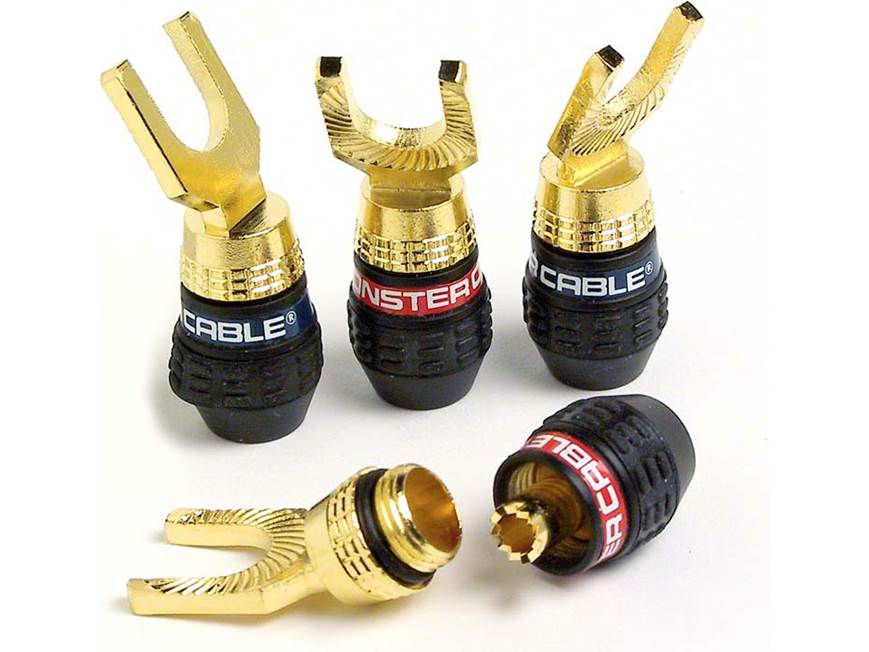
The weirdest thing I got once was a banana connectors where the wire entered and there was a screw that clamped down on the cable end to make it more or less reusable.
Also in soldering school at China Lake NWS we learned how to tin and make proper stranded wire hooks. Easy really following those steps
A Lafayette receiver was not high end. I'd just twist the wire's strands. Then loop clockwise around the terminal and cinch the screw down. Done. Everything else is overkill on an originally inexpensive low-end receiver.
Honestly, a modern bargain receiver might be a better option. Might also have AV switching.
I personally would not wrap stranded wire under the screws under no circumstance. Too great a chance a straw strand of wire touching each other and goodbye amp/receiver. Now if you solder the stranded wire and then loop/tighten the wire clockwise under the screw...much better and acceptable. Now if you use a good crimping tool and use a small spade be sure to position the "hump" side of crimping tool opening on the side opposite of the dividing line of the spade connector. Hard to explain but it produces a much better connection. Search for "McIntosh spade connectors" and you will have some good options to consider.
I'd crimp on good (audio?) quality thickish spade/fork connector, do it once do it right.
barbersurgeon
Thread starter
- Joined
- Jan 17, 2023
- Messages
- 163
Have been looking at options for moving the Lafayette 1000 to back up status. Schiit Audio looking like a serious option. Really split between two Ghorns and the Vidar amp. My shelf space is limiting but I think the vidar will fit, maybe need to ventilate the back of the cabinet though.
Advance Paris X-i75 is $999 on sale at Crutchfield for a few more days. It is not so deep to give me issues on the dedicated shelf.
Denon entry level amp is PMA-600NE, $600. Also fits space wise.
Those look like the best options I’ve seen so far?
Advance Paris X-i75 is $999 on sale at Crutchfield for a few more days. It is not so deep to give me issues on the dedicated shelf.
Denon entry level amp is PMA-600NE, $600. Also fits space wise.
Those look like the best options I’ve seen so far?
Only use a crimp type connector if you have the right kind of tool to crimp it with . I've seen too many people use pliers and that ain't gonna do it .
barbersurgeon
Thread starter
- Joined
- Jan 17, 2023
- Messages
- 163
Have been looking at options for moving the Lafayette 1000 to back up status. Schiit Audio looking like a serious option. Really split between two Ghorns and the Vidar amp. My shelf space is limiting but I think the vidar will fit, maybe need to ventilate the back of the cabinet though.
Advance Paris X-i75 is $999 on sale at Crutchfield for a few more days. It is not so deep to give me issues on the dedicated shelf.
Denon entry level amp is PMA-600NE, $600. Also fits space wise.
Those look like the best options I’ve seen so far?
Emotiva TA1 is $499 last call, and checks a lot of boxes too. 60watts x 2. Hi and low pass out as well.
Really want something USA, and the Schiit set-up is nagging at me.
barbersurgeon
Thread starter
- Joined
- Jan 17, 2023
- Messages
- 163
Placed my order for the Schiit mini stack, two G-horns & a Saga 2 preamp. Amps are back ordered a few weeks, so maybe by Christmas.
Need to figure out a way to high pass the balanced Xlr preamp to mono blocked G-horn units, but not mission critical. Would like to take some of the unused load of the amps and Polk es20 bookshelf speakers for clarity and longevity of both.
Will run a sub of the Saga 2 rca connectors, which is yet to be determined. SVS SB1000 pro or maybe the smaller Polk es8. Not looking to rock the base, just fill in the lows so maybe the SVS is overkill with the 30wt per channel mini stack. The setup app Svs has is pretty slick, though. (Also have to consider the wife and room arrangements. I’ve got a decent place to set a reasonable unit, but have to keep the peace with the interior designer as well. )
Need to figure out a way to high pass the balanced Xlr preamp to mono blocked G-horn units, but not mission critical. Would like to take some of the unused load of the amps and Polk es20 bookshelf speakers for clarity and longevity of both.
Will run a sub of the Saga 2 rca connectors, which is yet to be determined. SVS SB1000 pro or maybe the smaller Polk es8. Not looking to rock the base, just fill in the lows so maybe the SVS is overkill with the 30wt per channel mini stack. The setup app Svs has is pretty slick, though. (Also have to consider the wife and room arrangements. I’ve got a decent place to set a reasonable unit, but have to keep the peace with the interior designer as well. )
Similar threads
- Replies
- 15
- Views
- 564
- Replies
- 18
- Views
- 9K

- Replies
- 17
- Views
- 21K

- Replies
- 6
- Views
- 946
