Pressurized Coolant tank - circulation

Status
Not open for further replies.
Joined
Oct 25, 2013
Messages
13
Location
Ontario, Canada
For newer vehicles that have the pressurized coolant tank (no visible rad or rad cap) does the coolant re-circulate? It looks like it leaves the bottom of the tank, goes to the engine area and returns via a smaller hose at the top. Wondering if draining and re-filling this tank every spring and fall would have any benefit to keep the system somewhat fresh. I can get about one quarter to almost one third of the coolant capacity out this way.

 
My old Taurus had such a tank. The cap was the pressure cap.

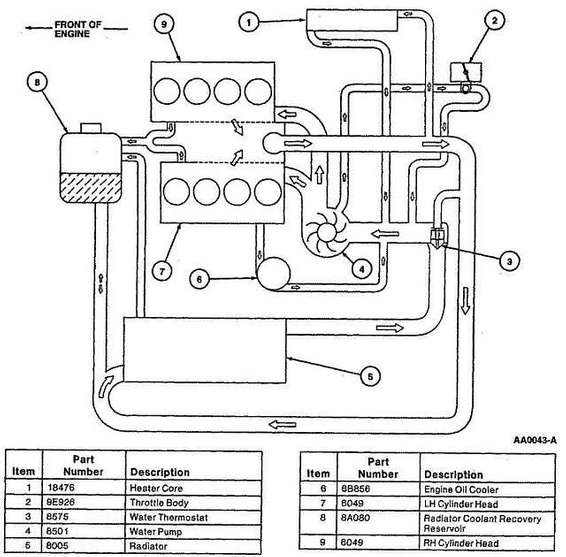
It does circulate. It had a small hose that went from the heads to the tank, then another small hose that went to the cold side of the radiator. A large hose also went to the lower radiator hose. It was a reverse flow system where when the t-stat opened it let coolant in through the lower hose. The upper hose went straight to the radiator and was open all the time.
 
I was just about to post a similar thread but I was interested in the circulation in traditional coolant overflow - radiator systems. Would the coolant circulate sufficiently over time (after several cooling/heating cycles)?

Basically, would the coolant in the overflow tank be an indication of overall coolant quality (contaminants) and can adjustments in concentration be made in the overflow tank?
 
The coolant is in constant circulation when the motor is running.

Trying to raise the concentration through the tank is no different than with a radiator. You really need to drain out some then just top off with 100%.

Just change out the coolant every two years with the cheap green stuff and you will not have cooling system problems.
 
My saturn has this, it is sometimes called a "degas bottle."

The bottom has a 3/4" hose that ties into the heater hose loop. The coolant in the loop moves quickly and mixes with the tank's stuff by "gurgling" past it.

Another hose, about 5/16", goes from the water outlet around the firewall to the surge tank. It holds, under normal conditions, pressurized air! (The bottle has a line where the engineers expect it to be half-full, and the hose comes in above this line.) This cleverly allows the cooling system to efficiently self-burp its air out. The hose is skinny on purpose to force 99% of the coolant from the water outlet to go through the radiator.

Oddly, I've had some serious air-locks at times where disconnecting this skinny hose has allowed it to release its air bubble, and a stream of coolant to follow. This theoretically shouldn't be any different than running without the cap.
 
On my Taurus the two lines from each head would join into one before the bottle. I use to put a restrictor in it so not so much coolant would bypass the block. The restrictor would force the coolant down the water jacket of cylinders 1 and 5.

It had a lot of flow.
 
You're better off just draining the radiator every two, three years and refilling with 50/50 mix.
Siphoning fluids out is good for some thing, such as power steering fluids, but for others where there are provisions already made to change the fluid more easily, I think siphoning out is rather useless. There is no reason to keep fluids fresh, other than feel good actions that accomplish little. Stick to a set interval and change them as intended and everything will be more then great.
 
Here's a picture of the cooling flow on a 1997 Taurus v8 SHO.

v8_coolant_flow.jpg
 
Status
Not open for further replies.
Back
Top Bottom