
PCV Oil trap

Status
Not open for further replies.
Joined
Feb 1, 2009
Messages
8,856
Location
Texas
I've always heard that Chrysler 2.4s in PT Cruisers lose a fair amount of oil through the PCV system since the PCV valve screws into the valve cover (high velocity air flow exposed to the oil mist under the cover) and since the hose is very short and horizontal (no opportunity for the oil to "pool" and drain back through the PCV valve when the engine is turned off.

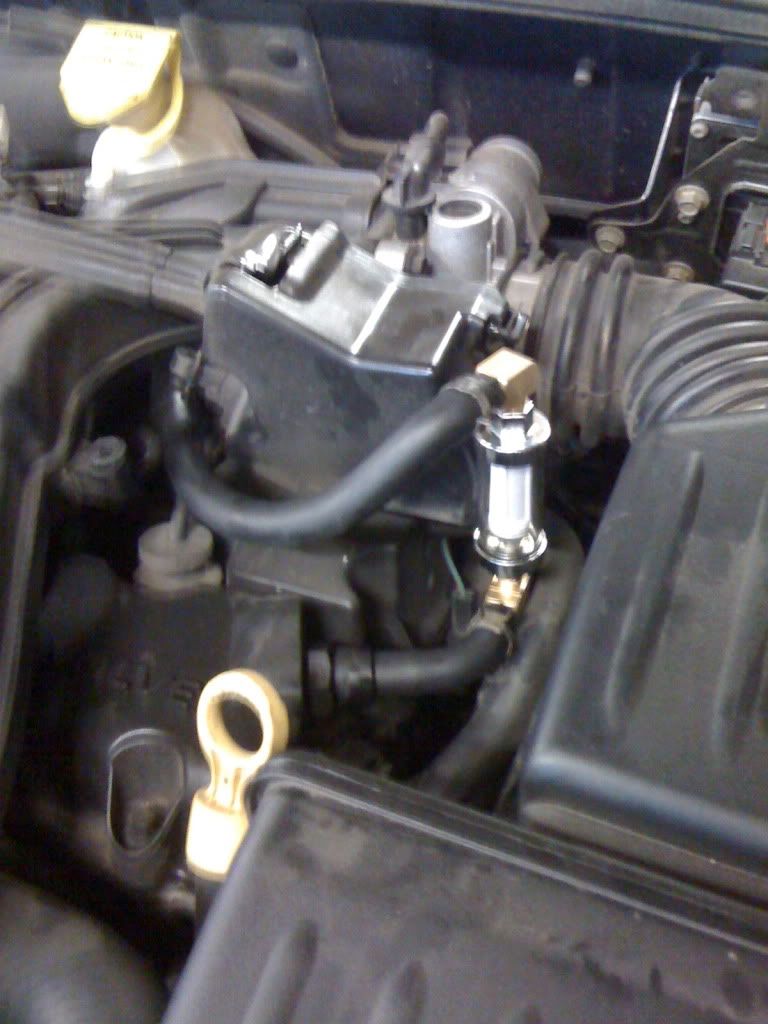
So I made myself a trap out of one of those clear glass fuel filters (pardon the phone camera low-quality picture):
IMG_0212.jpg


I drilled out some of the internal holes to reduce the air speed through the trap, and also installed it vertically so that the trapped oil will stay in the trap and then drain back on engine shut-down. I expected to see some visible oil residue after a few days of driving. Boy was I wrong- fired the engine up (hot- wife had just been out with the car) and within 10 minutes there were a couple of drops of oil trapped! This car doesn't exactly swill oil- it goes about 3000 miles to a quart, but if multiple drops are caught within 10 minutes, then I bet the engine itself doesn't burn any significant amount of oil at all and ALL the loss is through the PCV system.

I may need to do a further re-design to better trap (and return) the oil to the engine. Moving the PCV valve downstream of the filter and increasing the diameter of all the hoses and putting a bigger ID fitting into the valve cover should do a better job of preventing high-velocity air from picking up oil mist in the first place, and then aid with returning what mist does get trapped.

Just an FYI.
 
Yes. The maintenance free format is the way to go. You can merely gang those in parallel if need be. I will percolate some, but have absolutely no velocity to push heavy oil to the outlet. Some times no intermediate chamber is necessary if you use larger diameter hoses and can mange to lengthen them. Run them around the engine bay if necessary. Some like the dedicated catch can, but I'm lazy and prefer the passive self draining zero maintenance aspect to my designs. I don't even have anything needing one at the moment, but the extended fleet always has one that needs sensible modification from stock.
 
Originally Posted By: 440Magnum

I bet the engine itself doesn't burn any significant amount of oil at all and ALL the loss is through the PCV system.


A clever solution.

But I have never seen ANY engine with a PCV that does not lose oil into the intake side.
 
Originally Posted By: SteveSRT8
Originally Posted By: 440Magnum

I bet the engine itself doesn't burn any significant amount of oil at all and ALL the loss is through the PCV system.


A clever solution.

But I have never seen ANY engine with a PCV that does not lose oil into the intake side.


True, and if the engine really doesn't burn ANY oil past the rings, then the top ring is running dry, too. But my Jeep (OK, its a CCV system, not PCV) can run a 6k OCI and not be visibly down on the dipstick.
 
It strikes me as odd that any vechile should need this truly. Most PCV's vent into the air box. Nothing I have ever owned ever had so much as an oil stain on the air filter. On the other hand I have seen some that had pools of oil in the air box or half the air filter looked like someone sprayed it with dirty oil!IN this day and age ballancing the PPCV or CCV system versious spurious blow by should not be a big deal. A PCV with a built in expansion chamber would probably solve most issues with out an elaberate set up.
 
Originally Posted By: JohnBrowning
It strikes me as odd that any vechile should need this truly. Most PCV's vent into the air box. Nothing I have ever owned ever had so much as an oil stain on the air filter. On the other hand I have seen some that had pools of oil in the air box or half the air filter looked like someone sprayed it with dirty oil!IN this day and age ballancing the PPCV or CCV system versious spurious blow by should not be a big deal. A PCV with a built in expansion chamber would probably solve most issues with out an elaberate set up.


PCV's do not vent into the air box. They "vent" into the intake manifold, behind the throttle blades via engine vacuum. The hose going from the valve cover to the air box is only to supply clean air to the crankcase so they the engine vacuum doesn't suck your seals in.
 
Originally Posted By: JohnBrowning
It strikes me as odd that any vechile should need this truly. Most PCV's vent into the air box. Nothing I have ever owned ever had so much as an oil stain on the air filter. .


Wrong side of the system.

The MAKE UP air for the PCV system comes from the air box. Under every condition except wide-open throttle, manifold vacuum pulls air out of the crankcase through the PCV valve, and the fresh air to make up for what the PCV valve draws off leaves the airbox and flows INTO the engine through the pipe from the airbox to the crankcase. Gas only flows OUT of that pipe and into the airbox under wide-open throttle conditions where there's not enough manifold vacuum to pull air in thru the PCV valve and blow-by pressurizes (slightly) the crankcase.

The trap I put in is on the OTHER side- its between the PCV valve and the intake manifold, where the gas flow is fairly speedy and any oil mist that gets past the baffles in the valve cover gets inhaled by the PCV valve. When there's a long or large-diameter hose from the PCV valve to the intake manifold, the mist falls out of the air as the air slows down and it eventually drains back thru the PCV valve into the engine. On the PT Cruiser (and I gather some other installations of the Chrysler 2.0/2.4 family) the PCV hose is only about 6" long, fairly small diameter, and the oil never has a chance to drop out of the air. The trap creates a region of slow airflow where it can pool. Then when you turn the engine off, the oil drains back into the crankcase where it belongs. Some cars (Volvo in particular comes to mind and will pop up if you search for "PCV trap") had PCV oil traps from the factory.
 
Originally Posted By: chevrofreak
My car has so much vacuum that it keeps destroying my PCV catch cans. I was only catching maybe 4oz per 1,000 miles, so I removed it.


Just adapt up to 3/4 heater hose and adapt back down again. I don't care how much vacuum you have, you're not going to lift an oil column that big too far before you're percolating.
 
I follow you now. On all my Toyota's the PCV hose and it is a single hose has always gone directly from the PCV to the air box. I have never had a hose on both sides. Are you saying you took the PCV out of the valve cover and relocated it in addition to your catch/filter mod so now their is a stage between the valve cover and the PCV and between the air box and the PCV?

The only vechiles I have had that where not like this had open crank case breathers in the valve covers with filters in them.

I have seen plenty of catch can on race vechiles and old Mopar big blocks and such but not on a lot of daily drivers.Your set up is not like a catch can is it?
 
Originally Posted By: chevrofreak
What's happening is that it's cracking the clear polycarbonate bowls.


Open up the supply ..create an intermediate manifold if you have to. It's as simple as how a muffler works if you make it too big. The exhaust pulse hits the big chamber and goes DEAD. DEAD stop. It's got no velocity to make it out to the end. It just goes DEAD.

The same thing happens if the hose is big enough and long enough. It will just drop out and head back to where it came from if you can install it right. 440 has the right setup. The most he could do to improve it is to find a bigger chamber ..or gang a few in parallel.
 
Originally Posted By: Gary Allan
Originally Posted By: chevrofreak
What's happening is that it's cracking the clear polycarbonate bowls.


Open up the supply ..create an intermediate manifold if you have to. It's as simple as how a muffler works if you make it too big. The exhaust pulse hits the big chamber and goes DEAD. DEAD stop. It's got no velocity to make it out to the end. It just goes DEAD.

The same thing happens if the hose is big enough and long enough. It will just drop out and head back to where it came from if you can install it right. 440 has the right setup. The most he could do to improve it is to find a bigger chamber ..or gang a few in parallel.


The pressure is still going to be the same, it's just the velocity that will be reduced.
 
Originally Posted By: JohnBrowning
I follow you now. On all my Toyota's the PCV hose and it is a single hose has always gone directly from the PCV to the air box. I have never had a hose on both sides.


I don't see how that can work- you have to have the PCV valve connected to the intake manifold. The make-up air can come from anywhere, but its nice to pick it up downstream of the air filter so that its CLEAN make-up air. Lots of 70s'-90s vehicles had separate PCV filter pads, though.

Originally Posted By: JohnBrowning
Are you saying you took the PCV out of the valve cover and relocated it in addition to your catch/filter mod so now their is a stage between the valve cover and the PCV and between the air box and the PCV?


No, I'll only do that if this method doesn't work. Right now, it goes PCV valve->hose->trap->hose->intake manifold. In theory it would be better to put the PCV valve on the other side of the trap, but its not necessary.
 
I have a similar setup on my WS6, Works Awesome! I need to clean it up though and change out the PCV valve.

Yours looks very nice.
 
Originally Posted By: chevrofreak
Originally Posted By: Gary Allan
Originally Posted By: chevrofreak
What's happening is that it's cracking the clear polycarbonate bowls.


Open up the supply ..create an intermediate manifold if you have to. It's as simple as how a muffler works if you make it too big. The exhaust pulse hits the big chamber and goes DEAD. DEAD stop. It's got no velocity to make it out to the end. It just goes DEAD.

The same thing happens if the hose is big enough and long enough. It will just drop out and head back to where it came from if you can install it right. 440 has the right setup. The most he could do to improve it is to find a bigger chamber ..or gang a few in parallel.


The pressure is still going to be the same, it's just the velocity that will be reduced.


Exactly. Just like a shop vac. High velocity in ...DEAD SPACE -nothing to keep the heavier stuff in suspension - NO VELOCITY - DEAD CRAWL- exit at high velocity.

It works the same in a pressurized or evacuated (under vacuum) environment. Dead air is still dead air ..and gravity is still gravity.

The trick is having it so that it will drain back to the valve cover to make it maintenance free.

Let's say you had your typical normal sized catch can ..the one with the convenient drain on the bottom. If you simply put a very small hose to the drain...teeing it to the inlet hose, the thing would still fill up as usual since the pressure/draw/flow would be equal on to both of them. They would argue with each other with the big one winning the issing contest and the can would fill to whatever level it would anyway. Then when you turned off the engine, the contents would return to the sump. Never look at the thing again ..and have a warm fuzzy feeling about how much cleaner your intake is ..how much less oil you make up ..and how much more work the other guy does that didn't rig it this way.
 
But, I'm having problems with it breaking due the amount of vacuum, not with the efficiency of the catch can. The amount captured didn't come close to equaling the amount of oil that my engine is consuming otherwise, so it didn't seem worthwhile to try to build something that would withstand the pressure. I would also have no way of mounting it high enough to return the fluid to the sump, and I'm not sure I want that stuff going back into my oil anyway. It's an old car, with over 140,000 miles on it. I'm not too worried about getting more life out of it.
 
Status
Not open for further replies.
Back
Top Bottom