HTHS Viscosity questions

Status
Not open for further replies.
Joined
Oct 16, 2002
Messages
699
Location
Joplin
I've noted that the HTHS viscosity seems to be goint lower as the auto manufacturers reach for improving fuel economy by using lower viscosity oils like the Xw-20's (and now testing of an 0w-10 with HTHS of 2.0)

The engines in my fleet were spec'd for Xw-30 weight oils so that is the types I've been researching. I believe the lower range for a 30 weight is 2.9 (hths) with some still up around 3.5.

1. One half (1/2) of a point in viscosity is extremely small so what difference is it going to make if an oil is HTHS ~2.8 vs. 3.3, etc. ? For a daily driver with an engine that will spend 95% of it's time below 4,000 rpm's is it ever going to push the HTHS limits of the oil where this 1/2 point difference is going to be a factor?

2. I selected Mobil 1 0w30 recently and note it's HTHS is shown to be 3.0.

Will this number tend to be stable over time and mileage
, or does it tend to go lower as the miles add up so it may not protect at some point. For example, 7k miles and even more so at 10k or 12k miles, etc. for those like me that are doing more extended drain intervals?

If it does tend to drift lower, would it make sense to use a heavier grade oil for adding any make up oil before getting to the next oil change?
 
Last edited:
Originally Posted By: Cressida
1. One half (1/2) of a point in viscosity is extremely small so what difference is it going to make if an oil is HTHS ~2.8 vs. 3.3, etc. ? For a daily driver with an engine that will spend 95% of it's time below 4,000 rpm's is it ever going to push the HTHS limits of the oil where this 1/2 point difference is going to be a factor?


A half point in the number three is over 15%, so it's not that small in the scheme of things.
 
When it comes to HTHS viscosity, even 0.1 - 0.2 cP makes a huge difference in minimum oil-film thickness (MOFT).

Yes, it will drop a little with used oil, but you usually don't need to worry about it if you follow the manufacturer's recommendations on viscosity.

Mobil 1 Advanced Fuel Economy has more PAO than vanilla Mobil 1. However, in Missouri climate, you don't need 0W-x. You can simply use Mobil 1 5w30 or Mobil 1 Extended Performance 5w30, which has more PAO than Mobil 1 (probably similar levels to Mobil 1 Advanced Fuel Economy 0W-30). It has less viscosity-index improver (VII) than 0W-30; so, it will shear less. It will also run a little thinner than 0w30 when cold, despite being a 5w30, because it has a higher viscosity index (VI).
 
Originally Posted By: Cressida

Will this number tend to be stable over time and mileage[/b], or does it tend to go lower as the miles add up so it may not protect at some point. For example, 7k miles and even more so at 10k or 12k miles, etc. for those like me that are doing more extended drain intervals?

If it does tend to drift lower, would it make sense to use a heavier grade oil for adding any make up oil before getting to the next oil change?


Good question. Does HTHS decay as would a non shear stable "weight". Anyone?
 
Originally Posted By: Gokhan
It will also run a little thinner than 0w30 when cold, despite being a 5w30, because it has a higher viscosity index (VI).


Depending of course on how you define cold. 10-15 degrees below 0C, where the VI calcs no longer work, the 0w-xx oil is going to thicken less.
 
Originally Posted By: DeepFriar
Good question. Does HTHS decay as would a non shear stable "weight". Anyone?

Yes, of course. VII shears both temporarily (during high-shear conditions, such as in heavily loaded bearings) and permanently. Typical used 5w30 HTHSV can drop to as little as 2.6 cP with conventional oil. Synthetic oil shears less because it usually has less VII. Also, it depends on the quality of the VII used. Newer formulations of Mobil 1 tend to use shear-stable VII.

mobil_1_ages_technology.png
 
Originally Posted By: Gokhan

Yes, of course. VII shears both temporarily (during high-shear conditions, such as in heavily loaded bearings) and permanently. Typical used 5w30 HTHSV can drop to as little as 2.6 cP with conventional oil. Synthetic oil shears less because it usually has less VII. Also, it depends on the quality of the VII used. Newer formulations of Mobil 1 tend to use shear-stable VII.


Is there a direct relationship between VI and its shear proof-ness (sorry)?
 
Originally Posted By: DeepFriar
Is there a direct relationship between VI and its shear proof-ness (sorry)?

No, VI tells you little about the amount of VII used, let alone the type of VII being used. Some base stocks, such as HVI Group III (Group III+) and XHVI Group III (GTL) have VI at or over 140 and therefore they require very little amount of VII, therefore resulting in shear-stable oil.

In summary, it's the amount and type of VII used that determines the amount of shear. You can have an oil with a 10% VII content but only 10% of that VII content may shear if it's high-quality and you don't drop that much in viscosity. But then you can have an oil with only a 5% low-quality VII content and half of it could shear, resulting in more viscosity loss. Therefore, if you start with a base stock with high intrinsic VI and add a small amount of high-quality (shear-stable) VII to it, you will have a very shear-stable multigrade oil.
 
Originally Posted By: Gokhan
Originally Posted By: DeepFriar
Is there a direct relationship between VI and its shear proof-ness (sorry)?

No, VI tells you little about the amount of VII used, let alone the type of VII being used. Some base stocks, such as HVI Group III (Group III+) and XHVI Group III (GTL) have VI at or over 140 and therefore they require very little amount of VII, therefore resulting in shear-stable oil.

In summary, it's the amount and type of VII used that determines the amount of shear. You can have an oil with a 10% VII content but only 10% of that VII content may shear if it's high-quality and you don't drop that much in viscosity. But then you can have an oil with only a 5% low-quality VII content and half of it could shear, resulting in more viscosity loss. Therefore, if you start with a base stock with high intrinsic VI and add a small amount of high-quality (shear-stable) VII to it, you will have a very shear-stable multigrade oil.


As well as the PAO bases like Mobil's SpectraSyn series. For the Lo Vis stuff, SpectraSyn 6 has a VI of 138, 8 has a VI of 139, 10 has a VI of 137...etc. All have excellent CCS/MRV performance as well.

The Hi Vis PAO's have even higher VI's at 147 for SpectraSyn 40 and 170 for the SpectraSyn 100 (both of which can be used in small doses to thicken a blend up). Which is similar to the ELITE versions, the 65cSt one which has a VI of 179 and the 150 which has a VI of 210.

The AN's have much lower VI's than the PAO bases, as do most of Mobil's Esters, with only the really low-visc A-series (A32, A34, A41, A51) esters having VI's around and above the 140 range.
 
Originally Posted By: DeepFriar
Originally Posted By: Gokhan

Yes, of course. VII shears both temporarily (during high-shear conditions, such as in heavily loaded bearings) and permanently. Typical used 5w30 HTHSV can drop to as little as 2.6 cP with conventional oil. Synthetic oil shears less because it usually has less VII. Also, it depends on the quality of the VII used. Newer formulations of Mobil 1 tend to use shear-stable VII.


Is there a direct relationship between VI and its shear proof-ness (sorry)?


There was some discussion on BITOG some years gback that the percentage loss in HTHS was half the KV100 loss, but not enough evidence to even get it to a "rule of thumb" level.

I've come across similar a couple of times in a few SAE papers, but the relationship seems to be VII specific...just like Garak said
wink.gif


It's this behaviour that has a bunch of us enamoured with A Harmann's Shear Stability Index...it doesn't tell you which oil is going to shear permanently, but gives a feel for the amount of VII action in an oil.
 
Thanks for that discussion guys. I was more than usually interested after seeing the specs and tests of, and being impressed by, the Penrite racing oil a few days ago. Even after use it was spot on where it started in terms of its viscosity datapoints and I don't think I had ever seen such mad shear stability before.
 
Shannow I think you have Garak (who frequently posts) confused with Gokhan.


It seems you have read into the (perceived) intentional deception that is University 101 on the home page. A point at 100C or 150C probably means much more than several points at 40C.

Unless of course you drive a mile or two per trip....
 
Originally Posted By: mjoekingz28
Shannow I think you have Garak (who frequently posts) confused with Gokhan.


It seems you have read into the (perceived) intentional deception that is University 101 on the home page. A point at 100C or 150C probably means much more than several points at 40C.

Unless of course you drive a mile or two per trip....


I'm not sure how you got any of that from Shannow's post..... Particularly given the extensive nature of the posts he's made on the subject
21.gif
 
Switching the topic to gear oils. What holds true for VIIs in engine oil, should also apply to 75W140 and other lubricants. Viscosity wise, what would 75W140 be equivalent to in an engine oil?
 
Originally Posted By: userfriendly
Switching the topic to gear oils. What holds true for VIIs in engine oil, should also apply to 75W140 and other lubricants. Viscosity wise, what would 75W140 be equivalent to in an engine oil?


http://www.mobil.com/USA-English/Lubes/PDS/GLXXENPVLMOMobil1_Syn_Gear_Lube_LS_75W-140.aspx

Mobil 1 Syn Gear Lube LS
SAE Grade 75W-140
VViscosity (ASTM D445)
cSt @ 40ºC 170
cst @ 100ºC 24.4
Viscosity Index 175
Pour Point, ºC (ASTM D97) -48
Flash Point, ºC (ASTM D92) 207
[email protected] ºC g/ml (ASTM D4052) 0.872

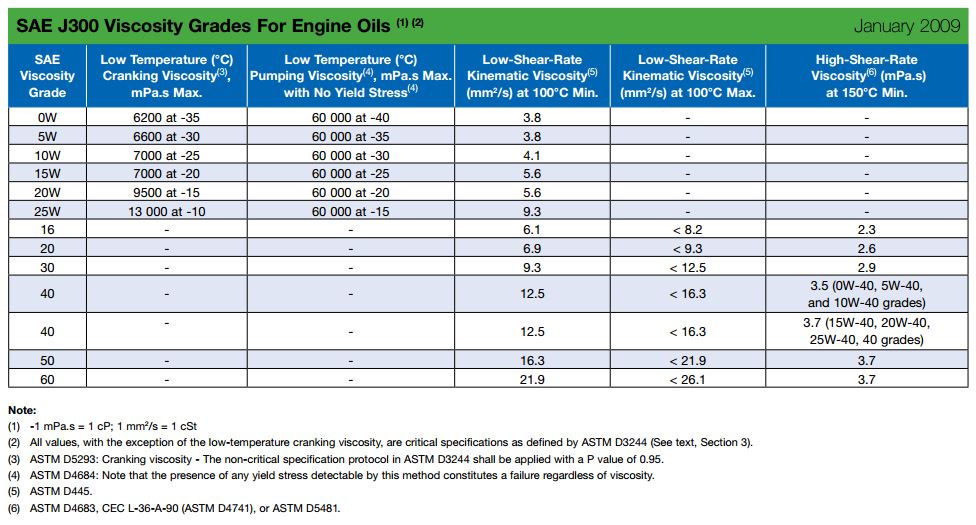
24.4cSt @ 100C would put at the equivalent of a 60 grade:

SAEJ3002009.JPG


A 75w-90:
http://www.mobil.com/USA-English/Lubes/PDS/GLXXENPVLMOMobil1_Syn_Gear_Lube_LS_75W-90.aspx

Mobil 1 Syn Gear Lube LS
SAE Grade 75W-90
Viscosity (ASTM D445)
cSt @ 40ºC 103
cst @ 100ºC 14.6
Viscosity Index 146
Pour Point, ºC (ASTM D97) -39
Flash Point, ºC (ASTM D92) 150
[email protected] ºC g/ml (ASTM D4052) 0.859

Would be the equivalent of a 40 grade.
 
Wow! The 75W140 has a lower pour point than the 75W90. I guess a 75W in a gear lube would be something like a 5W engine oil. Good to "I'm not going out in that weather anyway" below zero.
 
Last edited:
OP,
here's what I was referring to this morning before work (my time)....

HTHS%20Loss%20KV.jpg


The HTHS loss percentage being "half the KV loss" as a rule of thumb is sort of not a rule of thumb, it depends.

But the HTHS loss, as a percentage IS lower, considerably than the KV loss...for the PMA and OCP VIIs, the chart could be interpreted as relatively insensitive to KV loss over quite a range.

With regard to the oft quoted on BITOG "use a 5W20, as 5W30 shears down to 20 anyway", and ignoring the fact that the OEM chose the grade for the end of the OCI, not the initial fill, if your oil shears, then clearly you CAN drop a J300 grade in KV, and stay in grade HTHS wise depending on starting point on both scales...If you pick a 30 with an HTHS around 3.2, it will likely stay in 30 grade HTHS the whole OCI.

I wouldn't go up a J300 grade to keep the KV "in grade", just start with a high HTHS anyway (my 5W30 in my cars is 3.6 initial).

For further consideration, I really like this Klondike data sheet.

http://klondikelubricants.com/wp-content...ne-Oils-PDS.pdf

It's got the HTHS, but also has the "HTHS" done at 100C.

You can see that the HTHS100 viscosity of the 5W20 is approximately 7% higher than that of the 0W20, while the HTHS150 is only around 4% different...they are both "20s", and pop culture here is that "20s" are the same.

Look at the 5W30, it could easily shear down to a J300 20 in Kinematic viscosity, but stay a 30, where it counts in HTHS.
 
Would you like to see a rule change that would use HTHS only for "stay in grade"?
And
If the W number is allowed to thicken out of grade with age, why not KV100?

I would propose that if an engine oil thickened out of grade because of it's ability to suspend contaminates such as soot,
then that engine oil is being punished for being good at what it is designed to do.
That engine oil would receive a pass on the thickening out of grade if in fact it did so due to contamination.

If the engine oil thickened because of oxidizing for example, then that engine oil would fail thickening out of grade.

An HTHS trajectory from 40C to 200C would very interesting when comparing all lubricants, not just engine oil.
 
Last edited:
Status
Not open for further replies.
Back
Top Bottom