Douglas aircraft and ....

Elements critical to flight must either be redundant or must be fail-safe. IIRC, fail-safe is defined as no expected failures within a billion flight hours.
The trim jackscrew mechanism is obviously critical, so it was designed as an assembly that was robust enough that it would never fail in flight as long as it was kept properly greased and was inspected for end play and replaced as needed based upon the maintenance plan for the type.
Those maintenance procedures may not have been adhered to by at least some techs performing the work and the result was an MD-80 with all aboard lost off the west cost. Nobody intended any such outcome, but the access provided for servicing the jackscrew assembly is apparently very limited, making for a miserable job.
This trim jackscrew arrangement continues all the way through the last DC-9 derivative, the 717.
One interesting tidbit is that on all of these airplanes, the split elevator is not directly controlled by the crew. Rather the crew controls trim tabs on the elevator halves and the trim tabs in turn cause the surface to move. This is also the reason that you'll see stationary examples of these aircraft with one side of the elevators pitched up and the other pitched down. They are free to float and will do so in the absence of forward speed and airflow.
 
The DC-9 era continued for years with the MD-80 series, so beloved of American and Delta. The last DC-9 derivative is the 717, around a hundred of which continue carrying passengers today, mainly with Delta.

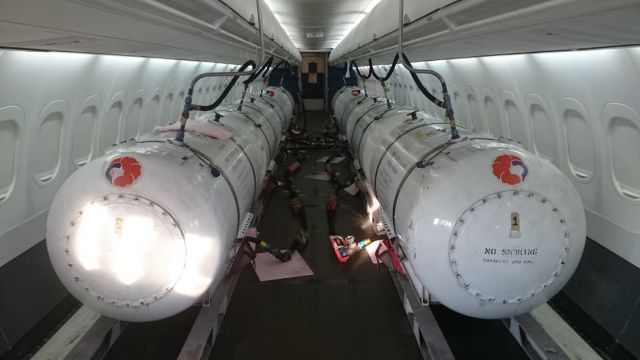
The 717 makes up Hawaiian Airlines's interisland fleet. Apparently it gets interesting when they have to send them in for maintenance, since they don't have the range to make it without this:

89f53ac635514e5f6189223a10e4eebbbab1fce0
 
Hawaiian is trying to decide what it will replace the 717 with since the 717 will cease to be viable to maintain once Delta parks the type.
I'd expect the Embraer E jet with the original GE engines to be the ultimate choice since the capacity of something larger isn't really needed nor is longer range. I'd rule out anything with the GTF Pratt, like the E2 or A220 since the engine has not proven reliable in service and I'd doubt that Hawaiian or its new masters Alaska want to put it to the test in high frequency short range operation. Also, the Embraer would be available quickish and the Brazilians would be keen to make a deal. Lord knows how long it would take to get newly ordered A220s or 737-7s. Alaska has also disposed of all of the Airbuses it inherited in acquiring Virgin America and is not likely to want to add another type and they already fly the E jet with Horizon.
We shall see.
 
Yes sort of forgot the DC-9's etc. I flew on a few of them and at the time had more trust for them over a 727, until the elevator trim screw disaster. And still can't understand the zero redundancy and not using ball screws.
As an aircraft designer, are you saying a Ball Screw system doesn't need lubrication and inspection as well?

The NTSB determined that the design of "the horizontal stabilizer jackscrew assembly did not account for the loss of the acme-nut threads as a catastrophic single-point failure mode." Quote of the NTSB in Wiki.

J. Goglia of the NTSB said: "This is a maintenance accident. Alaska Airlines maintenance and inspection of its horizontal stabilizer activation system was poorly conceived and woefully executed. The failure was compounded by poor oversight. Lubrication periods were extended, while inspection intervals were simultaneously lengthened, neither with sound technical basis...We want now to design a safer actuating system and we want to design a better wear measurement system. Fine. But the existing design is safe, it just includes grease as a part of the load transferring system and there wasn t any grease. And the measuring device we now have, no matter how rudimentary it is thought to be, seems to work well for many airlines, and it identified the fact that this jackscrew was wearing and needed to be replaced. The carrier simply failed to do its job."

NTSB Report
https://www.ntsb.gov/investigations/AccidentReports/Reports/AAR0201.pdf
 
The 717 makes up Hawaiian Airlines's interisland fleet. Apparently it gets interesting when they have to send them in for maintenance, since they don't have the range to make it without this:

89f53ac635514e5f6189223a10e4eebbbab1fce0


That 717 has much further range than a 787.
 
Last edited:
As an aircraft designer, are you saying a Ball Screw system doesn't need lubrication and inspection as well?
At the time of that failure and crash, machine tools have been literally banging very heavy parts of the machine axis's for decades and yes those ball screws are lubricated, just like I suppose they are now, on some aircraft that use them, all AUTOMATICALLY no lazy nut case with a grease gun is needed.
I just find it strange that a machine that doesn't have to be strong (yeah I know machine tools need rigidity) or redundant to protect a life, is built with better engineering than an aircraft, oh and that machine tool that literally hammers some of those axis members still after years of use will still hold a .0001 tolerance easy. Hammer ? just watch a high speed peck drill cycle you can hear and see the hammering.
Even 1940's and 50's recirculating ball steering gear was a thing, so not like they were special back then, inspection? What in 20 years or so? :ROFLMAO:
 
At the time of that failure and crash, machine tools have been literally banging very heavy parts of the machine axis's for decades and yes those ball screws are lubricated, just like I suppose they are now, on some aircraft that use them, all AUTOMATICALLY no lazy nut case with a grease gun is needed.
I just find it strange that a machine that doesn't have to be strong (yeah I know machine tools need rigidity) or redundant to protect a life, is built with better engineering than an aircraft, oh and that machine tool that literally hammers some of those axis members still after years of use will still hold a .0001 tolerance easy. Hammer ? just watch a high speed peck drill cycle you can hear and see the hammering.
Even 1940's and 50's recirculating ball steering gear was a thing, so not like they were special back then, inspection? What in 20 years or so? :ROFLMAO:
You mean you disagree with the NTSB report as to the cause of the crash?

Apparently you do not understand single-point failure probabilities of a single system versus redundant systems.

I am not sure what you said above, but here is one maker's suggestion for ball screw lubrication:

https://www.thomsonlinear.com/downloads/articles/Guide_to_Ball_Screw_Lubrication_tauk.pdf
 
At the time of that failure and crash, machine tools have been literally banging very heavy parts of the machine axis's for decades and yes those ball screws are lubricated, just like I suppose they are now, on some aircraft that use them, all AUTOMATICALLY no lazy nut case with a grease gun is needed.
I just find it strange that a machine that doesn't have to be strong (yeah I know machine tools need rigidity) or redundant to protect a life, is built with better engineering than an aircraft, oh and that machine tool that literally hammers some of those axis members still after years of use will still hold a .0001 tolerance easy. Hammer ? just watch a high speed peck drill cycle you can hear and see the hammering.
Even 1940's and 50's recirculating ball steering gear was a thing, so not like they were special back then, inspection? What in 20 years or so? :ROFLMAO:
Hmm. I think there are several problems with nuts here.
 
The screen name. Me? Always the personal attacks, why? :unsure: So what is the issue? The crash I'm talking about is the horizontal trim, jackscrew. Disagree with NTSB ???
Didn't they say it was a jack screw issue?
 
The screen name. Me? Always the personal attacks, why? :unsure: So what is the issue? The crash I'm talking about is the horizontal trim, jackscrew. Disagree with NTSB ???
Didn't they say it was a jack screw issue?
It was and they did, but you overlooked all of the details.
Like, had the assembly been properly maintained there would have been no problems, no failure and so no accident.
That's the reason that critical components always have a required maintenance and inspection interval, but that only works if it's followed.
In this case it wasn't, hence catastrophe.
 
It was and they did, but you overlooked all of the details.
Like, had the assembly been properly maintained there would have been no problems, no failure and so no accident.
That's the reason that critical components always have a required maintenance and inspection interval, but that only works if it's followed.
In this case it wasn't, hence catastrophe.
I did not over look anything about it. I just mentioned how it should have been designed correctly in the first place, and how the proper technology has existed for decades before. How does that deserve the constant insults? Though I should feel honored, Galileo, Tesla, Wright brothers all suffered ridicule at times.
 
Didn't they say it was a jack screw issue?
Well, there you go again. They said it was a maintenance issue. Had it been properly lubricated and maintained (as it was at the vast majority of airlines) there would not have been a catastrophic failure… as there was not at the vast majority of airlines.
 
I did not over look anything about it. I just mentioned how it should have been designed correctly in the first place, and how the proper technology has existed for decades before.
Why do you think a circulating ball screw has any mechanical advantage over a jakscrew in an aircraft?

Since you keep harping on the topic, please tell us in engineering and or aerospace terms why this would be so.

You now have a chance to plead your case so stay on topic without introducing any deflection topics.

How does that deserve the constant insults? Though I should feel honored, Galileo, Tesla, Wright brothers all suffered ridicule at times.
You are none of the above.
 
Last edited:
Ball screws brought us the precision (almost no slack) in the early days of CNC that Skippy still enjoys today - amazing ability to generate axis interpolation that you can’t pull off otherwise … or whatever it physically controls …
 
Ball screws brought us the precision (almost no slack) in the early days of CNC that Skippy still enjoys today - amazing ability to generate axis interpolation that you can’t pull off otherwise … or whatever it physically controls …
But I like running manual machines better..... 😂
Back on topic.... Yeah, keep them lubed up and they'll last forever. Let them go dry and they fail pretty quickly.

PXL_20251105_040613737.webp
 
Why do you think a circulating ball screw has any mechanical advantage over a jakscrew in an aircraft?

Since you keep harping on the topic, please tell us in engineering and or aerospace terms why this would be so.

You know have a chance to plead your case so stay on topic without introducing any deflection topics.


You are none of the above.
They use them now in aircraft.

And, You are none of the above. If you only knew. :ROFLMAO:
 
They use them now in aircraft.

And, You are none of the above. If you only knew. :ROFLMAO:
You never answered the technical questions as expected with your silly response, so here are some things to consider:

1. a jackscrew is simple, and due to its simplicity, inspection of lubrication and operation is readily observable. Wear is readily visible upon inspection. Lubricant gets purged easily.

2. A ball screw system has ball bearings that are hidden, with the ball nut acting as the race for the ball bearings. Inspection of lubrication is not readily observable. One cannot see if the ball nut or bearings are worn. Seals get worn and can pass lubricant, but amount of remaining lubricant cannot be easily determined. Continuously lubed, pressure-fed ball screws require extra components.

3. Both systems require the purging of lubricant in order to dispel wear contaminants.
 
Why do you think a circulating ball screw has any mechanical advantage over a jakscrew in an aircraft?

Since you keep harping on the topic, please tell us in engineering and or aerospace terms why this would be so.

You know have a chance to plead your case so stay on topic without introducing any deflection topics.


You are none of the above.
#1 question, I never said it had such. It does have a huge wear advantage as well as being more precise, and easy to integrate an automated lube system, and in the case of automotive steering gear it is mostly maintenance free yes because it is totally enclosed with the almost permanent lube.

#2 nothing to add here.

#3 I'm done pleading any case. Its a me thing I guess, always searching for a better mouse trap so to say.

And yes I'm just the wiggly worm here, since I do rate you as the top number one person that is on this website, and so helps make it as good as it is. There are so many others here, that are as helpful.

So I will stop here. You are correct that it was bad maintenance, and the proof is so far there has not been another issue like that.
Hope I worded this all correctly.
 
The stabilizer only needs to be moved slightly a few times during each flight, mostly to compensate for weight changes as fuel is used up.
It isn't constantly going back and forth like the X-axis of a CNC machine. Think of it more like the vise on the machine that only needs to move when mounting a work piece on or off the machine. That mechanism is a simple acme screw and nut.
 
Back
Top Bottom