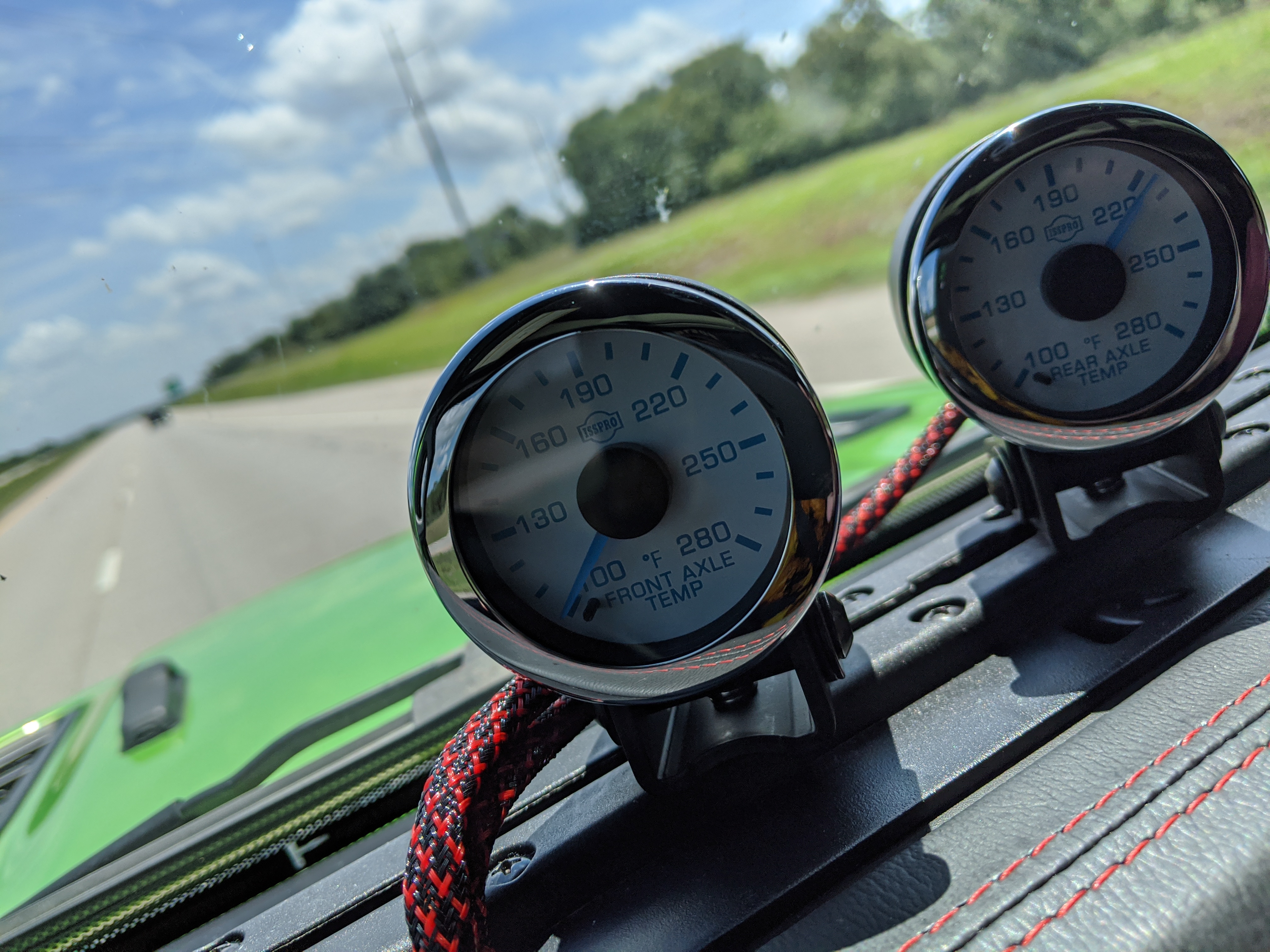
Differential temperature?

Status
Not open for further replies.
The only thing I don’t love about this idea is, what happens in the middle of winter when its 0F outside and you are just running to the grocery store or something mild? That fluid is gunna be cold.
OK.... for how long? The increased friction will bring it in a temperature range that's gonna be in thermal equilibrium.
Also, are we forgetting that we can use synthetic fluids?
If I would live in Arctic Canada or Alaska, probably I would not put that cover on, but if I live in Southern US??? What "cold" can that be that horrible to a synthetic fluid?
 
  • Like
Reactions: 4wd
OK.... for how long? The increased friction will bring it in a temperature range that's gonna be in thermal equilibrium.
Also, are we forgetting that we can use synthetic fluids?
If I would live in Arctic Canada or Alaska, probably I would not put that cover on, but if I live in Southern US??? What "cold" can that be that horrible to a synthetic fluid?
For as long as you drive?

if the fluid is only getting to 215F on a 94F day towing at max with a stock diff cover, then what do you propose the “thermal equilibrium” will be on a 0 degree day not towing with a diff cover specifically made to promote cooling?
 
Some things are getting posted that do not line up with that video and don’t line up with engineering principles

Does more fluid heat up slower or cool off slower ?
Regardless … in the end - BP elected to stay with two things stock:
1.) housing contour around ring gear (proper clearance as well).
2.) gear oil capacity

as for never saw temp data claims … it’s there and here:

https://www.bankspower.com/i-2896-r...mwith-aam-11-5-or-11-8-14-bolt-rear-axle.html

As for independent verification … people are free to do that in most countries … but I’m witnessing what we call at work “copy engineering” … lots of deep aluminum fins with high velocity air passing …
I don’t own anything that BP makes products for … but they make strong engines stronger … power goes to gears.

Now, AAM is making thousands of HD rear ends for the mainstream LT companies … like this one (note contour):

531E88BB-239A-40BA-AE3B-65F1DEDD3319.png
 
Last edited:
For as long as you drive?

if the fluid is only getting to 215F on a 94F day towing at max with a stock diff cover, then what do you propose the “thermal equilibrium” will be on a 0 degree day not towing with a diff cover specifically made to promote cooling?
So the fluid is thick enough to create drag resistance. That drag losses creates heat that heats up the fluid and the fluid becomes more fluid, decreasing the losses. The fluid will continue to raise its temperature until the point that the created heat is in equilibrium with the dissipated one.
That's true for both cover cases.
The heat dissipation is proportional with the delta T. If the oil temperature is close to the ambient, the dissipation trough both cases is almost equal. And very small. You need hot oil temperatures to actually see a difference in the two dissipations.
q= Cp x W x DT x Kt

Where: q = amount of heat transferred. Cp = specific heat of air. DT = temperature rise within the differential. W = air mass flow. Mass flow is defined as: W = CFM x Density. Kt = coefficient of transfer proportional with the area of the object.

So yes the fluid on the finned one will be probably a just bit cooler, and a bit thicker, with more parasitic loses, worse gas mileage. But that equilibrium it will be at sensible higher temperature than the outside temperature, because the above equation. Use a synthetic 75W-xxx and you are pretty good.

And like I said above, this cover is not made to be used at -20C/ 0F. Is made for people towing in southern states, at ambient temps around 90-100F.
Example: in my region (Virginia) I seldom see low temps in the +20F range. But I often see air temps above asphalt of 120F.

Note that the fins on the diff covers are on the opposite side of the air flow (when driving). So fast speed doesn't cool them more than sitting stopped in traffic. I would tend to say that the actual cooling is even less when moving because the pocket of stagnant air that gets created behind the diff.
 
Last edited:
Not sure what is being posted that does not line up with the videos, but in regards to his temp data:

Yes; it is there in typical marketing fashion with zero data to back it up—EXCEPT for the data that he created. It was not verified nor did it have any established procedures that were used. He even makes this statement:

Well, there was no precedent for testing rear differential covers, nor was any data available for rear differential lubricants as tested in vehicles. “There are just too many variables,” said the lubricant companies. Creating the proper test procedures was incredibly time-consuming. We started from scratch several times.

From my point of view, there are still no proper test procedures, only the procedures that he created. What are those proper test procedures and are they industry accepted at this point? Somehow this item is passed over as not important or relevant, but it is, because otherwise, it is all marketing statements.

For example, look at his fuel economy testing—is it grounded in reality? The dyno was calibrated to simulate a 7,500 lb vehicle with an engine output of 30 HP required to maintain a 50 mph steady state speed.

Also, notice there are no numbers for comparison, only a statement of “At $3.50 per gallon of diesel, Flatback owners will spend approximately $447 in lost fuel economy over stock over a period of 100,000 miles. enough money to buy another diff cover.

Everyone loves to beat on companies like Amsoil for making statements like that—which to Amsoil’s defense their data typically has an ASTM testing procedure listed that was used. His data is anecdotal at best, I could make a similar statement based upon my “testing” but we all know how well that data would be accepted.

For all of the things that he slams other covers about, he proves what many of them are stating—their covers are better than stock with relation to heat management—his “data” reflects that for what it is worth.

In the end, I will give him this—his marketing is very good and is doing exactly what he intended.
 
Not sure what is being posted that does not line up with the videos, but in regards to his temp data:

Yes; it is there in typical marketing fashion with zero data to back it up—EXCEPT for the data that he created. It was not verified nor did it have any established procedures that were used. He even makes this statement:

Well, there was no precedent for testing rear differential covers, nor was any data available for rear differential lubricants as tested in vehicles. “There are just too many variables,” said the lubricant companies. Creating the proper test procedures was incredibly time-consuming. We started from scratch several times.

From my point of view, there are still no proper test procedures, only the procedures that he created. What are those proper test procedures and are they industry accepted at this point? Somehow this item is passed over as not important or relevant, but it is, because otherwise, it is all marketing statements.

For example, look at his fuel economy testing—is it grounded in reality? The dyno was calibrated to simulate a 7,500 lb vehicle with an engine output of 30 HP required to maintain a 50 mph steady state speed.

Also, notice there are no numbers for comparison, only a statement of “At $3.50 per gallon of diesel, Flatback owners will spend approximately $447 in lost fuel economy over stock over a period of 100,000 miles. enough money to buy another diff cover.

Everyone loves to beat on companies like Amsoil for making statements like that—which to Amsoil’s defense their data typically has an ASTM testing procedure listed that was used. His data is anecdotal at best, I could make a similar statement based upon my “testing” but we all know how well that data would be accepted.

For all of the things that he slams other covers about, he proves what many of them are stating—their covers are better than stock with relation to heat management—his “data” reflects that for what it is worth.

In the end, I will give him this—his marketing is very good and is doing exactly what he intended.
So yeah it seems that the lube chosen is more important than the differential cover - just don't get the aftermarket flat cover and you're good.
 
- just don't get the aftermarket flat cover and you're good.
I buy my diff covers based on how much abuse they can take. That often leads to plate steel construction. While I don't drive my Jeep around the streets in Massachusetts much(for obvious reasons), I have driven on the highway in Moab in summer. It would seem the rear ring gear delivered enough oil to the pinion so nothing exploded. I run a rear spool, so there isn't any differential carrier helping to sling oil.

The off road covers still seem to follow the ring gear contour a bit, although likely not as smooth and close as a cast aluminum unit.
What manufacturer has a flat rear cover?
 
Last edited:
I buy my diff covers based on how much abuse they can take. That often leads to plate steel construction. While I don't drive my Jeep around the streets in Massachusetts much(for obvious reasons), I have driven on the highway in Moab in summer. It would seem the rear ring gear delivered enough oil to the pinion so nothing exploded. I run a rear spool, so there isn't any differential carrier helping to sling oil.

The off road covers still seem to follow the ring gear contour a bit, although likely not as smooth and close as a cast aluminum unit.
What manufacturer has a flat rear cover?
They are typically for 1/2 ton and above trucks. Mag-Hytec, AFE, G2 and others all make flat back covers. I am changing my Rubicon covers to Motobilt for the same reasons that you state--abuse. It is hard to destroy 1/4" steel plate with a 3/8" steel flange.
 
If I recall correctly, our member Jim Allen installed a temp sensor in his diff in a few vehicles. He told me that the best place to measure the oil temp is along the top of the diff, where it oil is flung off the ring gear (just off to the side a bit so as to not disturb the oil heading forward). I believe under heavy towing, a light duty truck will typically see up to 250F in the diff if pulling heavy loads; this would be a normal temp for that kind of use. Under lighter use, the temps will obviously be cooler. 250F is not "too hot" for a well made lube, but 300F would be pushing the limits of a conventional gear oil. Also, the duration of exposure at a high temp is also important to know. Hitting a temp at 275F for an uphill pull, only to have it cool down after coasting down the other side and resuming a reasonably flat pull, is a lot different than that same 275 sustained for hours on end. Saturation of temps regarding the duration of that event also needs to be taken into account.

I think one of the points that is missed from the GB videos is not such much the temps, but how the "flat back" aftermarket diff covers alter/interrupt the proper oil flow. The curved internal design of most OEMs helps the ring gear carry the oil around the circumference of the back side, and then it can be flung forward towards the pinion bearing. Lube that is badly aerated and has a poor path of travel won't lube the pinion bearing well. The curved back (technically, the inside curve is what's important) of the OEM designs helps hold the oil close to the ring gear, which promotes the gear's ability to push the oil up towards the top of the diff, where is can be thrown forward and sideways, creating the desired "splash" lubrication for the pinion and side bearings. The curved design actually uses the concept of fluid film contact to move the oil up/over the ring gear. If the distance is too great between gear and cover, the oil can't climb up the "wall" of the back cover and be thrown forward.

Option A: use the stock cover, and if you think you need it, use a syn. Temps may be a tad higher, but the oil goes where it belongs.
Option B: use a poorly designed aftermarket cover, and use a syn. Temps will be lower, but not get to all the right places well enough.
I'll take option A with the syn kicker, thank you.
 
If I recall correctly, our member Jim Allen installed a temp sensor in his diff in a few vehicles. He told me that the best place to measure the oil temp is along the top of the diff, where it oil is flung off the ring gear (just off to the side a bit so as to not disturb the oil heading forward). I believe under heavy towing, a light duty truck will typically see up to 250F in the diff if pulling heavy loads; this would be a normal temp for that kind of use. Under lighter use, the temps will obviously be cooler. 250F is not "too hot" for a well made lube, but 300F would be pushing the limits of a conventional gear oil. Also, the duration of exposure at a high temp is also important to know. Hitting a temp at 275F for an uphill pull, only to have it cool down after coasting down the other side and resuming a reasonably flat pull, is a lot different than that same 275 sustained for hours on end. Saturation of temps regarding the duration of that event also needs to be taken into account.
Yes; this is where I have mine mounted in both the front and rear axles (I did the same in my F-150 and F-250 trucks). I had to weld a 1/8" NPT threaded boss into the Rubicon covers since no one makes a durable cover with one. I conversed with Jim at length about this very subject and he highly recommended ISS Pro gauges. I took his nod and they have been working well for over 10 years through 3 different vehicles. If anyone is looking for a high quality set of gauges, look no further than ISS Pro.

Bj0tZQ.jpg
 
Looks good CarbonSteel. That reminds me of a photo Jim shared once; he had about 10 gauges all over the dash and was tracking the pressures and temps of just about every system in the vehicle! One might say Jim had in info-addiction!

Looks like your temps are very much in line with the expected norms. My opinion is that unless one's diff temps are sustaining 300F (or close to that) for hours on end, I see the whole issue is somewhat moot. Using any decent gear oil spec'd for the application is going to do a decent job of protecting the gears and bearings.

Jim's advice to me was generally not to worry too much about it (ironic from a man who stuck some type of sensor in just about every system in the truck! :ROFLMAO: ). According to him, what kills diff gears and bearings isn't so much the temps, but abuse or poor initial set-up. He's written a couple books on the topic of differentials; I have one personally-autographed from him. I trust his advice. I'll stick with the OEM cover and a syn fluid, and sleep well at night.

Along a similar line, I installed a pyrometer in my 2006 Dmax, along with drilling a hole in the diff for a temp sensor. I never "tuned" or "chipped" it; I just wanted to know how well the OEM programming did in terms of EGTs under heavy loads and how the AAM 11.5 was holding up. Turns out that the temps were completely "normal" even under the heaviest loads; pulling an RV up the Rockies for long sustained uphill runs. What I realised is that I was worrying about nothing worth worrying about. The OEM condition was reasonably engineered and applied. I didn't need to add extra coolers or super-duper additives. The diff temps and EGT temps were completely within the OEM max allowed conditions, even at the most extreme use. Also once added a temp sensor to a Ford 4R100 trans in my 2002 Expedition; same thing - nothing out of the ordinary. Worrying turned out to be moot.
 
Last edited:
Looks good CarbonSteel. That reminds me of a photo Jim shared once; he had about 10 gauges all over the dash and was tracking the pressures and temps of just about every system in the vehicle! One might say Jim had in info-addiction!

Looks like your temps are very much in line with the expected norms. My opinion is that unless one's diff temps are sustaining 300F (or close to that) for hours on end, I see the whole issue is somewhat moot. Using any decent gear oil spec'd for the application is going to do a decent job of protecting the gears and bearings.

Jim's advice to me was generally not to worry too much about it (ironic from a man who stuck some type of sensor in just about every system in the truck! :ROFLMAO: ). According to him, what kills diff gears and bearings isn't so much the temps, but abuse or poor initial set-up. He's written a couple books on the topic of differentials; I have one personally-autographed from him. I trust his advice. I'll stick with the OEM cover and a syn fluid, and sleep well at night.

Along a similar line, I installed a pyrometer in my 2006 Dmax. I never "tuned" or "chipped" it; I just wanted to know how well the OEM programming did in terms of EGTs under heavy loads. Turns out that the temps were completely "normal" even under the heaviest loads; pulling an RV up the Rockies for long sustained uphill runs. What I realised is that I was worrying about nothing worth worrying about. The OEM condition was reasonably engineered and applied. I didn't need to add extra coolers or super-duper additives. The engine oil temps and EGT temps were completely within the OEM max allowed conditions, even at the most extreme use.

Agree; though the D44 Advantek axles runs much hotter than any other axle I have had--the temp shown is me driving unloaded at 75MPH. FCA reduced the oil capacity from the previous generations in a quest for more MPG and that is not something that is conducive to long oil (or axle) life. The front axle uses about 1.3QTs and the rear about 1.6QTs. They also shed much more iron than previous generations or any other axle I have owned. At 10K miles, my Rubicon has generated more iron than my 2010 FX4 did in 160K miles.
 
Also once added a temp sensor to a Ford 4R100 trans in my 2002 Expedition; same thing - nothing out of the ordinary. Worrying turned out to be moot.
As a side note, my 2001 Explorer with V8 5.0L with 4R70W transmission and 1996, 2001 Mercury Sable with AX4N/4F50N transmissions, had internal temperature sensors that could be read with OBDII Bluetooth readers (or Forscan).
 
G
215F is not only high , but too high imo .
I would upgrade the GL5 to a thicker SAE140 monograde KV40 of 430 - 480 cSt preferably .
Alternatively a KV40 380 cSt in another 85W140 may be considered , if as-is KV40 in use is 280ish or thereabout .
Good luck finding SAE 140 GL5 in consumer packaging. A drum of ISO 460 is over a thousand $ and about 3x that for synthetic.
High final drive oil temperatures in your slow moving mining equipment is caused by friction in high load conditions.
On highway it's from a combination of fluid friction at high speeds and loads. A thicker fluid in this case would warm up faster.

Chevron has an interesting product called Delo Gear ESI they claim reduces friction and does not use a sulfur-phosphorus additive.
SAE 85W140 PDS shows KV40 341 and KV100C 25.0
 
Status
Not open for further replies.
Back
Top Bottom