Castrol GTX causes varnish?

Status
Not open for further replies.
Originally Posted By: aquariuscsm
I`d be curious to know the oci`s here. I`m willing to bet extended oci`s (especially on dino) are to blame.


My guess is 15K on Walmart ST.........
 
Originally Posted By: LeakySeals
Add Syntec to the evil Castrol list.
Originally Posted By: LeakySeals
On a several forums I'm a member of engines with high mileage (200-300k) are burning oil and being torn down for suspected mechanical problems. On a Toyota forum usually what is found are hardened deposits consisting of varnish and flashed oil blocking piston oil returns, rings, etc. I ask every time what oil was used. Usually Castrol GTX and the most recent was Castrol Syntec. In the recent teardown @318k it was the same engine as my camry. Castrol Syntec was used most of its life @5k intervals. Was a highway car which ran 200 miles a day so heat was definitely a variable. Upon teardown there were no mechanical problems, just varnish and hardened carbon blocking piston oil holes. Pictures show a clean but heavily varnished (IMO) engine. Same with the 98-02 Corollas. Clogged piston holes is all thats wrong with all the oil burners in these years. 50+% of them ran Castrol gtx for extended periods."

In pictures..

Looks great up top
Headat318k.jpg


Bearings look great too. It still had to be torn down anyways. Why?
Mainbearings-1.jpg


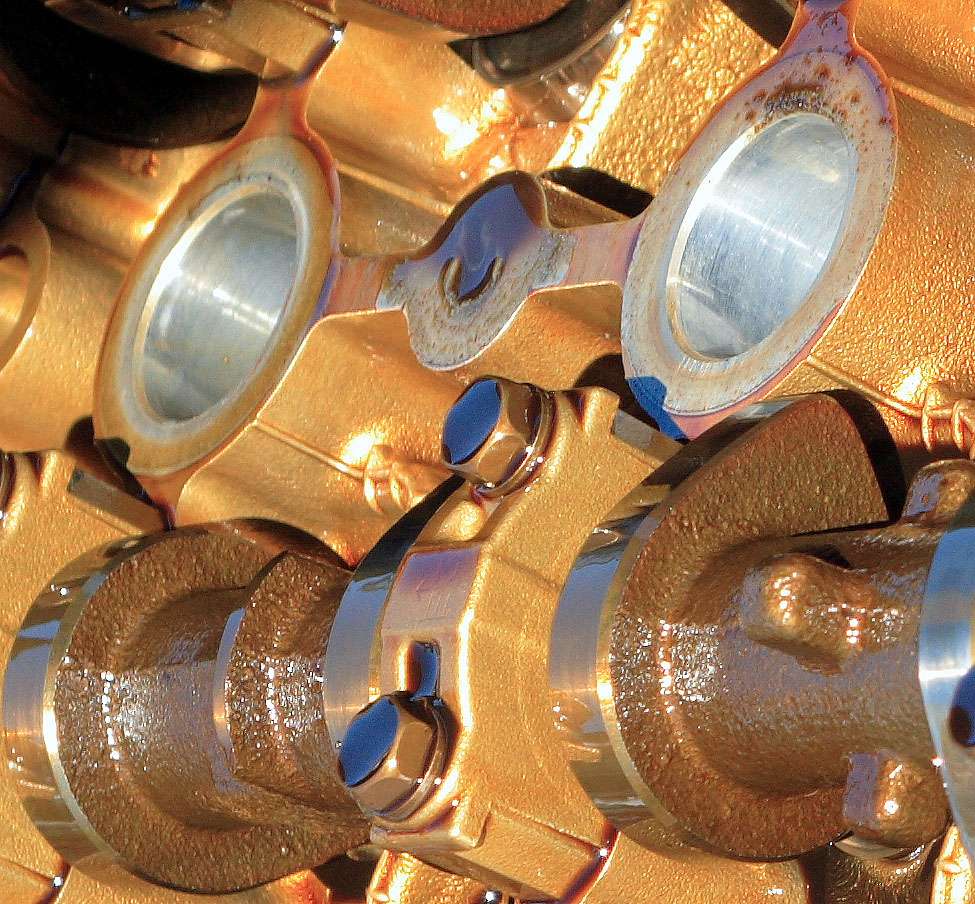
Getting closer to hotspots we start to see why.
Timingasfound.jpg
frontendpreassembly.jpg

Oilwipers.jpg

pistonholedebri.jpg

Oilholes.jpg


Wow. Almost makes the case for a solvent flush added to oil.
 
Originally Posted By: SlipperyPete
Originally Posted By: aquariuscsm
I`d be curious to know the oci`s here. I`m willing to bet extended oci`s (especially on dino) are to blame.


My guess is 15K on Walmart ST.........


Right. Because ST is such a poor oil that it will automatically sludge.
That engine looks neglected,period. I don't care what oil was used,if the engine was neglected then deposits will form.
Any API rated oil will do as well as any other API rated oil at a 5000 mile interval. If one wants to extend the interval then use a quality synthetic that is known(not assumed)to last longer in service.
As far as the engine pictured we have no idea if there was coolant contamination or anything else that can cause problems,so to assume or infer it was supertech,or any other decent oil is just more of that 60s thinking making its way into today's thinking.
Supertech is no better or worse than any other oil if ran for a proper interval. What that interval is is merely speculation without data from a used oil analysis.
To assume its a poor oil simply because its the Walmart brand shows just how much you've absorbed while being here,lets hope it gets better from here.
 
GTX is just as good as another oil on the market.

The engine and mechanical condition is far more important than the brand name on the bottle.

If you own a engine that throws oil threw the ringer and you do not change your oil in a timely fashion you will have problems no matter the brand on the bottle.
 
Originally Posted By: Clevy
Originally Posted By: SlipperyPete
Originally Posted By: aquariuscsm
I`d be curious to know the oci`s here. I`m willing to bet extended oci`s (especially on dino) are to blame.


My guess is 15K on Walmart ST.........


Right. Because ST is such a poor oil that it will automatically sludge.
That engine looks neglected,period. I don't care what oil was used,if the engine was neglected then deposits will form.
Any API rated oil will do as well as any other API rated oil at a 5000 mile interval. If one wants to extend the interval then use a quality synthetic that is known(not assumed)to last longer in service.
As far as the engine pictured we have no idea if there was coolant contamination or anything else that can cause problems,so to assume or infer it was supertech,or any other decent oil is just more of that 60s thinking making its way into today's thinking.
Supertech is no better or worse than any other oil if ran for a proper interval. What that interval is is merely speculation without data from a used oil analysis.
To assume its a poor oil simply because its the Walmart brand shows just how much you've absorbed while being here,lets hope it gets better from here.


I guess it didn't land.


Would it help if I said the motor appeared to be out of a Merc Villager?
laugh.gif
 
I don't want to start any Castrol bashing here, but I recently started a thread in which the Corolla developed a light varnish on the dipstick after one 5K OCI with Edge. It has nearly disappeared completely after 3.5K with a different oil. Varnish on the dipstick doesn't concern me, but I was surprised that only 5K did it. Also surprised how quickly it started going away with a different oil.

Here's my thread with pics on both pages:

https://bobistheoilguy.com/forums/threads/varnish-on-dipstick-after-5k-oci-suddenly.192793/
 
Originally Posted By: SlipperyPete
Originally Posted By: Clevy
Originally Posted By: SlipperyPete
Originally Posted By: aquariuscsm
I`d be curious to know the oci`s here. I`m willing to bet extended oci`s (especially on dino) are to blame.


My guess is 15K on Walmart ST.........


Right. Because ST is such a poor oil that it will automatically sludge.
That engine looks neglected,period. I don't care what oil was used,if the engine was neglected then deposits will form.
Any API rated oil will do as well as any other API rated oil at a 5000 mile interval. If one wants to extend the interval then use a quality synthetic that is known(not assumed)to last longer in service.
As far as the engine pictured we have no idea if there was coolant contamination or anything else that can cause problems,so to assume or infer it was supertech,or any other decent oil is just more of that 60s thinking making its way into today's thinking.
Supertech is no better or worse than any other oil if ran for a proper interval. What that interval is is merely speculation without data from a used oil analysis.
To assume its a poor oil simply because its the Walmart brand shows just how much you've absorbed while being here,lets hope it gets better from here.


I guess it didn't land.


Would it help if I said the motor appeared to be out of a Merc Villager?
laugh.gif


There is nothing to guess about. Its in bold capital text above the pics so it would not be missed. 5k OCI's on Syntec for years and hundreds of thousands of miles. I believe the guy because of the conversations, and the extent he went to stop oil consumption shortly after it started (rebuild). He refused to believe that it was his favorite oil, so I had to drag stats out of him. Agree, would use ST before Castrol anything.

 
Originally Posted By: panthermike
I don't want to start any Castrol bashing here, but I recently started a thread in which the Corolla developed a light varnish on the dipstick after one 5K OCI with Edge. It has nearly disappeared completely after 3.5K with a different oil. Varnish on the dipstick doesn't concern me, but I was surprised that only 5K did it. Also surprised how quickly it started going away with a different oil.

Here's my thread with pics on both pages:

https://bobistheoilguy.com/forums/threads/varnish-on-dipstick-after-5k-oci-suddenly.192793/


Its not bashing, its the truth. Your thread is proof "SN" is overrated, and does not guarantee a clean engine. Varnish on the dipstick is an indicator of whats going on inside the engine. Namely oil volatility. Owning an all-aluminum Toyota 1.8L engine with vvt-i and a track record of oil consumption from clogged piston oil returns it should concern you. You were smart to dump GTX before the holes clogged, because they cant be cleaned. Need to rip the pistons out and drill the deposits out.
 
Also, no data to support the Pennzoil conventional claim. Not recent years anyways. Assume they actually did change/update the brew. 1 or 2, but I feel they were dishonest about intervals. One thing I've found attempting to collect bad/failed oil stats is people lie about neglect and intervals. They cant even admit neglect anonymously in a forum. So.. have to be a deposit problem "profiler", trick data out of people in casual thread conversation. At this point I can tell right away if they are lying about neglect. Neglectors are lazy and cheap, head for the quick fix. Avoid, skip, and ignore the "why" it happened questions. Because they know why and they don't want you to know. Here's a clue... a poster complaining about deposits states "I bought a Toyota because of the reputation for not having any problems and lasting a long time! They suck, I'm gonna sue!". This the "Blame the auto manufacturer" neglector that translates reliability to "I don't have to do any maintenance".

Why am I saying all this? Want people to know the lengths I went to before forming the opinion that I "Won't use any Castrol product".
 
One more. In the 70's it was SE, then it was obsolete and "will cause equipment harm". Then it was SH, now thats obsolete. Then it was SJ/SL.. Ouch! that eats the catalyst.. On to SN. What will they find out in a year or 2? According to BITOG SN is the end of the line, its the perfect oil, all problems are solved. Nope, if your bought into the latest "SN" API standard solving all deposit related oil problems, and any API SN oil is fine, your simply repeating the errors of the past.
 
Lets not forget some engines [Honda and Toyota come to mind, there's more] are prone to sludge and varnish either by how their used or by design. In some cases oil selection doesn't help much either. For the record I'm not defending Castrol, or attacking Honda and Toyota.
 
Agree, and it drives home the point that replies like "any SN oil is fine, sleep well" is mythical baloney. Engines are prone to sludge varnish and deposits for a reason. Design, metals used, etc. For them, oil choice is critical. IMO "prone to" deposits/sludge is 33% design, 33% oil selection, 33% owner maintenance/neglect.
 
From what I've read/heard, a lot of Toyo engines seem to "tarnish" before any varnish...whether that is brand-specific I can't say but many different oils seem to result in the same as Panther saw on the dipstick...and one local Toyo dealer used Castrol for its conventional 5w30 OC...

Here's what my L4 Camry engine looked like after 97K of Shell and 3k of Pennzoil conventional...both conventional...

camtpcur.jpg
 
Last edited:
Your over on the TN forum, you know exactly why that happened. Toyota's choice of thin lightweight aluminum for a couple more MPG. Result - lack of heat dissipation, scalding surface temps, stripped threads. Staying on topic, I'm not talking about the coolant temperature gauge, I'm talking about the scalding hotspots and surface temps in that engine. Cooks/flashes lesser oils which leads to varnish, eventually sludge if left too long. What we see is a "thin skinned" 2AZ-FE stained from a prior oil flashing event. Your clean but stained into the pores of the soft, lightweight aluminum.
 
Toyota hacked every ounce of aluminum out of the 2.4L 2AZ-FE block they could. Looks like a skeleton. Look at the 3 headbolts in relation to the coolant gallies and pistons. No kidding there is a "stripped headbolt" problem if you don't change your coolant or deposits using a cheap oil.
000_0039_2_1.jpg
 
Originally Posted By: LeakySeals
Agree, and it drives home the point that replies like "any SN oil is fine, sleep well" is mythical baloney. Engines are prone to sludge varnish and deposits for a reason. Design, metals used, etc. For them, oil choice is critical. IMO "prone to" deposits/sludge is 33% design, 33% oil selection, 33% owner maintenance/neglect.


01.gif
How about blanket statements like any modern Conventional oil can handle a 5K OCI, or any modern Synthetic Oil is good for 10K? That might be true for some regions of the USA, in some vehicles, under certain driving conditions.
 
Yep, GTX fries like an egg in that block, could be fine in a cast iron 350. "SN" is irrelevant, just the latest compliance standard.
 
Also, on here there are many recommendations to "back spec" older Toyota 2AZ-FE 2.4L I4 engines to 0w20. These recommendations are based on oil chemistry ignoring design and problem history which should be considered for this engine which has been discontinued, replaced with engines designed for 0w20.
 
Originally Posted By: LeakySeals
Your over on the TN forum, you know exactly why that happened. Toyota's choice of thin lightweight aluminum for a couple more MPG. Result - lack of heat dissipation, scalding surface temps, stripped threads. Staying on topic, I'm not talking about the coolant temperature gauge, I'm talking about the scalding hotspots and surface temps in that engine. Cooks/flashes lesser oils which leads to varnish, eventually sludge if left too long. What we see is a "thin skinned" 2AZ-FE stained from a prior oil flashing event. Your clean but stained into the pores of the soft, lightweight aluminum.


I understand...and I was just commenting...:
...that I see a lot of posted pix of "stained" aluminum that isn't necessarily indicative of the "scalded hotspots" that we have no way of knowing is happening...that staining isn't reason enough to worry...or not to worry...I had thought that a sudden rise in coolant temp on the dash gauge might be a "sign" but as you make clear...by then it's too late....
...and...
...that I know a dealer that uses Castrol for its conventional OCs...which surprised me given what I've read here and elsewhere on the net...
 
Status
Not open for further replies.
Back
Top Bottom