
Anyone using Purolator on Subaru?

Status
Not open for further replies.
Originally Posted By: mechanicx

I see what you are saying but I'm of the belief that the oil filter is much more restrictive to cold oil than other engine parts/areas are.


The oil filter is basically a fixed flow resistor as is the engine's oiling system. An engine's oiling system is much more restrictive to oil flow than any oil filter is. Just like the data shows from Purolator when I asked them to flow test the PL14006. At 18 GPM it only had 5 PSID. It would take probably 150+ PSI of pump pressure to make 18 GPM flow through an LS6 V8 engine.

Originally Posted By: mechanicx
I always think the oil pump delivers, although maybe a reduced flow of oil to the filter, a fairly good volume of cold oil flow.


The pump can only deliver what it's max pressure (regualated by its pressure relief vavle) can push through the system - the rest gets dumped back to the sump before going to the filter/engine. The pump's pressure relief valve is the max pressure dictator. Like I said above, the only time you could flow much more cold oil volume is if there is no back pressure from the engine. Once the engine back pressure is established, the engine is the main restriction to flow ... for both hot and cold oil.

Originally Posted By: mechanicx
Well this oil filter leaking and possible blowing filters effect happens well after the initial start and after the oil filter can refill like when you rev the eng up.


It could be that even though the flow volume is much less when cold, the pump's pressure relief valve might not be able to handle and regulate as well with cold, thick oil. If that is true, then it could very well be that there is more pump output pressure with very cold oil which can cause this to happen (ie; max pump pressure might be 120 PSI with some RPM instead of 80 PSI). It's obviously not a common thing, otherwise everyone who lives in very cold climates would be blowing oil filters off their engines. It could be vehicle specific and/or even filter related due to it's design and bypass setting.

Originally Posted By: mechanicx
Overall I totally believe oil filters are more restrictive to cold oil flow than the rest of the oiling system and that oil pumps can pump a decent volume of cold oil especially at higher RPM. I think there is higher pressure diferential at the filter depending on oil temperature/viscosity.


Like I said above, the engine is always the more restrictive part of the oil system regardless if the oil is hot or cold, or anywhere in between.
 
Originally Posted By: SuperBusa
The oil filter is basically a fixed flow resistor as is the engine's oiling system. An engine's oiling system is much more restrictive to oil flow than any oil filter is. Just like the data shows from Purolator when I asked them to flow test the PL14006. At 18 GPM it only had 5 PSID. It would take probably 150+ PSI of pump pressure to make 18 GPM flow through an LS6 V8 engine.


How do you know that? I can maybe partially agree with you if we are talking about hot oil, but I just thgink an oil filter has different flow rates at cold oil temperatures.I would think that most parts of the engine oiling ssytem would be less restrictive than an oil filter, which by the way is one part of the oiling system. Just how restrictive do you think the engine's oil galleis could be? In this discussion I was talking about restriction due to cold oil in the oiling system from the oil pump pickup to the oil filter. I don't think the pump to filter is very restrictive.

Quote:
The pump can only deliver what it's max pressure (regualated by its pressure relief vavle) can push through the system - the rest gets dumped back to the sump before going to the filter/engine. The pump's pressure relief valve is the max pressure dictator. Like I said above, the only time you could flow much more cold oil volume is if there is no back pressure from the engine. Once the engine back pressure is established, the engine is the main restriction to flow ... for both hot and cold oil.


Right, although some oil pumps bypass right back into the oil pump, but all that really matters here is how restrictive the oil filter is to cold oil flow. If you have 80 psi and a big enough pressure diferential across the filter it still will bypass. What you are saying that the filter pressure can't go above oil pump relief pressure sounds right but it doesn't explain how without a bypass oil filter have been known toleak and even burst.


Quote:
It could be that even though the flow volume is much less when cold, the pump's pressure relief valve might not be able to handle and regulate as well with cold, thick oil. If that is true, then it could very well be that there is more pump output pressure with very cold oil which can cause this to happen (ie; max pump pressure might be 120 PSI with some RPM instead of 80 PSI). It's obviously not a common thing, otherwise everyone who lives in very cold climates would be blowing oil filters off their engines. It could be vehicle specific and/or even filter related due to it's design and bypass setting.


It doesn't happen often because few people block off their bypass and the ones who do keep the revs down till oil warms up and/or use a heavy duty filter. The point though is that it happens is indicative that there is a lot of flow and the oil filter is restrictive at cold oil temps.


Quote:
Like I said above, the engine is always the more restrictive part of the oil system regardless if the oil is hot or cold, or anywhere in between.

And there's the crux of it. You seem to say oil filters aren't very restrictive to cold oil. I think they are. It's all conjecture unless we have some definitive proof. Also I don't see that much restriction before the oil filter to drop flow the much which is an important point. Oil will find the path of least resistance, in the engine it has various paths and in the oil filter it has the bypass.
 
Originally Posted By: mechanicx
Originally Posted By: SuperBusa
The oil filter is basically a fixed flow resistor as is the engine's oiling system. An engine's oiling system is much more restrictive to oil flow than any oil filter is. Just like the data shows from Purolator when I asked them to flow test the PL14006. At 18 GPM it only had 5 PSID. It would take probably 150+ PSI of pump pressure to make 18 GPM flow through an LS6 V8 engine.


How do you know that? I can maybe partially agree with you if we are talking about hot oil, but I just think an oil filter has different flow rates at cold oil temperatures.


It’s an estimate – and yes, I’m talking about HOT oil. Think about it … I know the LS6 flows ~10 GPM of hot oil with 80 psi of pump pressure. So it’s obvious that it would take much more pump pressure to flow 18+ GPM through the same flow circuit. You can't have more flow unless you have more pressure to push that increased flow volume. Fluids 101.

Originally Posted By: mechanicx
I would think that most parts of the engine oiling system would be less restrictive than an oil filter, which by the way is one part of the oiling system.


Again … and I’d wish some other members here would chime in on this stuff. The engine is BY FAR more restrictive to oil flow than any filter is. Yes, the oil filter is part of the oiling system, but think of it as a separate element in the system. The oil goes through the filter, THEN through the engine. It’s like having two separate resistors in series. I don’t know why I have to explain this stuff in such agonizing detail.

Originally Posted By: mechanicx
Just how restrictive do you think the engine's oil galleis could be? In this discussion I was talking about restriction due to cold oil in the oiling system from the oil pump pickup to the oil filter. I don't think the pump to filter is very restrictive.


It’s not the main oil galleries … it’s the bearings that are the “choke points” or main “restrictions” in an engine. No, the path from the oil pump to the filter is not very restrictive … either is the filter. The engine is … if the pump puts out 80 psi, there might be a 5 psi drop across the filter and a 75 psi drop (the pressure you see on your oil pressure gauge) across the engine. The 75 psi drop across the engine is because it's restrictive to the flow - the same flow volume that goes through the filter.

Originally Posted By: mechanicx
Originally Posted By: SuperBusa
The pump can only deliver what it's max pressure (regulated by its pressure relief valve) can push through the system - the rest gets dumped back to the sump before going to the filter/engine. The pump's pressure relief valve is the max pressure dictator. Like I said above, the only time you could flow much more cold oil volume is if there is no back pressure from the engine. Once the engine back pressure is established, the engine is the main restriction to flow ... for both hot and cold oil.


Right, although some oil pumps bypass right back into the oil pump, but all that really matters here is how restrictive the oil filter is to cold oil flow.


It doesn’t matter where the relieved oil from the pump’s output dumps back to. Fact is, if the pump’s pressure regulator works correctly, it “regulates” the pump’s output pressure. That’s why it’s call a “pump pressure regulator valve”. If the regulator is set to 80 psi, then the MAX pressure the pump can theoretically put out is 80 PSI. Now as I mentioned earlier, if the regulator valve doesn’t work well for some reason (like with very think, cold oil or it is under designed, or sticking or ??) it could over shoot the regulation set point and cause much higher pump output pressure until it tries to regain pressure control.

That’s probably why oil filters over pressure with cold oil and leak or burst. It takes pressure inside the can to make that happen. If the pump’s regulator valve worked correctly with cold oil there would only be 80 PSI inside the filter with cold oil … same as with hot oil if the pump was at max regulated pressure. Pressure is pressure … regardless of the oil temperature. ONLY the oil pump is responsible for creating the oil pressure, and the pump's regulator valve is the only device in the system that controls the pumps MAX pressure output. If the regulator valve is not working right, then it's anybody's guess on what kind of pump pressures are seen.

Originally Posted By: mechanicx
If you have 80 psi and a big enough pressure differential across the filter it still will bypass. What you are saying that the filter pressure can't go above oil pump relief pressure sounds right but it doesn't explain how without a bypass oil filter have been known to leak and even burst.


That’s right … how could the pressure inside the filter can be higher than the pump causing the pressure inside the filter? It can’t … unless there was some instantaneous pressure impulse or spike … that’s the only way.

Originally Posted By: mechanicx
Originally Posted By: SuperBusa
It could be that even though the flow volume is much less when cold, the pump's pressure relief valve might not be able to handle and regulate as well with cold, thick oil. If that is true, then it could very well be that there is more pump output pressure with very cold oil which can cause this to happen (ie; max pump pressure might be 120 PSI with some RPM instead of 80 PSI). It's obviously not a common thing, otherwise everyone who lives in very cold climates would be blowing oil filters off their engines. It could be vehicle specific and/or even filter related due to it's design and bypass setting.


It doesn't happen often because few people block off their bypass and the ones who do keep the revs down till oil warms up and/or use a heavy duty filter. The point though is that it happens is indicative that there is a lot of flow and the oil filter is restrictive at cold oil temps.


So why would anyone want to block off the filter bypass valve? Sounds like you are talking about racers doing this … which probably also means they are running a very high output volume pump with a modified pressure relief valve to give higher pump pressure, and running high engine RPM with an engine with loose bearing clearances, etc. Of course this could cause filter over pressure issues. You just don't hear much about the avg Joe public car on the road exploding oil filters in cold weather.

As a unknowing kid, I always ran 20w-50 oil all year round, and would start my car in -25 deg F with that viscosity oil. I never had any filters fail from it. That's probably because the oil pump's pressure regulator worked OK, and with that cold of oil the flow rate going through the filter & engine was very low.

Originally Posted By: mechanicx
Originally Posted By: SuperBusa
Like I said above, the engine is always the more restrictive part of the oil system regardless if the oil is hot or cold, or anywhere in between.


And there's the crux of it. You seem to say oil filters aren't very restrictive to cold oil. I think they are. It's all conjecture unless we have some definitive proof. Also I don't see that much restriction before the oil filter to drop flow the much which is an important point. Oil will find the path of least resistance, in the engine it has various paths and in the oil filter it has the bypass.


No, I didn’t say oil filters are not restrictive to cold oil flow. Please go back and re-read my posts. Most anyone here knows that the thicker the oil and/or the higher the flow rate, the higher the PSID will be across the filter. I don’t even think about the restriction between the pump output and the filter … consider that whole gallery at pump output pressure. I’m talking about the filter as one flow restrictor, and the engine as a whole as another flow restrictor in series with the filter. The oil hits the filter first, then the engine next.

The engine will always be more restrictive than an oil filter unless the engine has crank, rod and cam bearings that are totally shot … even then, it’s probably more restrictive. I know there are many member here who would agree with this.
 
Originally Posted By: mechanicx
I saw this link in the recent Fram thread. It said that most filter only flowed about 8 oz per min at 10 psi with room temperature oil. That doesn't sound very high and imagine of the oil was much colder as it would be in winter. I didn't really read through it, but I'd assume this rate is not including bypass to be that low.

http://www.offshoreonly.com/forums/general-q/86056-oil-filter-study-2.html


I'm betting that is a flow test on a very small area of the media. This is totally misleading information - as many of these "garage tests" prove to be. The data can only be useful in a relative way.

A real filter assembly will flow many GPM of oil at room temperature with a 10 PSI delta across it. That PL14006 PureONE that as flow tested flowed 18 GPM of 200 deg F oil with only a 5 PSI pressure across the filter. No way in you know what that a filter only flow 8 oz/min with 10 PSI across it. It's misleading info.
 
Well I'm not going to debate this. I don't think the engine is that restrictive, for example, the mains feed off a fairly large oil galley and if the bearing were all that restrictive they would be getting bypassed and oil starved. None of that is my main point which was an oil filter may not be restrictive when the oil is hot and viscosity is low. But when the oil is cold the filter may have a high enough pressure drop to go into bypass mode.

You seem to not think so and that the cold oil doesn't get bypassed. I provided a link that suggested that filters were very much more restrictive to oil at room temperature than hot and you dismiss it out of hand. That's the only link I had offhand. We don't have any conclusive information about pressure drop across the filter at cold oil temperatures and that's really all that matters, so it's all conjecture.
 
Originally Posted By: mechanicx
Well I'm not going to debate this. I don't think the engine is that restrictive, for example, the mains feed off a fairly large oil galley and if the bearing were all that restrictive they would be getting bypassed and oil starved.


The engine is definitely much more restrictive than a filter. Again, this example shows that it's true. If an oil pump is putting out 80 PSI, and there is 75 PSI showing on the engine's oil pressure gauge, this means there is a 5 PSI drop across the oil filter, and a 75 PSI drop across the engine (ie, from press sensor at inlet to the engine to the oil pan which = 0 PSI). If you can't grasp this concept then you will never understand just how restrictive an engine's oiling system is.

Originally Posted By: mechanicx
None of that is my main point which was an oil filter may not be restrictive when the oil is hot and viscosity is low. But when the oil is cold the filter may have a high enough pressure drop to go into bypass mode.


Yes, it's possible that when the oil is cold there could be high enough PSID to cause the filter to go into bypass mode. But again, it all depends on how well the oil pump's pressure regulator works with cold oil. I'm still believing that with cold oil there is a big decrease in the volume of oil that will flow at the same max oil pump pressure, so that helps offset the increase in viscosity.

Originally Posted By: mechanicx
You seem to not think so and that the cold oil doesn't get bypassed.


I said that if the filter is free flowing, and the bypass valve doesn't open at max pump pressure with high volume hot oil, then I doubt the bypass valve will open with low volume cold oil. Keep in mind that this assumption is based on the assumption that the pump's pressure relief valve works perfectly and will no allow the max pressure to rise above the relief valve's setting. As discussed, it may very well be that some pressure relief valves are under designed and cause the pump output pressure to well above the setting when the oil is very cold and thick.

Originally Posted By: mechanicx
I provided a link that suggested that filters were very much more restrictive to oil at room temperature than hot and you dismiss it out of hand. That's the only link I had offhand. We don't have any conclusive information about pressure drop across the filter at cold oil temperatures and that's really all that matters, so it's all conjecture.


There is a chart from ACDelco that shows the flow vs. PSID of many filters with very thick oil. I'll find it and post it later – it’s posted all over this site. Like I've said about a dozen times now, there is no doubt that a filter is more restrictive to cold oil ... anything that flows any liquid is more restrictive when the fluid is cold. Everyone knows this, as it's a very fundamental aspect of fluid flow.
 
Originally Posted By: SuperBusa

The engine is definitely much more restrictive than a filter. Again, this example shows that it's true. If an oil pump is putting out 80 PSI, and there is 75 PSI showing on the engine's oil pressure gauge, this means there is a 5 PSI drop across the oil filter, and a 75 PSI drop across the engine (ie, from press sensor at inlet to the engine to the oil pan which = 0 PSI). If you can't grasp this concept then you will never understand just how restrictive an engine's oiling system is.


I don't know why you keep discussing whether engine oil circuits are more restrictive than the filter, it's not really important to the discussion of cold oil flow through the filter. Also you keep saying "you don't get it". I got your argument a long time ago, I'm just not agreeing. Anyway what you are saying is misleading. Of course the pressure drops to zero after it completes its path through the engine, but not just because of restriction. It all bleeds off into the sump. But if you were to tap the oil presure at the other end of the oil galley there would not be that much pressure drop and therefore not much restriction.


Quote:
Yes, it's possible that when the oil is cold there could be high enough PSID to cause the filter to go into bypass mode. But again, it all depends on how well the oil pump's pressure regulator works with cold oil. I'm still believing that with cold oil there is a big decrease in the volume of oil that will flow at the same max oil pump pressure, so that helps offset the increase in viscosity.


This is the crux of the argument and where we disagree. First, whether the filter goes into bypass mode is most dependent on just how restrictive it is to cold oil flow. You think oil filters aren't that restrictive to flow. You seem to think the oil pump route to the oil filter is restrictive and so less oil gets to the filter. I don't think it is. If what you were saying is true, filter bypassing wouldn't be the biggest problem, oil starvation to the engine would be when cold even if the filter bypassed.


Originally Posted By: mechanicx
You seem to not think so and that the cold oil doesn't get bypassed.


Quote:
I said that if the filter is free flowing, and the bypass valve doesn't open at max pump pressure with high volume hot oil, then I doubt the bypass valve will open with low volume cold oil. Keep in mind that this assumption is based on the assumption that the pump's pressure relief valve works perfectly and will no allow the max pressure to rise above the relief valve's setting. As discussed, it may very well be that some pressure relief valves are under designed and cause the pump output pressure to well above the setting when the oil is very cold and thick.


But why do you think the oil flow would be such low volume even though there could be high pressure? It's a short trip usually from the oil pump to the filter. The main point is we really don't know what the pressure drop across the filter is.


Quote:
There is a chart from ACDelco that shows the flow vs. PSID of many filters with very thick oil. I'll find it and post it later – it’s posted all over this site. Like I've said about a dozen times now, there is no doubt that a filter is more restrictive to cold oil ... anything that flows any liquid is more restrictive when the fluid is cold. Everyone knows this, as it's a very fundamental aspect of fluid flow.


This discussion is about cold oil. I am betting that chart is for hot oil. You didn't want to accept the link I found regarding cold oil flow, so the burden is on you to find a cold flow study.
 
Originally Posted By: mechanicx

This discussion is about cold oil. I am betting that chart is for hot oil. You didn't want to accept the link I found regarding cold oil flow, so the burden is on you to find a cold flow study.


From our discussions, you obviously can not grasp some of the concepts I've described. It's not rocket science. I might try one more time, but this is getting close to a SB/GA type of discussion.
wink.gif


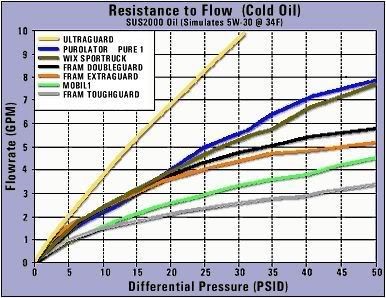
Here you go ... COLD oil flow PSID vs. flowrate in various filters. Data produced by ACDelco filter testing.

pi_filt_oil_gold_coldoil_thumb.jpg
 
Originally Posted By: SuperBusa
Originally Posted By: mechanicx

This discussion is about cold oil. I am betting that chart is for hot oil. You didn't want to accept the link I found regarding cold oil flow, so the burden is on you to find a cold flow study.


From our discussions, you obviously can not grasp some of the concepts I've described. It's not rocket science. I might try one more time, but this is getting close to a SB/GA type of discussion.
wink.gif


Here you go ... COLD oil flow PSID vs. flowrate in various filters. Data produced by ACDelco filter testing.

pi_filt_oil_gold_coldoil_thumb.jpg


Thanks for the chart but you can drop the comment, "can't grasp what I'm saying". Going by that chart even at just under 2GPM most of those filter (except AC DElco-how shocking when it's an AC Delco chart) are well into the bypass pressure differential for most applications. The Fram extraguard and Mobil 1 were in bypass zone at just over 1 GPM. Anyway, that's part of the puzzle. What we need is nominal GPM flowfrom the pump. The fact that this chart is in 1 GPM intervals and goes all the way to 10 GPM is probably indicative of the flow rates a typical oiling sytem has, so that would put the filter well into bypass mode.
 
Originally Posted By: mechanicx
Originally Posted By: SuperBusa

The engine is definitely much more restrictive than a filter. Again, this example shows that it's true. If an oil pump is putting out 80 PSI, and there is 75 PSI showing on the engine's oil pressure gauge, this means there is a 5 PSI drop across the oil filter, and a 75 PSI drop across the engine (ie, from press sensor at inlet to the engine to the oil pan which = 0 PSI). If you can't grasp this concept then you will never understand just how restrictive an engine's oiling system is.


I don't know why you keep discussing whether engine oil circuits are more restrictive than the filter, it's not really important to the discussion of cold oil flow through the filter.


True ... but you’ve claimed many times that the filter is more restrictive to oil flow than the filter. That is just plain false. The engine is much more restrictive to flow than any filter is. You need to realize that, or you’ll will never understand the system as a whole.

I don’t know why others here never chime in on this stuff.

Originally Posted By: mechanicx
Also you keep saying "you don't get it". I got your argument a long time ago, I'm just not agreeing. Anyway what you are saying is misleading. Of course the pressure drops to zero after it completes its path through the engine, but not just because of restriction. It all bleeds off into the sump. But if you were to tap the oil pressure at the other end of the oil galley there would not be that much pressure drop and therefore not much restriction.


I’m talking about the pressure drop across the engine from the main inlet to the engine (where the engine’s oil pressure sensor is located) to the sump. I don’t care about the miniscule pressure drop along a large oil gallery. If the engine oil pressure gauge shows 75 PSI, then that means there is a 75 PSI pressure drop across the engine. It’s just that simple. 75 PSI inlet, 0 PSI outlet (ie, the sump).

Originally Posted By: mechanicx
Originally Posted By: SuperBusa

Yes, it's possible that when the oil is cold there could be high enough PSID to cause the filter to go into bypass mode. But again, it all depends on how well the oil pump's pressure regulator works with cold oil. I'm still believing that with cold oil there is a big decrease in the volume of oil that will flow at the same max oil pump pressure, so that helps offset the increase in viscosity.


This is the crux of the argument and where we disagree. First, whether the filter goes into bypass mode is most dependent on just how restrictive it is to cold oil flow. You think oil filters aren't that restrictive to flow.


You must be reading between the lines, because I’ve never claimed oil filters are not restrictive to cold oil. I’ve said many times now that the restriction is dependant on visosity and flowrate. The thicker the oil, the more restriction. The more flow rate, the more restriction. Go back and re-read ... you’re missing these points.


Originally Posted By: mechanicx
You seem to think the oil pump route to the oil filter is restrictive and so less oil gets to the filter. I don't think it is. If what you were saying is true, filter bypassing wouldn't be the biggest problem, oil starvation to the engine would be when cold even if the filter bypassed.


Again, you’re not comprehending my inputs. Less oil gets to the filter when the oil is cold because the oil pump goes into pressure relief with much less volume going to the filter. Not because there is restriction between the pump and filter – I’ve never claimed that.

When the oil is very cold and thick, much more flow goes to the sump (or back to the pump inlet) when the oil is cold and the pump is in pressure relief mode. You need to fully understand how the pressure relief system works to grasp this. If the oil was thick as honey, the pump would go into pressure relief instantly, and only a very small amount of oil could be pushed down the path to the filter/engine. The rest of the pump’s output would be shunted back to the sump or pump inlet. Remember that the oil pump if theoretically a positive displacement device. Everything it puts out needs to go somewhere. Either to the filter/engine circuit or back to the sump.

Originally Posted By: mechanicx
Originally Posted By: SuperBusa

I said that if the filter is free flowing, and the bypass valve doesn't open at max pump pressure with high volume hot oil, then I doubt the bypass valve will open with low volume cold oil. Keep in mind that this assumption is based on the assumption that the pump's pressure relief valve works perfectly and will no allow the max pressure to rise above the relief valve's setting. As discussed, it may very well be that some pressure relief valves are under designed and cause the pump output pressure to well above the setting when the oil is very cold and thick.


But why do you think the oil flow would be such low volume even though there could be high pressure? It's a short trip usually from the oil pump to the filter. The main point is we really don't know what the pressure drop across the filter is.


You are not understanding what I’m saying. You’ve locked in your own “read between the lines” thoughts. Again, the flow volume has to be lower at the same max pump pressure because the viscosity is much higher. This is a basic fluids flow fact.

If you have a small diameter pipe (represents a fixed resistance to flow, like a filter/engine circuit) and can only supply 80 PSI to its inlet with an unlimited oil volume source, the flow rate through the small dia pipe will decrease significantly as the oil gets colder and colder. As an example, this pipe might flow 10 GPM with 200 deg F oil, but only flow 2 GPM with 0 deg F oil ... 80 PSI supply pressure in both cases. If you can’t understand this concept, you will always be confused in these technical discussions.
 
Originally Posted By: mechanicx
Originally Posted By: SuperBusa
Originally Posted By: mechanicx

This discussion is about cold oil. I am betting that chart is for hot oil. You didn't want to accept the link I found regarding cold oil flow, so the burden is on you to find a cold flow study.


From our discussions, you obviously can not grasp some of the concepts I've described. It's not rocket science. I might try one more time, but this is getting close to a SB/GA type of discussion.
wink.gif


Here you go ... COLD oil flow PSID vs. flowrate in various filters. Data produced by ACDelco filter testing.

pi_filt_oil_gold_coldoil_thumb.jpg


Thanks for the chart but you can drop the comment, "can't grasp what I'm saying". Going by that chart even at just under 2GPM most of those filter (except AC DElco-how shocking when it's an AC Delco chart) are well into the bypass pressure differential for most applications. The Fram extraguard and Mobil 1 were in bypass zone at just over 1 GPM. Anyway, that's part of the puzzle. What we need is nominal GPM flow from the pump. The fact that this chart is in 1 GPM intervals and goes all the way to 10 GPM is probably indicative of the flow rates a typical oiling system has, so that would put the filter well into bypass mode.


Obviously, this chart represents just the media, and I agree if you actually could put that much flow through it with that oil viscosity the bypass valve would certainly open. Note that the PureONE would need about 3 GPM of cold oil to go into bypass (ie, 14~165 PSI). The ACDelco Ultragaurd even more flow.

But, what you have to realize is that in a cold oil situation, the oil pump's pressure relief valve will still try to keep the max oil pressure to whatever the relief valve is set to (say 80 PSI). Depending on how restrictive the filter/engine is, will determine how much cold oil flow volume does down the filter/engine circuit at 80 PSI. It very well could be that when the oil is that cold there is only 1 or 2 GPM max oil flow, and the rest is going back to the sump. Again, it all depends on the engine's restrictiveness, and the oil pump's volume output vs. RPM and the pump's pressure relief setting. There are many factors involved in the system that would determine if the filter does or doesn't go into bypass mode.
 
You are making this into an epic argument and a lot more complicated than it needs to be. Whenever I disagree with you, you either create a strawman out of what I said, or insinuate I don't understand what you're saying when I'm simply not agreeing with one of your unsupported claim.

It's real simple whether or not a filter bypasses cold oil depends on flowrates and the restrictiveness of the filter to cold oil. Your own chart seem to suggest that a most filters can't flow much more 5w30 oil than 1-2 GPM at 34 degrees F without reaching bypass pressure differential. The question remains is how much oil flow does the pump deliver. I think it can deliver enough for the filter to bypass, and you seem to think it cannot.
 
Originally Posted By: SuperBusa
Originally Posted By: mechanicx
Originally Posted By: SuperBusa
Originally Posted By: mechanicx

This discussion is about cold oil. I am betting that chart is for hot oil. You didn't want to accept the link I found regarding cold oil flow, so the burden is on you to find a cold flow study.


From our discussions, you obviously can not grasp some of the concepts I've described. It's not rocket science. I might try one more time, but this is getting close to a SB/GA type of discussion.
wink.gif


Here you go ... COLD oil flow PSID vs. flowrate in various filters. Data produced by ACDelco filter testing.

pi_filt_oil_gold_coldoil_thumb.jpg


Thanks for the chart but you can drop the comment, "can't grasp what I'm saying". Going by that chart even at just under 2GPM most of those filter (except AC DElco-how shocking when it's an AC Delco chart) are well into the bypass pressure differential for most applications. The Fram extraguard and Mobil 1 were in bypass zone at just over 1 GPM. Anyway, that's part of the puzzle. What we need is nominal GPM flow from the pump. The fact that this chart is in 1 GPM intervals and goes all the way to 10 GPM is probably indicative of the flow rates a typical oiling system has, so that would put the filter well into bypass mode.


Obviously, this chart represents just the media, and I agree if you actually could put that much flow through it with that oil viscosity the bypass valve would certainly open. Note that the PureONE would need about 3 GPM of cold oil to go into bypass (ie, 14~165 PSI). The ACDelco Ultragaurd even more flow.

But, what you have to realize is that in a cold oil situation, the oil pump's pressure relief valve will still try to keep the max oil pressure to whatever the relief valve is set to (say 80 PSI). Depending on how restrictive the filter/engine is, will determine how much cold oil flow volume does down the filter/engine circuit at 80 PSI. It very well could be that when the oil is that cold there is only 1 or 2 GPM max oil flow, and the rest is going back to the sump. Again, it all depends on the engine's restrictiveness, and the oil pump's volume output vs. RPM and the pump's pressure relief setting. There are many factors involved in the system that would determine if the filter does or doesn't go into bypass mode.


Ok then what is the argument about? My whole point was that oil filters probably bypass in cold running. I will add that many bypasses kick in at 7 psi. So based on that chart the PureONe would bypass at 2 GPM on engines that have their own bypass. I could be wrong but I think the oil pump could easily deliver 2 GPM or more at this temperature. You don't think it will? Isn't that your position? The reason why I say that is because of the oil pressure that develops at the tap near the filter. If the oil pump wasn't pumping a few GPM I don't think there'd be the oil pressure you typically see.
 
Originally Posted By: mechanicx
You are making this into an epic argument and a lot more complicated than it needs to be. Whenever I disagree with you, you either create a strawman out of what I said, or insinuate I don't understand what you're saying when I'm simply not agreeing with one of your unsupported claim.


I'm just commenting on the various false statements you'd posted. Yes, I agree, it's not complicated but if you make false technical statements (like the filter is more restrictive than the engine) then I make comments to say why that's not true - nothing wrong with that IMO. No straw man ... just facts.

I'm really surprised GA hasn't chimed in ... I know he also knows the engine is way more restrictive to flow than a filter.

Originally Posted By: mechanicx
It's real simple whether or not a filter bypasses cold oil depends on flowrates and the restrictiveness of the filter to cold oil. Your own chart seem to suggest that a most filters can't flow much more 5w30 oil than 1-2 GPM at 34 degrees F without reaching bypass pressure differential.


I agree ... but as said below it all depends on what the real flow output is from the pump. See more below.

Originally Posted By: mechanicx
The question remains is how much oil flow does the pump deliver. I think it can deliver enough for the filter to bypass, and you seem to think it cannot.


Maybe it can, maybe it can't ... it all depends on many things. It's not black and white Again ... how much oil flow the pump can deliver to the filter/engine is dependant on these things: a) The pump's volumetric output vs. engine RPM, b) The pump's pressure relief setting, c) Does the pressure relief valve work as designed, or is it under designed for cold oil bypassing and causing much higher max oil pressure when cold, d) How restrictive is the filter/engine flow circuit, e) What weight oil is used. f) How much engine RPM is used before oil warm-up.
 
Originally Posted By: mechanicx

Ok then what is the argument about? My whole point was that oil filters probably bypass in cold running. I will add that many bypasses kick in at 7 psi. So based on that chart the PureONE would bypass at 2 GPM on engines that have their own bypass.


I'm not claiming every oil filter will never bypass with cold oil. But it's possible some will not and some will based on all the factors I listed in the post above.

Originally Posted By: mechanicx
I could be wrong but I think the oil pump could easily deliver 2 GPM or more at this temperature. You don't think it will? Isn't that your position? The reason why I say that is because of the oil pressure that develops at the tap near the filter. If the oil pump wasn't pumping a few GPM I don't think there'd be the oil pressure you typically see.


This is where you're missing the big picture. Extreme example: A pump could put out its max pressure (as regulated by the pressure relief valve) with zero oil flow to the filter/engine (assume the filter is completely blocked and no filter bypass). You could develop 80 PSI supply pressure to the filter/engine with zero flow ... meaning ALL the flow from the pump would be going back to the sump.

Just because a pump puts volume out doesn't mean it all goes to the filter/engine. Only the amount that will flow at that pressure will go ... the rest goes back to the sump. If the filter/engine circuit is restrictive to cold oil flow, then there really will not be much flow going to the filter/engine (maybe less than what it takes to make the filter go into bypass).

Without actually taking test data on each car/oil/filter combination in the world, you could never tell for sure what situation will or will not cause the filter to go into bypass with cold oil on any specific car/oil/filter/temp combo. There are just too many factors involved as discussed earlier.

All I'm saying is that you can not assume every filter in the world will go into bypass with cold oil. I’ve never claimed the all don’t ... I’ve claimed it’s possible and probably does happen, but also claim that some may not.
 
Originally Posted By: SuperBusa
mechanicx said:
I'm just commenting on the various false statements you'd posted. Yes, I agree, it's not complicated but if you make false technical statements (like the filter is more restrictive than the engine) then I make comments to say why that's not true - nothing wrong with that IMO. No straw man ... just facts.


This is a good example of you using strawman and being a smart elic and condescending to boot. What I've said is that I believe that it's possible that an oil filter is more restrictive to COLD oil flow than the the engine galleys are that feed the oil filter, the main bearings, and other engine parts, etc. Your "facts" other than the AC Delco chart is just your opinion.

Quote:
I'm really surprised GA hasn't chimed in ... I know he also knows the engine is way more restrictive to flow than a filter.


I'm fine with anyone chiming in with substantiated facts that the engine's oil system is more restrictive to cold oil flow than a filter. But you keep banging on this topic, when my main point all along was that filters probably bypass a lot of cold oil.


Quote:
Maybe it can, maybe it can't ... it all depends on many things. It's not black and white Again ... how much oil flow the pump can deliver to the filter/engine is dependant on these things: a) The pump's volumetric output vs. engine RPM, b) The pump's pressure relief setting, c) Does the pressure relief valve work as designed, or is it under designed for cold oil bypassing and causing much higher max oil pressure when cold, d) How restrictive is the filter/engine flow circuit, e) What weight oil is used. f) How much engine RPM is used before oil warm-up.


You are over-complicating the issue. Sure all those variable matter but my intent was to ball park it. Most oil pumps are of similar designs. Usually the pickup is a firly straight shot into the pump. And then a fairly short trip to the filter. I think the oil pump can typically deliver enough volume of cold oil that the filter must bypass. You keep complicating this and riding the fence, and going back to whether or not the engine is more restrictive to cold oil flow which is a vague argument and not my main point anyway. Your position seems to be not much cold oil flows out of the pump and the engine is restrictive. That's just your opinion I don't necessarily agree with without much hard facts to back it up. So why the attitude?
 
Originally Posted By: SuperBusa

I'm not claiming every oil filter will never bypass with cold oil. But it's possible some will not and some will based on all the factors I listed in the post above.


I never said you claimed no oil filter will bypass with oil, but you implied that it's unlikely. If you are now agreeing that oil filter in generally probably bypass cold oil, which is my main point, then why do you keep debating this with me into the ground?


Quote:
This is where you're missing the big picture. Extreme example: A pump could put out its max pressure (as regulated by the pressure relief valve) with zero oil flow to the filter/engine (assume the filter is completely blocked and no filter bypass). You could develop 80 PSI supply pressure to the filter/engine with zero flow ... meaning ALL the flow from the pump would be going back to the sump.


I think you are missing it. If the pump can develop 80 psi beteween itself and the oil filter then that represents a lot of flow the pump can deliver. You are arguing my point that a pump could hypothetically deliver more flow than a filter could likely flow in cold oil.

Quote:
Just because a pump puts volume out doesn't mean it all goes to the filter/engine. Only the amount that will flow at that pressure will go ... the rest goes back to the sump. If the filter/engine circuit is restrictive to cold oil flow, then there really will not be much flow going to the filter/engine (maybe less than what it takes to make the filter go into bypass).


Why do you keep re-explaining the oil pump pressure relief process? I don't need you to keep explaining it to me. The point is if the pump is going into pressure relief status then it's output is in excess volume. Your originally argument was that the pump would not have much volume of cold oil flow.

Quote:
Without actually taking test data on each car/oil/filter combination in the world, you could never tell for sure what situation will or will not cause the filter to go into bypass with cold oil on any specific car/oil/filter/temp combo. There are just too many factors involved as discussed earlier.

All I'm saying is that you can not assume every filter in the world will go into bypass with cold oil. I’ve never claimed the all don’t ... I’ve claimed it’s possible and probably does happen, but also claim that some may not.


Well whatever. I never said they all go into bypass mode, and I never said you claimed none did. Anyone knows you'd have to measure for all the variable on a specific engine to have an exact answer. The whole point of mine from the beginning is that I think it's likely that many filter applications typically go into bypass mode during cold start running. I believe in most designs oil flow takes precedent over filtering for sake of engine lubricating and protection reasons. This is just beating a dead horse now
18.gif
.
 
Originally Posted By: mechanicx
Originally Posted By: SuperBusa
mechanicx said:
I'm just commenting on the various false statements you'd posted. Yes, I agree, it's not complicated but if you make false technical statements (like the filter is more restrictive than the engine) then I make comments to say why that's not true - nothing wrong with that IMO. No straw man ... just facts.


This is a good example of you using strawman and being a smart elic and condescending to boot. What I've said is that I believe that it's possible that an oil filter is more restrictive to COLD oil flow than the the engine galleys are that feed the oil filter, the main bearings, and other engine parts, etc. Your "facts" other than the AC Delco chart is just your opinion.


You shouldn't get involved in technical discussions if you can't stand someone pointing out the technical facts. I have seen no back up material from you explaining in detail on why a filter is more restrictive than an engine. I guess you won't believe it until a few others chime in.

Answer this question. An oil pump puts out 80 PSI. How can you see 75 psi oil pressure at the inlet to the engine (ie, pressure gauge between filter and engine), and only a 5 psi pressure drop across the filter on that engine when there is the same exact oil volume going through both? What do you think is causing the PSID across each (5 PSID across the filter, and 75 PSID across the engine)?


Originally Posted By: mechanicx
Originally Posted By: SuperBusa
I'm really surprised GA hasn't chimed in ... I know he also knows the engine is way more restrictive to flow than a filter.


I'm fine with anyone chiming in with substantiated facts that the engine's oil system is more restrictive to cold oil flow than a filter. But you keep banging on this topic, when my main point all along was that filters probably bypass a lot of cold oil.


I keep banging on this topic because we don't agree ... and you animatedly claim the engine is less restrictive than a filter. It's not.

Originally Posted By: mechanicx
Originally Posted By: SuperBusa
Maybe it can, maybe it can't ... it all depends on many things. It's not black and white Again ... how much oil flow the pump can deliver to the filter/engine is dependant on these things: a) The pump's volumetric output vs. engine RPM, b) The pump's pressure relief setting, c) Does the pressure relief valve work as designed, or is it under designed for cold oil bypassing and causing much higher max oil pressure when cold, d) How restrictive is the filter/engine flow circuit, e) What weight oil is used. f) How much engine RPM is used before oil warm-up.


You are over-complicating the issue. Sure all those variable matter but my intent was to ball park it. Most oil pumps are of similar designs. Usually the pickup is a firly straight shot into the pump. And then a fairly short trip to the filter. I think the oil pump can typically deliver enough volume of cold oil that the filter must bypass. You keep complicating this and riding the fence, and going back to whether or not the engine is more restrictive to cold oil flow which is a vague argument and not my main point anyway.


No, I'm not over complicating this stuff. There are the facts ... it's not "black and white". You can't ball park it. Some filters may bypass and some may not depending on many factors as discussed above.

Forget about the oil pickup and the gallery to the filter. Pretend they don't even exist ... I've never even considered them. Instead, assume that the passage between the pump outlet and filter inlet is zero resistance, and at the same pressure as the pump outlet. The filter/engine series circuit will only flow what the pumps pressure will push through it. If the oil if very thick, then the flow will be small. How small? ... as I said earlier, it depends on many factors.


Originally Posted By: mechanicx
Your position seems to be not much cold oil flows out of the pump and the engine is restrictive. That's just your opinion I don't necessarily agree with without much hard facts to back it up. So why the attitude?


No, my position is that with cold oil the volume that actually goes to the filter/engine is much much lower at the same max pump pressure. The same volume comes out of the pump (positive displacement), but the volume split between what goes to the filter/engine vs what goes back to the sump all depends on those factors I listed above. And if the filter goes into bypass mode or not again depends on design factors of that specific oil filter.

I've said about all I can say on this subject. If you don't want to listen or believe then that's fine ... I'm done. Maybe if you hang out here for a while you will understand it better. Sometimes it takes awhile for this stuff to “sink in”.
wink.gif
19.gif
 
Originally Posted By: mechanicx
Originally Posted By: SuperBusa

This is where you're missing the big picture. Extreme example: A pump could put out its max pressure (as regulated by the pressure relief valve) with zero oil flow to the filter/engine (assume the filter is completely blocked and no filter bypass). You could develop 80 PSI supply pressure to the filter/engine with zero flow ... meaning ALL the flow from the pump would be going back to the sump.


I think you are missing it. If the pump can develop 80 psi between itself and the oil filter then that represents a lot of flow the pump can deliver. You are arguing my point that a pump could hypothetically deliver more flow than a filter could likely flow in cold oil.


Not going to reply to all your last posts ... just going in circles. But I will comment on the one above.

Just because the pump can deliver 80 PSI doesn't mean there is a lot of flow. Just like I said above, what if the filter was clogged completely and had no bypass valve? If you had a pressure gauge at the inlet of the filter you would still see 80 PSI ... but see ZERO flow. ALL the flow from the pump would be diverted back to the sump by the pressure relief valve -- IF the pressure relief valve works well.

Now imaging slowly unclogging the filter while keeping the pump outlet pressure at 80 PSI and the oil viscosity constant. As the flow restriction becomes less and less, the flow going to the filter/engine will slowly increase more and more as the restriction become less and less. The flow volume that actually goes through the filter/engine circuit will depend on the many factors discussed earlier.

My whole argument has been that when oil is very cold and thick that the flow rate will naturally cut WAY down due to the system operation - mainly hinged on the pump's pressure relief/bypass vavle operation. IF the flow rate is low, it may be that the filter will not go into bypass mode even with cold oil. Not saying this is always the case, but certainly could be the case based on many factors. Those are my points in this whole discussion.

Nobody can positively claim that all filters will or will not go into bypass mode when the oil is cold. Do you agree that this is not a "black and white" issue? Do you agree that some filters may and some filters may not go into bypass mode with the same temperature/viscosity of oil depending on exactly what filter it is and what car it is on?
 
Status
Not open for further replies.
Back
Top Bottom