
Anti-drainback valve on vertical mount filter

Status
Not open for further replies.
Joined
May 6, 2005
Messages
15,066
Location
San Francisco Bay Area
Is it really needed?

I've changed the oil on a few cars that had a vertically mounted filter, including my 2004 WRX and my dad's old '96 Buick Regal Custom.

Pretty much every filter I've used has what I guess would be considered an ADV. However, some are different than others. I'd use AC PF47s for the Buick. Those were really cheap sometimes at Walmart when they still had them, or maybe KMart. However, once I saw an equivalent on the shelf at KMart for the same application. It was in the applications book, but I'd never seen it before. It was the same size but had no valve.

I was under the impression that it wasn't necessarily needed given that gravity keeps oil in the filter. I've heard some claims that it might help if there's backpressure - to keep the crud trapped by the filter from going backwards into the engine. I suppose that could happen on shutoff where the oil just drops back into the filter. Then it would be more of a "check valve" to prevent backwards flow. I used to keep aquarium fish, and check valves were something that we put in lines to protect air pumps from water. If the power went off, water would eventually find its way down the air lines.

The other thing about those AC filters were that they contained nitrile rubber ADVs that would be hard after a few thousand miles and didn't seem to seal against the filter plate. I also remember when the specific GM division was specified on the bottom label, including AC Rochester or Delphi). They also seemed to have some made for them by Champion Labs, and those didn't specify where they were made.
 
They dont work if the filter is inverted and at the highest point above the sump. Other wise , the adbv IS the check valve that helps keep oil in the system.
 
This has been discussed many times. It should be a sticky in this section in my opinion.

The ADBV, even in a filter mounted with its base end up, keeps the oil that is above the filter, ABOVE the filter. In other words, it doesn't let it drain back down through the filter. The head pressure of oil in the galleries will push oil that's in the filter backwards through the media and out through the oil pump back into the pan.

While it is generally true that a filter in this configuration wouldn't empty, it's also true that without a good ADBV, the oil galleries would empty and you'll still have a small duration of time where the oiling system is not primed, and operates only on the residual film left from the last time the system was primed.

This is obviously only valid for "traditional" systems where the filter is located near the bottom of the engine.

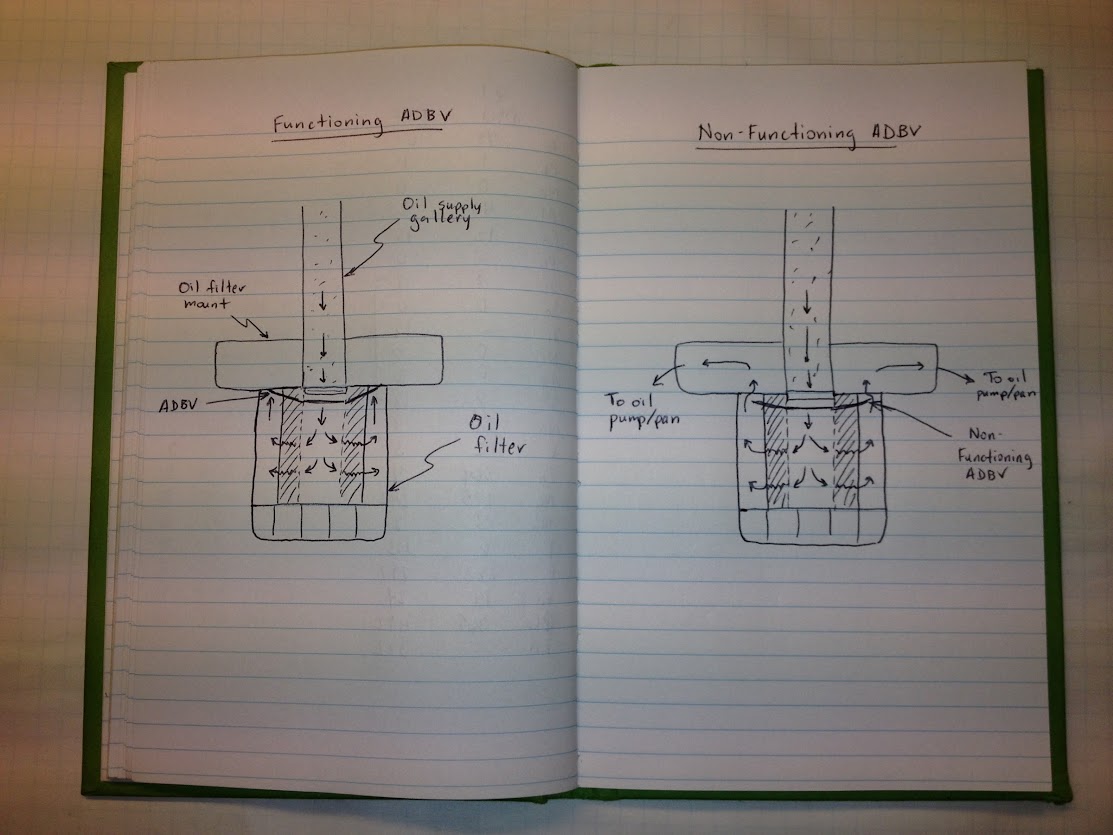
This is a sketch I made a while back that shows what happens after you turn the engine off. Oil will backflow through the filter without an ADBV (or if it's cold and the valve doesn't work properly).

IMG_0647.JPG
 
Anti-Drainback Valves are an essential component of an engine's oiling system. I always buy the Motorcraft for my Town Car because they have the silicone ADV that is supposed to be better than the nitrile ADVs. Whether they actually are is another story, but I go about 5,000 to 6,000 per oil change and when checking the oil filter upon removal, the silicone ADV is more supple than the nitrile was.

Anything that helps ensure the quickest pump up to adequate oil pressure on start up is important to me.

With the exception of an oil accumulator, like Accusump, an good ADV is the best protection against dry starts. Keep in mind that the vast majority of engine wear takes place on start-up.
 
So I had a quick 20 minutes and put together some graphics using PowerPoint to illustrate what happens. It's so quick, I just took a quick (and *literal*) screen shot and uploaded that to Picasa with my phone. I will post a better copy of this later, generated by the computer.

Questions/comments about my graphic?

IMG_0910.JPG
 
I specifically remember there were equivalents of the AC Delco PF47 and PF52 that contained no ADV and were spec'ed in the catalog as suitable for certain applications where the filter was mounted baseplate up. I remember using the PF52 for a GM minivan, but where the filter was mounted sideways.

The other thing I recall about those filters was that there was no bypass valve. Supposedly the bypass was internal to the oiling system. I found the part:

http://www.amazon.com/ACDelco-25014006-Filter-Bypass-Valve/dp/B000EPT4U8

31D88e2zQeL.jpg
 
Originally Posted By: Hokiefyd
So I had a quick 20 minutes and put together some graphics using PowerPoint to illustrate what happens. It's so quick, I just took a quick (and *literal*) screen shot and uploaded that to Picasa with my phone. I will post a better copy of this later, generated by the computer.

Questions/comments about my graphic?


Looks pretty good.
thumbsup2.gif
Only comment I have is you might show the oil flow arrows actually going around the ABDV instead of through it just to make it more clear.
 
Many GM vehicles have the bypass in the engine/block so none is required in the filter itself. Thus those GM applications have none.

There was a recent thread regarding some GM filter applications with no adbv and it is linked below. It appears though that an adbv is used in many of AC Delco filters for those applications now. One thing for sure, while not having an adbv where the vehicle manufacturer(s) specifies non, is ok, having one whether specified or not, will hurt nothing. As the thread shows, both Purolator and Wix agree with that idea.

Fram filter with no adbv.
 
The ADBV is probably not as critical in instances where the filter hangs off the engine vertically, but a lot of these filters will have them as the filter might fit another vehicle where the filter is not hanging vertically.

As far as this silicone vs. nitrile rubber ADBV, I have cut open quite a few PF48 oil filters and the nitrile rubber ADBV is still soft and pliable.

I have seen zero evidence of where a nitrile rubber ADBV caused engine damage and where a silicone ADBV saved teh engine.
 
Originally Posted By: Hokiefyd
This has been discussed many times. It should be a sticky in this section in my opinion.

The ADBV, even in a filter mounted with its base end up, keeps the oil that is above the filter, ABOVE the filter. In other words, it doesn't let it drain back down through the filter. The head pressure of oil in the galleries will push oil that's in the filter backwards through the media and out through the oil pump back into the pan.

While it is generally true that a filter in this configuration wouldn't empty, it's also true that without a good ADBV, the oil galleries would empty and you'll still have a small duration of time where the oiling system is not primed, and operates only on the residual film left from the last time the system was primed.

This is obviously only valid for "traditional" systems where the filter is located near the bottom of the engine.

This is a sketch I made a while back that shows what happens after you turn the engine off. Oil will backflow through the filter without an ADBV (or if it's cold and the valve doesn't work properly).

IMG_0647.JPG


yea you explained this when I found a FRAM TOUGH Gaurd oil filter for my Trail Blazer that has a INLINE 6 and when I saw the FRAM oil filter I could see the Fiber End cap..
There was no ADBV and I thougt it was a defect but you explained it.

smile.gif
 
Originally Posted By: y_p_w
I specifically remember there were equivalents of the AC Delco PF47 and PF52 that contained no ADV and were spec'ed in the catalog as suitable for certain applications where the filter was mounted baseplate up. I remember using the PF52 for a GM minivan, but where the filter was mounted sideways.

Chevy small blocks in my taxi fleet days had the filter with the baseplate up (dome side down) and no ADBV was specified at the time.
 
Status
Not open for further replies.
Back
Top Bottom