Alternator Output and Cooling

Status
Not open for further replies.
It's always interested me the various methods used in cooling alternators. Bosch got the most creative with those big ducts to feed fresh ambient ram air into the back of the alternator, to their completely coolant jacketed design.
 
I had to feed filtered air to ours on the weekend toy, swapped the heatsinks out for fabricated copper ones too - as well as gear it down, 130-140*c underhood air temperatures and lots of RPM's melted half the connections on the board the first time around!

Be interesting to see what they do in future, electrical loads are going through the roof these past few years.
 
Last edited:
When I first saw the alternator on the M275 engine in the S600, I realized that it was liquid cooled. Surrounded by the coolant jacket from the engine, sealed to the block with gaskets/o-rings. Pretty wild...but it's rated at 200 amps, so all that heat has to go somewhere...
 
Originally Posted By: Astro14
When I first saw the alternator on the M275 engine in the S600, I realized that it was liquid cooled. Surrounded by the coolant jacket from the engine, sealed to the block with gaskets/o-rings. Pretty wild...but it's rated at 200 amps, so all that heat has to go somewhere...


Yup, the 540i had an optional 150A water cooled alternator on it IIRC.
 
The 190A Mitsubishi alternator in 2004+ CVPIs had 12 diodes (2 per leg in parallel) to increase the current handling capability.
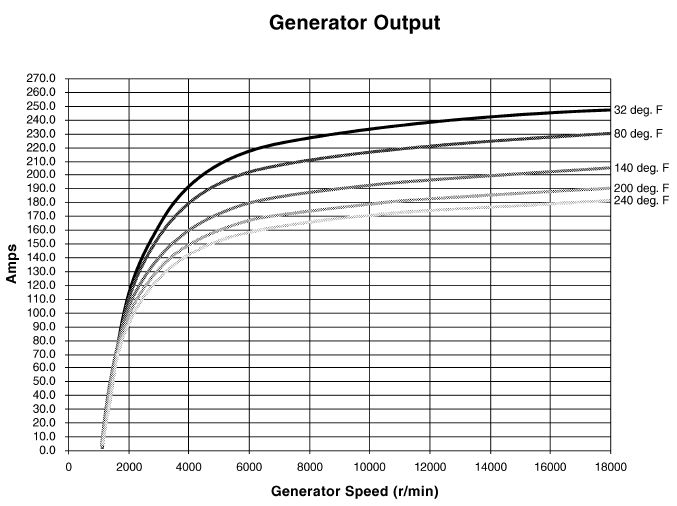
Heres a neat graph depicting alternator output of it at various temperatures. (does not say where, but I assume its probably case temperature.)
04policegraph.jpg

Dead cold its capable of nearly 250A!, though you'd have to be holding the engine at 6000rpm to get it. At a reasonable highway speed the alternator would be spinning about 6000-7000 and you could pull 220A cold but only 160A heat soaked.

alternatorparts.com sells what they call a 'Quicktifier' which has three leads that hooks to the stator output so it takes the AC current directly and does the rectification externally to the alternator. I always thought it was a cool idea, but their implementation has looked a little iffy to me.
 
Last edited:
Some BMW's (ours does) pull some intake air through the alternator. I am not sure exactly what purpose this serves.

I have always wondered for a specific power demand, is it better to have the alternator spinning faster?
 
I'm sure it helps to cool it, on my 530i there is a duct leading to the front bumper rather than using hot engine compartment air. My 530i alternator is so tucked in low down on the left side that it has to be quite hot there.

Of course this works fine until a mass of various arachnids, insects and other arthropods decide to nest in the duct and up into the alternator. Then it doesn't work so well.

Originally Posted By: CBR.worm
Some BMW's (ours does) pull some intake air through the alternator. I am not sure exactly what purpose this serves.
 
This discussion got me to thinking about how our 420 MW generators were cooled. It's been eighteen years since I retired so I had to think about it awhile. The generator rotor(60 tons) was cooled by 98% pure hydrogen that was circulated by fans on each end of the rotor. The H2 was cooled by tube and shell heat exchangers along the top of the generator. The generator stator windings( our generators were 3 phase alternators) were cooled by circulating, demineralized water. These cooling systems required both a hydrogen seal oil unt to prevent H2 escaping along the shaft to atmosphere and a stator cooling skid. Kind of hard to remember after so many years. I wrote the first pm schedules for this equipment 35 years ago.I expect that they are still is use.
 
Status
Not open for further replies.
Back
Top Bottom