An interesting bit of reading I came across, on an Australian oil company's website, and thought I'd share:
Quote:
There is a growing trend to use heavy duty diesel engine oils in older, “classic” engines due to apparently higher zinc levels.
However, changes to heavy duty engine oil specifications have meant a decrease in zinc levels and in some cases, these are less than what some engine builders desire – but more than what others require. This is apparent with ACEA E6 type oils and to a lesser extent, API CJ-4 oils.
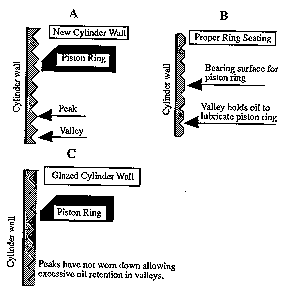
Also in the background is the fact that for many years, some owners of classic cars, club experts and mechanics have always been against diesel engine oils because they have too much detergent which will clean out and maybe damage engines. This is not unique to any one country. So there is some contradiction here as detergent is suddenly not a factor. In reality, it has not been a factor, especially in a reconditioned engine once run in. (Note: high detergency may cause bore glazing if the engine is not loaded enough during the run in phase as the oil is “too good”.)
Remember the zinc maximum (actually phosphorus) for API SM (ILSAC GF-4) products only applies to SAE 0W-20, 0W-30, 5W-20, 5w30 and 10w30 viscosity grades. Other SAE grades do not need to comply. Incidentally, ILSAC GF-5, due in a couple of years will drop phosphorus maximums to 700ppm (or about 770ppm of zinc from ZDDP).
Source
Quote:
There is a growing trend to use heavy duty diesel engine oils in older, “classic” engines due to apparently higher zinc levels.
However, changes to heavy duty engine oil specifications have meant a decrease in zinc levels and in some cases, these are less than what some engine builders desire – but more than what others require. This is apparent with ACEA E6 type oils and to a lesser extent, API CJ-4 oils.
Also in the background is the fact that for many years, some owners of classic cars, club experts and mechanics have always been against diesel engine oils because they have too much detergent which will clean out and maybe damage engines. This is not unique to any one country. So there is some contradiction here as detergent is suddenly not a factor. In reality, it has not been a factor, especially in a reconditioned engine once run in. (Note: high detergency may cause bore glazing if the engine is not loaded enough during the run in phase as the oil is “too good”.)
Remember the zinc maximum (actually phosphorus) for API SM (ILSAC GF-4) products only applies to SAE 0W-20, 0W-30, 5W-20, 5w30 and 10w30 viscosity grades. Other SAE grades do not need to comply. Incidentally, ILSAC GF-5, due in a couple of years will drop phosphorus maximums to 700ppm (or about 770ppm of zinc from ZDDP).
Source