Wix's ADBV/Bypass Combo Valve

Status
Not open for further replies.
Joined
Jun 30, 2011
Messages
11,846
Location
Mahzurrah!
Howdy all...

I wanted to hear your thoughts on the Wix "combo" ADBV/Bypass valve. Most here are aware Wix uses this arrangement on some of it's lower tier filters, and in fact recently it may be starting to show up on some of Wix's better filters.

Here's what I know... every comment I've seen on it here has been negative. Yet I've never seen an explanation as to why people don't like it. I was looking at the design, and from what I can tell you essentially end up with an economical thread end bypass. Wouldn't that be a good thing?

Please elaborate on what's good or bad about this arrangement. Is it disliked simply because it doesn't work, or for some other reason?

I looked at all the info I could find on it here:

Wix Combo Valve

I don't understand how the thing is supposed to go into bypass? Does the rubber simply flex enough at a certain pressure differential to allow oil past?

I do know the other combo valve filter I experimented with (very briefly) was the ecore combo. I have no idea if the bypass worked or not the ADBV was so bad I ditched it after only 6 days I couldn't take it anymore.

Comments? Enlighten me on how this thing works (or doesn't).
 
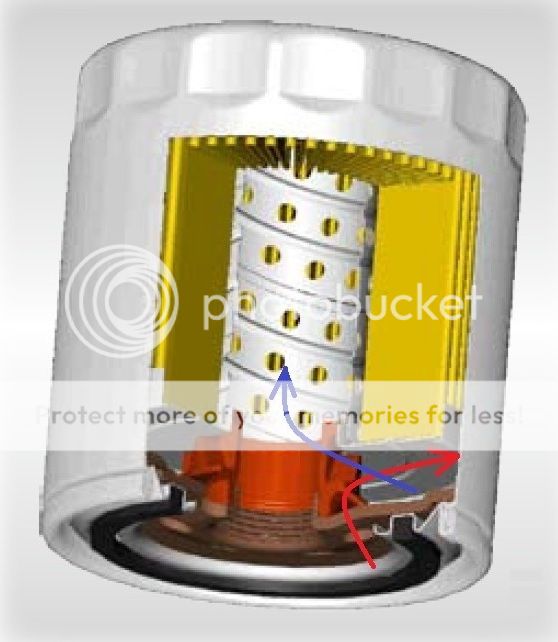
Red path is oil going through base plate holes and past ADBV part of the combo valve. Blue path is the oil going through the bypass part of the combo valve. I think the rubber part that seals against the center core tube flexes inwards when there is enough delta-P, and that allows oil to go into the center tube, thereby bypassing the media. Of course the oil would make a 180 from the direction I show on the blue path, and go out the center hole of the filter to the engine.

OilFilterComboValve.jpg


If the rubber is not silicone (and I don't know if it is or not), I can see it not wanting to flex very well in cold weather, and that would make me question the correct operation of the bypass valve. It would take more PSID in cold weather to cause a bypass event.

And if the rubber's flexibility changes a lot with higher temps, it could make the filter bypass at a lower PSID than when the rubber is cold. I don't think the ADBV part is at question, but the bypass valve functionality.

Metal springs used in bypass valves don't change their spring constant within the operating temps of an oil filter, but rubber certainly could unless they have some secret flubber rubber used in these combo valves.
 
What Zee said.

Plus, a couple of years ago when some of the filter engineers from a couple of companies were very skeptical of the reliability of them and made a point of letting me know that they though the technology was "not ready for prime time.".
 
Thanks for taking the trouble guys, well I had it right then the oil is supposed to mysteriously flex the rubber and make it past if need be. That's the only thing I could see.

Still don't really see how it's supposed to actually do it but I'll figure that out when I cut one sometime.

Did find some good info here after I posted:

Bob thread with more combo valve info

Well if it actually works it is rather ingenius. If it doesn't...you'd think they'd have tested it extensively but then again the ecore not only made it into production but remains so.
shocked.gif
 
Originally Posted By: KCJeep
Thanks for taking the trouble guys, well I had it right then the oil is supposed to mysteriously flex the rubber and make it past if need be. That's the only thing I could see.

Still don't really see how it's supposed to actually do it but I'll figure that out when I cut one sometime.


The delta-P pushes the collar of the combo valve inward towards the center of the filter, and that causes the annular seal against the inside of the center tube to break seal so oil can flow into the center tube. The blue path in my posted photo shows the flow path. Where the red line (ADBV) and blue line (bypass valve) cross the combo valve is where the rubber flexes and lets oil pass by.

The bypass valve PSI setting is all dependent on the flexibility of the rubber collar, and as I said, I'm betting the rubber's flexibility changes some with temperature and age. It would be like having a spring with a changing spring constant.

Does anyone know if these combo valves are silicone rubber or not? I can't find where is says one way or the other. If they are silicone, I'd have less skepticism on their function and reliability.
 
Originally Posted By: ZeeOSix
Does anyone know if these combo valves are silicone rubber or not? I can't find where is says one way or the other. If they are silicone, I'd have less skepticism on their function and reliability.


Well I couldn't resist the steal of a price and I bought 3 Napa Silvers today for $2.54 each. One of them has this combo valve in it, which I was already wondering about anyway.

The one I have with the combo is the PH16 equivalent, the valve is black and appears to be plain old nitrile. On the original link I posted though I noticed they had 5 different color coded valves laid out, they had different configurations too, so I presume they have different valves for different psi specs. I don't know if any of them are silicon or not, the one I have most certainly isn't.
 
Originally Posted By: KCJeep
I noticed they had 5 different color coded valves laid out, they had different configurations too, so I presume they have different valves for different psi specs. I don't know if any of them are silicon or not, the one I have most certainly isn't.


Makes sense ... the color probably does represent the bypass valve's PSI setting.

You gonna dissect the one you have and check it out?
 
Originally Posted By: ZeeOSix
Originally Posted By: KCJeep
I noticed they had 5 different color coded valves laid out, they had different configurations too, so I presume they have different valves for different psi specs. I don't know if any of them are silicon or not, the one I have most certainly isn't.


Makes sense ... the color probably does represent the bypass valve's PSI setting.

You gonna dissect the one you have and check it out?


You betcha I am!
grin.gif
I wanna get it dirty first though. Fun and cheap experiment for only $2.54.
 
Originally Posted By: KCJeep
I don't know if any of them are silicon or not, the one I have most certainly isn't.


I would say that the one you have possibly isn't. Remember that color doesn't indicate material. They can make red rubber and they can make black silicone. I'd say that the color likely indicates different "durometers" if you will if the material, different levels of flexibility, but I'd bet that the material (whatever it is, rubber, silicone, etc) is consistent across the line.
 
Originally Posted By: KCJeep
...The one I have with the combo is the PH16 equivalent, the valve is black and appears to be plain old nitrile.....

I would agree that that's exactly what it is. I've only seen a Wix silicone combo valve in pictures on the Motorcraft FL820S comparison dissection posted here several times. And apparently that experiment didn't last long because members subsequently posted that application now using a dome end bypass. In the pics, the silicone combo valve was typical orange/red. I have never seen posted here or anywhere a black silicone adbv and as the Silver is Napa's second tier filter, something similar to a Classic, it would be a nitrile adbv.

My thought on a nitrile combo valve is much as nitrile adbv can become less pliable/flexible over time, so can a combo valve. Difference is, when it's just an adbv worst you can get is some drainback, perhaps causing some start up rattle. But as a combo valve with built in bypass, if the bypass fails to function properly then the results could possibly be more serious.

That's why for me, when it comes to Wix or Napa, I stick to the Napa Gold or equivalent Wix filter.
 
Sorry for late reply, I m using a toughgard with screen , I don't recommend it . this I like a lot but, metal end cap ? No ty . also yes silicon is what need to be in there
 
Last edited:
Status
Not open for further replies.
Back
Top Bottom