Tires with extra outside shoulder tread?

Status
Not open for further replies.
Quote:


Also, Audis are typically quite front heavy


Quattros are "quite" front-heavy? Like an Accord?
tongue.gif
My A4 (B5) quattro has a front-to-rear weight ratio of 55:45, not counting what I keep in the trunk.
 
Quote:


I was going to suggest a tire with an uninterrupted block of tread in the center like this one. The solid tread block in the center squirms around less and bears the brunt of load on the tire better.
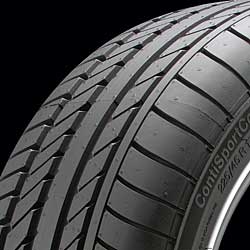


The ContiSportContact he's currently using already has such a solid tread block. I guess it's not helping.

co_contisportcontact_ci2_l.jpg
 
There are a couple of things not really being addressed here:

1) STIFFER SIDEWALLS - Everyone is focusing on the outer tread blocks and not the sidewall stiffness. If the sidewall is stiff enough, the tire won't roll over as much and will help with the wear on the outer tread blocks where they meet the sidewall. This is a function of the internal construction of the tire, look for tires with extra plies in the outer sidewall, or other reinforcements meant to prevent sidewall flex. Unfortunately, tires with massively stiff sidewalls usually aren't very comfortable. Recommendation: Falken Azenis RT-615, Bridgestone RE-01R, etc. They may not last as long overall, but they will probably wear less on the outside sidewall.

2) DRIVING STYLE - and I sure as ____ don't mean slow down. But, you can probably find a way to change your driving style to be even faster without sliding as much. Recommendation: Skip Barber, Bob Bondurant, etc. high performance driving school.
 
Quote:


Quote:


I was going to suggest a tire with an uninterrupted block of tread in the center like this one. The solid tread block in the center squirms around less and bears the brunt of load on the tire better.


The ContiSportContact he's currently using already has such a solid tread block. I guess it's not helping.

co_contisportcontact_ci2_l.jpg


Good point. I guess I was wrong.
pat2.gif
 
Quote:


There are a couple of things not really being addressed here:

1) STIFFER SIDEWALLS - Everyone is focusing on the outer tread blocks and not the sidewall stiffness. If the sidewall is stiff enough, the tire won't roll over as much and will help with the wear on the outer tread blocks where they meet the sidewall. This is a function of the internal construction of the tire, look for tires with extra plies in the outer sidewall, or other reinforcements meant to prevent sidewall flex. Unfortunately, tires with massively stiff sidewalls usually aren't very comfortable. Recommendation: Falken Azenis RT-615, Bridgestone RE-01R, etc. They may not last as long overall, but they will probably wear less on the outside sidewall.

2) DRIVING STYLE - and I sure as ____ don't mean slow down. But, you can probably find a way to change your driving style to be even faster without sliding as much. Recommendation: Skip Barber, Bob Bondurant, etc. high performance driving school.


AlfaGuy,

I'm with you. I was thinking the same thing. It look to me like Moribund either had weak sidewalls, or was scrubbing off speed in the corners with his driving style. I run 19" Pzero Rossos on my RS4, which is even heavier than his and don't experience near the problems at the track.
 
I run on roadcourses and have equipment to adjust my own alignment. What some of these other folks having been telling you is correct even if you have chosen not to listen to them. factory alignment specs are there for civil driving. They are inadequate for very aggressive driving.

Simply put, you ARE rolling the sidewall of your tires and riding on the tire shoulders. Anyone who runs autocrosses already knows the 2 simple solutions for that: higher psi in the tires, or more negative camber. The solution is the same for roadcourses (or you can run a stiffer suspension or stiffer rollbars to decrease the amount of roll the car experiences when cornering hard).

Tires with stiffer sidewalls will also help as they are less prone to rollover. Falken RT-615's have very stiff sidewalls as do BFG's T/A KD's. The tires I run are Yokohama Advan Neova AD07's. Very good tire with a lot of grip, decently stiff sidewalls (I mounted them on wider wheels to increase sidewall stiffness by using tire stretch).

The proper way to setup the alignment is based on the way you drive. Hit a roadcourse, use a tire pyrometer and measure the tire temps across the width of the tire on the inside tread, center and outer tread. The objective is to achieve minimal temp deviation between these temperatures.

If the tire temp is higher on the outsides the tire is cupping because tire pressure is too low. If it is too high in the center, tire pressure is too high. Tire temps lower on the inside than the outside? Not enough negative camber.


Max
 
Quote:


There are a couple of things not really being addressed here:

1) STIFFER SIDEWALLS - Everyone is focusing on the outer tread blocks and not the sidewall stiffness. If the sidewall is stiff enough, the tire won't roll over as much and will help with the wear on the outer tread blocks where they meet the sidewall. This is a function of the internal construction of the tire, look for tires with extra plies in the outer sidewall, or other reinforcements meant to prevent sidewall flex. Unfortunately, tires with massively stiff sidewalls usually aren't very comfortable. Recommendation: Falken Azenis RT-615, Bridgestone RE-01R, etc. They may not last as long overall, but they will probably wear less on the outside sidewall.


This is not being addressed not because we don't know about it, but rather by his unwillingess to use a different rim/tire size. Remember that he wants to keep running on 205/55/16 tires due to comfort reasons. IMO, no tire in this size will have stiff enough sidewalls. The sidewalls on those tires are just too tall and they will exhibit excessive flex, no matter what.
 
Pete, remember this is an 11 year old car. I am not going to buy new wheels. I'd have to buy five of them and then it's still a gamble wether or not there will be an improvement. In terms of monetary value, saving a little tread over buying 5 rims and 5 tires is obviously a bad idea.

All I want is a little (2/32") more tread depth on and beyond the shoulder than the Conti has, since that will solve this minor wear issue. You guys may well make suggestions other than specific tires in my size for your own amusement, but I won't entertain them.
 
Quote:


Pete, remember this is an 11 year old car. I am not going to buy new wheels.


Perfectly understood. I didn't mean for my previous response to sound like a complaint. I was just stating a fact to the previous poster.
smile.gif
 
You know a little more neg. camber would help. The problem is, even if you decided to follow this advice, in the front, all you can do is balance the camber side to side. To go more neg. on one side will require the other side to go more positive. A real shortcoming on the cars. Used to drive me crazy aligning Audis, some times you couldn't get the camber in spec. on both sides on the front at the same time.
Ted
 
Yes, Ted, in order to change camber, the subframe has to be moved left/right. Since camber on the left and right are currently as even as can be, and because wear on both sides is virtually identical, adjusting camber (= making it unequal) makes no sense at all.

I didn't feel like sharing this information before, because an alignment adjustment wasn't the suggestion I wanted to begin with -- which I had made perfectly clear from the beginning, but naturally folks won't read carefully.

Anyway, I've decided to stick with the tires I've been using. If I get 2 or 3k miles more out of them is really not such a big deal. I'm just driving an awful amount in the city now, compared to a few years ago. That means sharp turns nonstop.
 
Are there no available camber plates or bolts for the car? That would be very odd, but I could see it being the case on an older Audi. The reason everyone suggested the camber is because that is the only way you can improve the wear unless you modify your driving. There is no such thing is a tire with more outside tread so people gave you the only realistic option.

Jon
 
Quote:


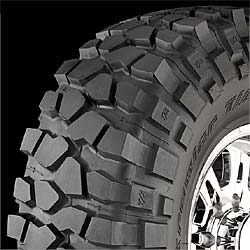
Goodyear Eagle F1 GS-D3:
Quote:


And finally, the virtual ribs flow into the shoulder area to form long, stable shoulder blocks that grip the road during cornering and help resist the wear associated with aggressive driving


That appears to be the best candidate so far.


Bursting the bubble: I am running Goodyear Eagle F1 GS-D3 tires (225/50R17) on the front end of a Mazda6 (at 38psi), and the biggest disappointment I have had with them so far has been exactly your problem: excessive wear on the outside shooulder, more wear than the OEM Michelin Pilot HX MXM4 (215/0R17) tires showed.

The GS-D3 tires have a UTQG treadwear rating of 280 vs. the Michelins' UTQG 300 treadwear rating, but the greater rate of wear of the Goodyears relative to the rate at which the Michelins wore, has been dramatic.

Of course, the GS-D3s do handle much better than the Michelins did (especially in the wet, where the Michelins, being "all season" tires, were predictably execrable; the non-all-season Goodyears are ever so much more secure when the pavement is wet). But the wear rate of the GS-D3s, especially at the outer shoulder, has been disappointing.
 
Status
Not open for further replies.
Back
Top Bottom
