Oil temperature versus ambient

Status
Not open for further replies.
My 2015 Cayman has oil and coolant temp readouts on the dash.

My cars oil temp will climb up into the 211-220 range when not in sport mode, and drops between 200 and 210 when in sport mode, with normal driving.

Since my commute to work is ~25 miles, mostly highway, I get to watch it hit full temp every day. Not bad for an 8 quart capacity.

I also have watched the same behavior on my old '98 Boxster, using the Durametric program logging the data on one of my commutes to work several years back. I also tested it during the winter months, and was happy with the results.

Both Porsche cars have oil to coolant heat exchangers, which allows the engine to get up to temperature quicker, and maintain a good temp from then on out. It's awesome.

BC.
 
Really cold here this AM. About 42 degrees, remember this is Fl.

At the end of my jaunt the oil temp was 219. Coolant was 181 (I run a 176 stat). The ambient was then 50 degrees. Admittedly some wheelspin at the top of second gear intimidated me a bit from using full power...
 
Originally Posted By: Bladecutter
My 2015 Cayman has oil and coolant temp readouts on the dash.

My cars oil temp will climb up into the 211-220 range when not in sport mode, and drops between 200 and 210 when in sport mode, with normal driving.

Since my commute to work is ~25 miles, mostly highway, I get to watch it hit full temp every day. Not bad for an 8 quart capacity.

I also have watched the same behavior on my old '98 Boxster, using the Durametric program logging the data on one of my commutes to work several years back. I also tested it during the winter months, and was happy with the results.

Both Porsche cars have oil to coolant heat exchangers, which allows the engine to get up to temperature quicker, and maintain a good temp from then on out. It's awesome.

BC.


thumbsup2.gif


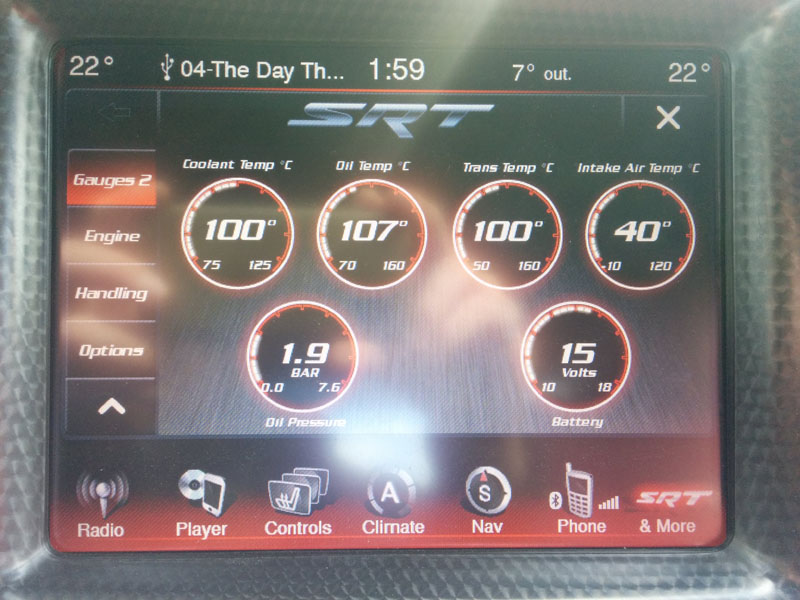
My SRT has the readouts on the UConnect screen:
SRT8Temps01.jpg


It has a oil to coolant heat exchanger as well. My BMW had one also, but it was a thermostatically controlled air/oil/coolant unit that was very large and nestled in the valley of the engine and was a little too good at getting rid of the heat IMHO. Great in the summer, bad in the winter.
 
My Gen Coupe runs cooler in the winter. The engine block and timing cover are good surfaces for the air to cool. You can see this in the summer too if I let the car idle and the oil temp rises. Soon as you start moving it drops more.
 
Originally Posted By: OVERKILL
It has a oil to coolant heat exchanger as well. My BMW had one also, but it was a thermostatically controlled air/oil/coolant unit that was very large and nestled in the valley of the engine and was a little too good at getting rid of the heat IMHO. Great in the summer, bad in the winter.


One of the interesting things that I have noticed about my Cayman, and the coolant/oil temps is that when I go for lunch, after the car has sat parked in the office parking lot for several hours, the coolant temp is higher than the oil temp when i start it up.

Today the coolant was 120 and the oil was 102, at 12:20 pm.
That's with the coolant being 194 and the oil being 219 at shutdown at ~9 am.

I wouldn't think that the heavier, thicker oil would shed heat quicker in one shared sump under the engine when compared to the huge, long coolant system in the car that has two radiators.

BC.
 
Originally Posted By: Bladecutter
Originally Posted By: OVERKILL
It has a oil to coolant heat exchanger as well. My BMW had one also, but it was a thermostatically controlled air/oil/coolant unit that was very large and nestled in the valley of the engine and was a little too good at getting rid of the heat IMHO. Great in the summer, bad in the winter.


One of the interesting things that I have noticed about my Cayman, and the coolant/oil temps is that when I go for lunch, after the car has sat parked in the office parking lot for several hours, the coolant temp is higher than the oil temp when i start it up.

Today the coolant was 120 and the oil was 102, at 12:20 pm.
That's with the coolant being 194 and the oil being 219 at shutdown at ~9 am.

I wouldn't think that the heavier, thicker oil would shed heat quicker in one shared sump under the engine when compared to the huge, long coolant system in the car that has two radiators.

BC.


You have to factor in the engine as coolant will continue to circulate as it cools/sinks, where the oil pan is somewhat of a radiator with most of the oil in it after shut down.
 
Also consider where the coolant and oil temps are taken. Virtually all the oil ends up in the pan, and sheds heat through the pan surfaces. If the coolant temp is taken from a point in the engine block, the block itself will act as a larger buffer to hold that heat longer. Almost a guarantee that the coolant temp in the radiator will be colder than the oil in the pan though - but not in the block.
 
The coolant will thermosyphon until the thermostat closes, then you only have the block and head surface to shed the combined heat of the engine and coolant.

The oil in the pan will become rapidly thermally disconnected from this, and do it's own thing...in this case, cooling to a lower temperature than the coolant.
 
The coolant temp is also measured somewhere in the engine, so you've got several hundred pounds of engine and coolant to hold heat. The oil temp is typically measured in the sump, which doesn't get convective heat from the rest of the engine (and has far less mass), so the oil cools faster.
 
Also I have a '15 6.7 PowerStroke, my oil temp runs 200-205 f year around as its controlled by a thermostat.
 
Originally Posted By: MNgopher
Also consider where the coolant and oil temps are taken. Virtually all the oil ends up in the pan, and sheds heat through the pan surfaces. If the coolant temp is taken from a point in the engine block, the block itself will act as a larger buffer to hold that heat longer. Almost a guarantee that the coolant temp in the radiator will be colder than the oil in the pan though - but not in the block.
I have an oil temp sender right after the oil filter and there is an OEM one up in the head by the CVVT solenoid. The filter one will read higher until 140f then the CVVT one starts to over take it. The CVVT one will then read 10-15f higher while driving. But if I let the car idle, the temps then equalize at the higher temp.

Currently have an oil/water heat exchanger on the oil filter mount.
 
My brother used to have a '99 C5 with a 6-speed. Indicated oil temperatures (via the DIC) would always stay very low with me driving it moderately (staying under 3000 rpm). "Low", like in the 135-150 deg F range. Only after sustained higher RPM driving would the oil temperature begin to climb.

It was supercharged and had all sorts of other stuff on it, so it likely had a cooler that wasn't thermostatically controlled.

Thing would go like mad, and would lay rubber into third gear on a swift gear change...with 295 series summer Nittos on the rear. With traction, it'd run through the first two gears so fast, you could hardly shift it fast enough before it was banging off the rev limiter. It was a real demon. Fastest I drove it was 142 mph, out on a deserted road in Arizona one Christmas when we were out there. With the convertible top down. It was breezy.
 
Status
Not open for further replies.
Back
Top Bottom