Oil filters bypass valves opening pressure

Status
Not open for further replies.
Joined
Feb 5, 2016
Messages
516
Location
USA
Any filter maker (Fram, Wix...) makes a number of filters and each filter is suitable for one or more vehicle from different manufacturers.
Is there a "standard" bypass valve opening pressure agreed upon between each car manufacturer so that these filters can be safely use across different cars?
Or is this a grey-area that is not really discussed and whose numbers are not really published out in the open?

oil-pressure-valves.png
 
The car MFG's are more concerned with relief pressure for their oiling systems.

Filter by-pass is related to filter media area and density. The finer the media, the sooner it will plug/fill. The smaller the area, the sooner it will too ...

That's why I suggest running oversized filters. More media area to collect contaminates, but more important, more area to pass cool oil (thicker) w/o going into by-pass ...

5 PSI and 12 PSI are common numbers. Personally I'd take 12 PSI any day. I'd prefer oil to be filters unless something is really off ...
 
Originally Posted By: BrocLuno
The car MFG's are more concerned with relief pressure for their oiling systems.

Filter by-pass is related to filter media area and density. The finer the media, the sooner it will plug/fill. The smaller the area, the sooner it will too ...

That's why I suggest running oversized filters. More media area to collect contaminates, but more important, more area to pass cool oil (thicker) w/o going into by-pass ...

5 PSI and 12 PSI are common numbers. Personally I'd take 12 PSI any day. I'd prefer oil to be filters unless something is really off ...


It's also possible that with a larger filter the oil will pass thru the filter element just that little bit slower. That could mean improved filtering. Over the life of the engine every little bit helps. What do you think?
 
Originally Posted By: OneEyeJack


It's also possible that with a larger filter the oil will pass thru the filter element just that little bit slower. That could mean improved filtering. Over the life of the engine every little bit helps. What do you think?

If 1cm2 of filtering material flows 1cm3 of oil per minute under 5psi of differential pressure, and the pressure is identical inside a small and a big filter, then the bigger filter will let more oil through during the same amount of time.
A bigger filter flows faster, not slower.
 
Originally Posted By: BrocLuno
The car MFG's are more concerned with relief pressure for their oiling systems.

Filter by-pass is related to filter media area and density. The finer the media, the sooner it will plug/fill. The smaller the area, the sooner it will too ...

That's why I suggest running oversized filters. More media area to collect contaminates, but more important, more area to pass cool oil (thicker) w/o going into by-pass ...

5 PSI and 12 PSI are common numbers. Personally I'd take 12 PSI any day. I'd prefer oil to be filters unless something is really off ...

Thanks
 
Originally Posted By: BrocLuno


That's why I suggest running oversized filters. More media area to collect contaminates, but more important, more area to pass cool oil (thicker) w/o going into by-pass ...


On a base-down filter mount, the center tube will take longer to fill on an oversize filter on a cold start. So there's that to keep in mind as well.
 
Originally Posted By: DrRoughneck
Originally Posted By: OneEyeJack


It's also possible that with a larger filter the oil will pass thru the filter element just that little bit slower. That could mean improved filtering. Over the life of the engine every little bit helps. What do you think?

If 1cm2 of filtering material flows 1cm3 of oil per minute under 5psi of differential pressure, and the pressure is identical inside a small and a big filter, then the bigger filter will let more oil through during the same amount of time.
A bigger filter flows faster, not slower.


If the flow is fixed before or after the filter by system geometry then the flow across the media might slow down a tiny bit.
 
Originally Posted By: OneEyeJack
Originally Posted By: DrRoughneck
Originally Posted By: OneEyeJack


It's also possible that with a larger filter the oil will pass thru the filter element just that little bit slower. That could mean improved filtering. Over the life of the engine every little bit helps. What do you think?

If 1cm2 of filtering material flows 1cm3 of oil per minute under 5psi of differential pressure, and the pressure is identical inside a small and a big filter, then the bigger filter will let more oil through during the same amount of time.
A bigger filter flows faster, not slower.


If the flow is fixed before or after the filter by system geometry then the flow across the media might slow down a tiny bit.

Good point.
 
As a side note to the conversation:
I remember the Pontiac 400 C.I. motors from the 60s and 70s had large can type oil filters. Today it seems the small can types are more popular. I have a 2016 Camaro SS 6.2L LT1. It uses a PF64 which a smaller can type filter. The relief valve bypass pressure is around 20 psi... (higher than most). I am unable to find an after market filter with that kind of rating; still using PF64 while under warranty.
 
Last edited:
Originally Posted By: DrRoughneck
Originally Posted By: OneEyeJack
It's also possible that with a larger filter the oil will pass thru the filter element just that little bit slower. That could mean improved filtering. Over the life of the engine every little bit helps. What do you think?

If 1cm2 of filtering material flows 1cm3 of oil per minute under 5psi of differential pressure, and the pressure is identical inside a small and a big filter, then the bigger filter will let more oil through during the same amount of time.
A bigger filter flows faster, not slower.


You have to always understand that the oil supply is coming from a positive displacement (PD) oil pump ... not a gigantic "oil tower" like the water in your house. It's fed a forced volume by the PD pump, and the seen oil pressure is the result of forcing X GPM through a fixed resistance to flow (ie, the oiling system as a whole).

If the PD oil pump is not in pressure relief, then it's putting out X GPM at Y RPM. And in that case, all of the same volume of oil flow is going through the oil filter regardless of how small or big the filter is.

Therefore, as BrocLuno and OneEyeJack pointed out, with a larger filter with more media area, the oil flow velocity will be slower than in a smaller filter - and hence the delta-p across the filter will also be lower. and farther away from the bypass valve setting. But the same exact oil volume will be going through them both.

BTW, the pump pressure relief valve is before the oil filter, not after like shown in the schematic post #1.

 
Originally Posted By: theeagleflies
As a side note to the conversation:
I remember the Pontiac 400 C.I. motors from the 60s and 70s had large can type oil filters. Today it seems the small can types are more popular. I have a 2016 Camaro SS 6.2L LT1. It uses a PF64 which a smaller can type filter. The relief valve bypass pressure is around 20 psi... (higher than most). I am unable to find an after market filter with that kind of rating; still using PF64 while under warranty.


The GM motors typically had the oil filter bypass valve built into the engine block. Does the 2016 Camaro not have that anymore? Maybe GM has gotten away from the block bypass design (?).
 
Originally Posted By: ZeeOSix

BTW, the pump pressure relief valve is before the oil filter, not after like shown in the schematic post #1.

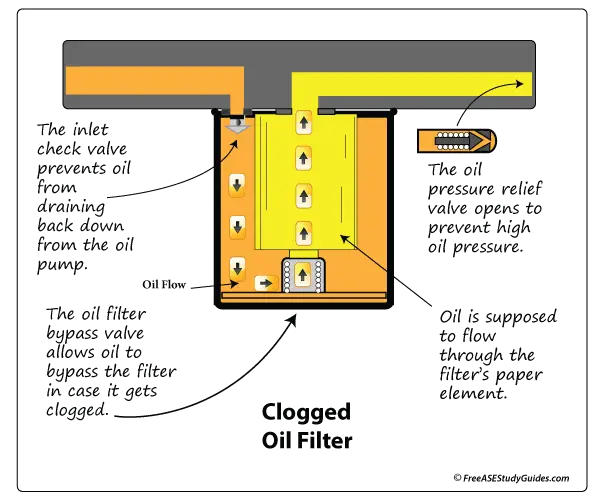
There is a pump pressure relief valve always located in the engine near the pump but there is also a filter byp[[censored] valve that can belocated near the filter in the engine, or inside the engine. In the case of my engine, it relies on the bypass valve in the filter.

The way I understand it (plz correct if inaccurate) is that the pump pressure relief valve when actuated bypasses the hydraulics of the filter. There is then no oil being pumped into the heads and the oil pressure sensor will detect a pressure drop and alert.
The filter bypass valve when actuated pypasses the filter element with a secondary routes and send unfiltered oil into the heads which is better than no oil at all. The oil pressure sensor won't alarm on this and you won't even notice it happening.
 
Originally Posted By: DrRoughneck
The way I understand it (plz correct if inaccurate) is that the pump pressure relief valve when actuated bypasses the hydraulics of the filter. There is then no oil being pumped into the heads and the oil pressure sensor will detect a pressure drop and alert.
INDUSTRIALLY, we try to put the relief after the filter to maximize the filtered oil. Only with non-bypass filters (don't let failed pump parts downstream) do we have a relief in most cases.

Originally Posted By: DrRoughneck
The filter bypass valve when actuated bypasses the filter element with a secondary route and sends unfiltered oil into the heads which is better than no oil at all. The oil pressure sensor won't alarm on this and you won't even notice it happening.
Industrial systems are the same.
 
Originally Posted By: DrRoughneck
Originally Posted By: ZeeOSix

BTW, the pump pressure relief valve is before the oil filter, not after like shown in the schematic post #1.

There is a pump pressure relief valve always located in the engine near the pump but there is also a filter bypass valve that can be located near the filter in the engine, or inside the engine. In the case of my engine, it relies on the bypass valve in the filter.

The way I understand it (plz correct if inaccurate) is that the pump pressure relief valve when actuated bypasses the hydraulics of the filter. There is then no oil being pumped into the heads and the oil pressure sensor will detect a pressure drop and alert.
The filter bypass valve when actuated bypasses the filter element with a secondary routes and send unfiltered oil into the heads which is better than no oil at all. The oil pressure sensor won't alarm on this and you won't even notice it happening.


In the automotive world, the pump's pressure relief valve is usually built into the oil pump, so it's always before the oil filter. When the pump's pressure relief valve opens up, it limits the pump's output pressure and directs the excess oil volume back to the sump or back to the pump's inlet.

You don't lose any oil flow going to the filter & engine when the pump hit's pressure relief ... you just limit the maximum flow volume as determined by the pressure relief point of the pump.

A filter bypass valve built into the engine block bypasses oil around the filter basically like a bypass valve in the filter would, except with the block bypass there is no chance of sweeping any debris through the bypass valve. Kind of like a base end bypass valve, but built into the engine block.

The only time you would see a low oil pressure warning is if there was actually low oil pressure. Oil pump hitting pressure relief or the oil filter going into bypass will not give any warning or indication it's happening. You might be able to see the oil pump hit pressure relief if you have a good oil pressure gauge, and see the oil pressure climb up to a certain point and stop there when at high RPM.
 
Let's not forget the data Jim Allen collected for us a few years back...

On a stone cold engine, with cold ambient temps, using an oil thicker than recommended (10w-30 instead of 5w-20) upon cold start with the flare up in revs, his filter only went into BP for a blip. That was it. Never after that. Additionally, he tried WOT runs before fully warmed. Never BP at all. In all his battery of tests, he essentially could not force the BP to happen unless he purposely abused the conditions and even then it was a RARE thing.

Also, think of the two conditions that may or may not take place.
a) Let's say the BP does not open much if ever (which Jim's data points towards). So what? If it's rare, than it's not really a big risk because super infrequent events don't have much chance to affect the wear by passing particles.
b) Let's say the BP opens all the time (Jim's data proves otherwise). Who cares? If it's frequent, it's clear from a bazillion used oil analysis that this does not cause high wear. There is no way that you can infer BP events are frequent, but then look at UOA data and explain how most all have excellent results. It's just a contradiction of concepts.


So I have these two things to point out:
1) It is RARE that the BP will ever open at all.
2) Regardless of who much it does, it does not affect wear much if any at all.

I realize that takes all the fun out of the BFF (Bitog Fretting Factor), but that's just the logical way to look at it.
 
Status
Not open for further replies.
Back
Top Bottom