NASA's Hybrid Concept with GE Aerospace

MolaKule

Staff member
Joined
Jun 5, 2002
Messages
25,651
Location
Iowegia - USA
No efficiiency figures were given, but anytime there is energy conversion, one always loses some efficiency in that conversion.

And then there is the additional weight penalty of the increased size of the generators, motor controllers, wiring, batteries and battery storage, etc.

https://www.bing.com/videos/rivervi...6F9554B0852B179AA9BE6F9554B0852B17&ajaxhist=0

Those geared turbofan concepts makes some sense but even then, with the larger diameter fans, one loses some efficiency with the gearing reduction and constant lubrication is needed for gearing.
 
No efficiiency figures were given, but anytime there is energy conversion, one always loses some efficiency in that conversion.

And then there is the additional weight penalty of the increased size of the generators, motor controllers, wiring, batteries and battery storage, etc.

https://www.bing.com/videos/rivervi...6F9554B0852B179AA9BE6F9554B0852B17&ajaxhist=0

Those geared turbofan concepts makes some sense but even then, with the larger diameter fans, one loses some efficiency with the gearing reduction and constant lubrication is needed for gearing.
Seems P&W has been working issues with PurePower NEO’s …
(Check title spelling, btw) …
 
And I thought there was no such thing as a free lunch. Lower thrust engines to produce more thrust overall.
Interesting....
Increased weight on the extreme aft of the plane and increased tail strike possibility, would be additional considerations.
 
And I thought there was no such thing as a free lunch. Lower thrust engines to produce more thrust overall.
Interesting....
Increased weight on the extreme aft of the plane and increased tail strike possibility, would be additional considerations.
Increased weight from the batteries and larger generators alone relate to extra fuel burn. (And we haven't even discussed the safety risks from the batteries).

Larger wing area for more weight lifting results in more drag and extra fuel burn.

In aerspace design you have to determine if new technologies have any real efficiency improvements. Otherwise, you're chasing your own tail.
 
No efficiiency figures were given, but anytime there is energy conversion, one always loses some efficiency in that conversion.

And then there is the additional weight penalty of the increased size of the generators, motor controllers, wiring, batteries and battery storage, etc.

https://www.bing.com/videos/rivervi...6F9554B0852B179AA9BE6F9554B0852B17&ajaxhist=0

Those geared turbofan concepts makes some sense but even then, with the larger diameter fans, one loses some efficiency with the gearing reduction and constant lubrication is needed for gearing.
Both GE and Rolls Royce had looked at geared turbofans. Pratt&Whitney PW1100G is in theory more efficient on paper than a non geared turbofan but P&W have had a lot of reliability issues. Spirit Airlines has claimed that this is one of the reasons for so many cancellations and worse than expected profit. If I remember recently there was a chart showing airlines their aircraft and manufacturer used. Spirit went big with the P&W 1100G something like 38% of their fleet was specced this way.
 
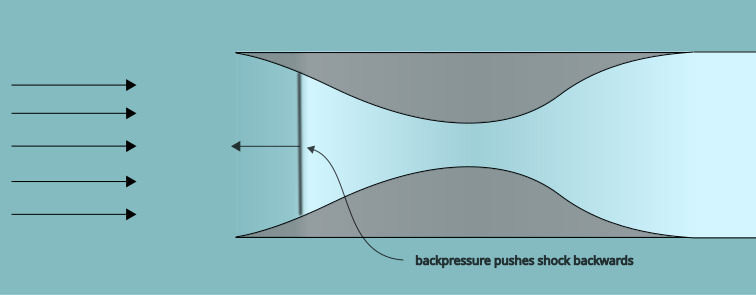
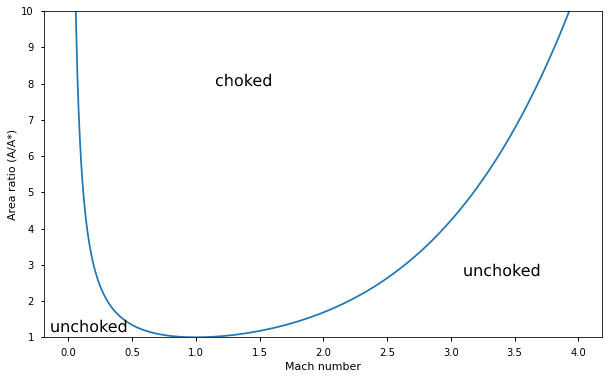
There is no heat in that aft fan. Therefore discharge velocity is limited to choked or stagnant flow speeds at the duct discharge temperatures, which are directly related to temperatures aloft. Such "no heat" designs are typically best at cruise speeds of 350Kts as discharge speeds rarely reach 600MPH. The work-around is of course, very power-intensive, multi stage fans, creating enough compression to increase discharge temperature markedly, thereby raising the duct stagnation (choked flow) speed.

At the speeds, temperatures and pressures involved (all quite modest) a shockwave forms forward of a "choke point" (nozzle) when airflow reaches close to the speed of sound.

TLDR: The hotter the exhaust, the faster we can push it through a duct or nozzle, at a given pressure and the faster we can go. Elec drive, no heat, low velocity.

unstable-shock.png


compression_ratio_to_mach_annot.png


An afterburner heats the exhaust. An example would be 22 PSI of duct pressure, whether or not the afterburner is in use. When AB is employed, temp increases over 2000ºF, the air expands (a lot) and the Speed of Sound, and therefore discharge velocity increases to over 2000MPH also.

1717786274175.jpeg
 
Last edited:
  • Like
Reactions: 4wd
The only way electric or magnetic attraction repulsion motors will work is in this form.
For fuel savings aviation will need to regress, back to props on everything. :ROFLMAO: :ROFLMAO:

 
Last edited:
Back
Top Bottom