Lets discuss Oil Temperature and it's implications

Status
Not open for further replies.
Joined
Aug 12, 2013
Messages
45
Location
NJ
What is the relevance of monitoring engine oil temperature related to driving?
My assumption has always been oil should be at it's operating temperature prior to hard driving.

What is considered oil's optimum temperature from a functionalstandpoint for the basic end-user (street driven car). I'd assume above the boiling point to remove moisture/fuel dilution from the oil itself? What is the 'ideal' oil operating temp? I've heard 200-210, 220-230, I've also heard 'warmed up' is above 170~

I've heard not to drive hard prior to letting the oil warm up. I've always done this on any car I've had. However, I've never had an oil temp gauge, so I have to make estimates when it's safe to do so.

What should oil temp ideally be before hard driving? I've also heard it's fine to drive hard when coolant is up to temp, all that needs to warm up is the engine itself, to take into account thermal expansion. Which is true?
Is oil at the correct temperature necessary for hard driving? (Anyone who's been to the drag strip has seen cars come off trailers and head right to the strip)

What would implications of driving hard on cold oil? What about very hot oil (I would assume loss of viscosity)?

Sorry this is a scatterbrained grammatical nightmare, I was focused on communicating all of the questions I had opposed to fluidity, forgive me grammar Nazis.

Thanks in advance.
 
Last edited:
Coolant comes up to temperature much faster than the oil sump, especially if you have a particularly large oil capacity. I've monitored this on my current car and previous car -- oil takes anywhere from 5-15 minutes to reach its operating temperature after the coolant gauge levels off.

And FWIW, the last few cars I've owned have a 210-225 operating temperature for the oil across a variety of diffent viscosities (5w40, 0w40, 10w60).
 
Now what implications does that have on driving hard in the winter time?
Are you referring to the M3 in your signature? Those calculate 'maximum revs' based on oil temperature, correct? On short winter drives, does the oil ever get up to temp?
 
Originally Posted By: RobS
Now what implications does that have on driving hard in the winter time?
Are you referring to the M3 in your signature? Those calculate 'maximum revs' based on oil temperature, correct? On short winter drives, does the oil ever get up to temp?


It means I shouldn't apply high engine load for a while. As I said, it can take up to 15 minutes beyond the coolant stabilizing for the oil to level off. On a very cold day, and if the car was parked outside, that means it could take 20+ minutes.

As for the M3, yes, it moves the powerband as the oil warms up. It allows redline once the oil temp has hit 175 F, but normal operating temp is around 210. I haven't had it long enough to know how that works in the winter.
 
Good questions all.

In most cars the coolant warms faster than the oil due to the thermostat bypassing the flow through the radiator. In our fleet trucks all vital fluids go into the rad first and then into aux coolers. This may be part of the reason for their longevity.

On my car the oil heats almost equally to coolant, it has those pesky squirters that bathe the undersides of the pistons in oil for heavy duty usage on the track. FWIW I have seen 300 degrees oil temp at the track and it was absolutely unaffected per oil analysis. Mobil also said via email that 300 degrees is well within their norms.

My normal oil temp is around 220, and I never get on it unless I see 140 degrees or thereabouts first.
 
Good examples of operating temps mentioned above.
thumbsup2.gif


Originally Posted By: RobS
Now what implications does that have on driving hard in the winter time?


Oil flow is impaired when it's cold. Whether on fast idle or full load@2000RPM makes little difference on cold oil. OTOH free revving or loading an engine @6000RPM are both just as harmful. I don't place much of a load limit on cold engines, however I adhere to a strict RPM limit. Now, some may argue piston clearances, which depending on design and alloy, are minimal and often easily compensated for by the cold oil viscosity. If I'm dealing with an engine design or wear that allows a piston to rock too much when cold, then I will limit both RPM and load accordingly. Loading a cold engine (within reason, ie usually after the 10 second rule) will shorten the time spent operating under-temp. The oil will heat up faster through both molecular friction (the work required to overcome the oil's own viscosity) and work lost in shearing, friction etc. The dynamic limiter on the M3 is a good example of RPM safety limits implemented by the factory.
 
During the summer, the Cherokee's coolant comes up to temperature within 5-10 minutes easily.

However, the oil seems to take 30 minutes on a hot summer day to reach full temp. I don't have a temperature gauge, but I consider it to be up to temp when hot idle is at 21PSI with RT6.
 
Part of the warm up process is to allow all of the parts to heat up and expand to their normal working clearances, or at least I've always thought so.
Some additives are not effective when cold and oil will obviously not flow as well when cold, but I think that oil temperature is only a part of the equation.
I never get on a car at all until I've warmed the engine and its fluids with at least eight miles of gentle driving, more in very cold weather.
 
Ideally, every engine should have oil cooler/heat exchanger to keep oil temps constant. However, I'm hearing that a few Toyota/Lexus cars that have that, it's just yet another point where oil can leak out, sometimes in a catastrophic like fashion.
 
Ask this guy with a TT-RS what happens when you don't warm up a car properly.

Quote:
Now, the ugly. Two weeks ago I pulled my car out of my work parking lot. Seeing traffic coming, I gunned it. No warm up, no mercy. Immediately afterwards, my car was running rough. Thinking it was a bad coil pack after speaking with the dealer over the phone, I proceeded to drive it into the shop. The car died as I pulled in.

... the rings on the number 1 piston somehow broke off and severely gouged my block. No compression.


http://forums.quattroworld.com/tt2/msgs/29418.phtml

-Dennis
 
I sold a race car with a 302. I warned the new owner to let the oil get some temp in it before racing. He didn't listen and the oil pump drive shaft twisted up like a barber pole and broke. It had 15w50 Mobil 1 in it.
 
The only oil temp gauge I have (at home) is on the Harley and the one for the deep turkey fryer. Takes awhile to get the oils up to temp and also takes awhile to cool too. They turkey fryer oil smells better... with a turkey in it.
 
Originally Posted By: bluesubie
Ask this guy with a TT-RS what happens when you don't warm up a car properly.

Quote:
Now, the ugly. Two weeks ago I pulled my car out of my work parking lot. Seeing traffic coming, I gunned it. No warm up, no mercy. Immediately afterwards, my car was running rough. Thinking it was a bad coil pack after speaking with the dealer over the phone, I proceeded to drive it into the shop. The car died as I pulled in.

... the rings on the number 1 piston somehow broke off and severely gouged my block. No compression.


http://forums.quattroworld.com/tt2/msgs/29418.phtml

-Dennis


I'd say that's an extremely unusual thing to happen, though that motor is quite high-strung to begin with.
 
Excellent responses. I really appreciate the information this far.

So often I had heard "don't drive hard until engine is warm (Oil warm or water warm?) because X explanation, or "you can drive as hard as you want as long as the coolant is up to temp" but neither theory had ANY substantiation as to how they reached that conclusion or any evidence to back it up.

However, I've seen more people than I can count bang on cold-ish cars at the drag strip than I can count, and that's what really led me to post this in the first place. I do mean, off the trailer, idle a minute, right to the staging lanes. Many of these aren't purpose built all out drag cars either, most are streetable cars that weren't driven there.

In fact, friend of mine has a 3rd Gen Golf GTI VR6 with an aftermarket one-off turbo set-up on it. Those cars had a very cool feature to check the oil temperature through the digital gauge cluster display. I noticed after his first two passes (65-70 degrees ambient temp), it read 190~F. Car came off the trailer, went through tech inspection, and right to the strip. (I'm aware it's an aged mechanical device and I cannot attest to it's accuracy, I just felt compelled to check it afterwards)

-I'm also going to edit my initial post for clarity's sake when I have a chance.
 
Last edited:
Hi,
Robs - The Porsche Museum in Zuffenhausen has a standard practice of warming the engine lubricant to 80C prior to applying load or revs. Their engine families are of course priceless!

In my experimentation with my own Porsche engine families a decade or so back I found that it takes about 20minutes to get to a stabilisation point coolant to lubricant. This was typically around 85C

This was done to debunk the reason why some service shops were filling these engines with lubricants with viscosities of up 25W-70 "to get good hot idle pressure and to minimise the risk of starvation in tight turns when racing.......and etc"

It proved that Porsche's recommendation of a 5W-40 (or 0W-40) synthetic was correct and other factors were of course at play with the "issues" described

Over a long period of months I used an infra-red temperature reader at various strategic engine points as well as the usual gauges etc. On various engines of course

With my heavy high speed diesel engines I used special filtration systems and a 5W-40 synthetic lubricant (instead of a 15w40 mineral lubricant) to decrease the stabilisation time in order to safely use mid range revs early after a cold start. This proved to be successful. It was cost effective in this situation!
These engines have about 39 litres of coolant and about 38 litres of lubricant
 
Thanks for the info Doug. 80 C is 176 F. A number I'd heard before regarding operating temperature. I can't recall the car, but for an oil pressure test, the FSM recommended to have the engine oil at 176-210 F to get an accurate reading.

-So in a practical sense, a smaller sump capacity would result in a shorter warm up time?

-How is warm up time affected by the grade of oil used? Would a 0-30 warm up quicker than a 5-30, x-40 etc.? What about dino/synthetic? (would a car more frequently driven on short trips benefit from a lower grade such as 0-30 opposed to 5-30?)

I know synthetic has a higher operating range (regarding maximum temperature), but is there a difference regarding it's ascent to op temp?

Does a smaller sump capacity result in the necessity of shorter OCI's (as a generalization)because the oil has to "work harder" because there's less of it?

I ask too, as BMW's N54/N55 twin turbo I6 engine's had 15K~ OCIs from the factory. I know the oil capacity in those cars is somewhere around 7 qts. Is there a specific reason they chose this oil capacity for an engine that only displaces 3 liters? (resistance to thermal breakdown, ability to 'safely' run long drain intervals, etc?)
 
My car (like dparm's) has an oil temperature gauge as well as a variable redline on the tach. In the summer months, oil and coolant temperatures correlate very closely, as the car has a thermostatically controlled air/coolant heat exchanger for the oil in the valley of the engine.

However, in the winter I discovered that it took forever to get the oil up to temp. This is with a 7L sump. In the summer, by the time I drive the few kilometers it takes to get to work, the oil and coolant are both about normal. In the winter, the coolant is headed there but oil isn't even close. This, and the UOA I did showing the amount of fuel dilution this caused last winter has indicated that this isn't good for the health of the engine or the health of the lubricant.

The pressure fed areas of the engine are less effected by cold oil than the splash and spray lubricated areas. Think about the flow of oil coming out the top of the rockers in a pushrod engine through that fixed orifice, think about the spray of oil from piston squirters or the spray of oil out the sides of the rod bearings to spray the cylinder walls. All of these are effected by cold, thick oil. I once saw a video that vividly demonstrated that last one with "drops" of oil coming out of the side of the bearing just sort of splattering on the cylinder walls with the cold oil, whilst the hot, thinner oil came out in a strong spray coating it all.

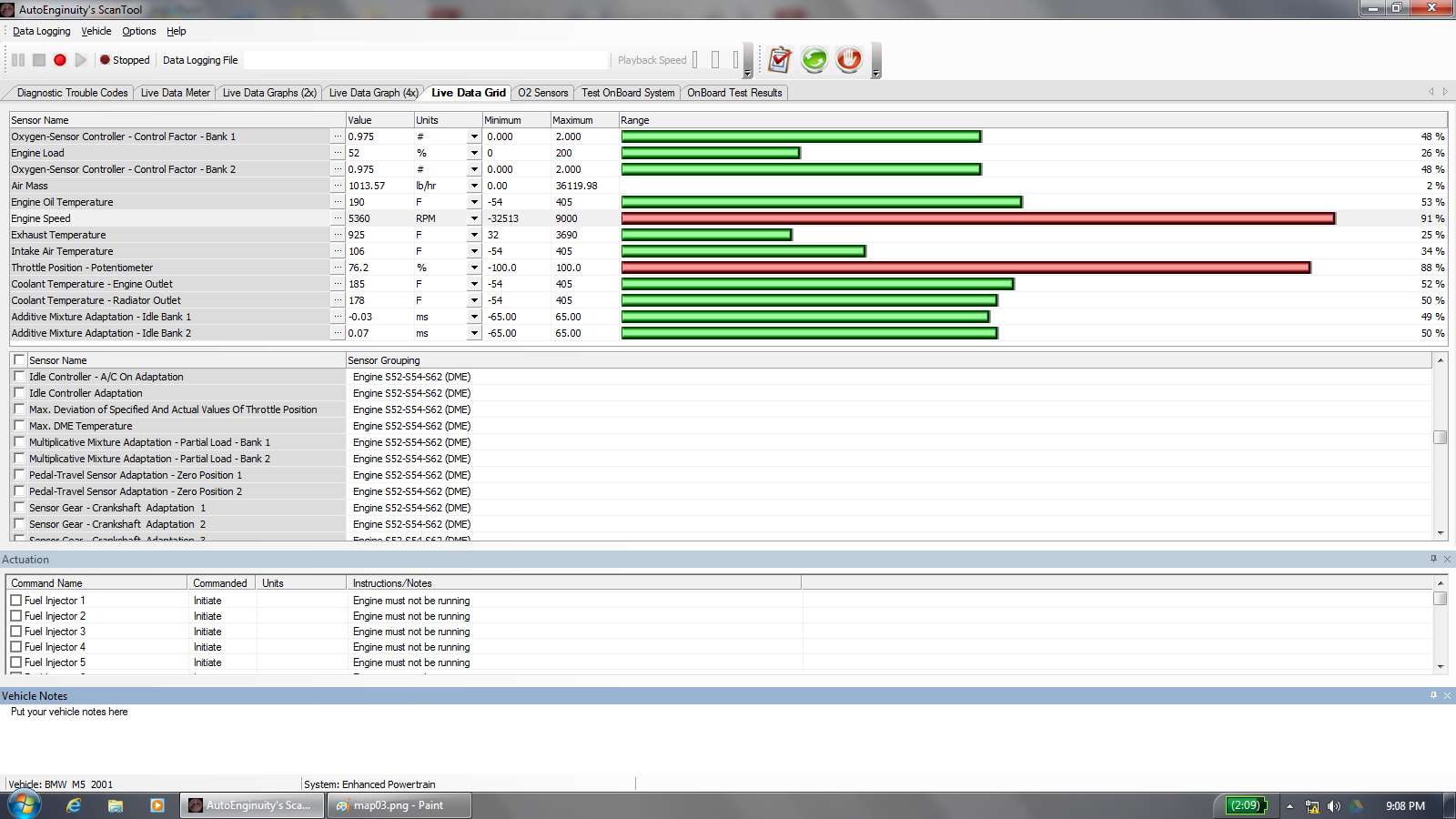
And somewhat OT, but it is really neat what you can datalog with newer cars. I can graph my oil/coolant temps with the software I use, and can also view them, along with a host of other parameters in real time:

map04.png
 
Originally Posted By: dparm
Originally Posted By: bluesubie
Ask this guy with a TT-RS what happens when you don't warm up a car properly.

Quote:
Now, the ugly. Two weeks ago I pulled my car out of my work parking lot. Seeing traffic coming, I gunned it. No warm up, no mercy. Immediately afterwards, my car was running rough. Thinking it was a bad coil pack after speaking with the dealer over the phone, I proceeded to drive it into the shop. The car died as I pulled in.

... the rings on the number 1 piston somehow broke off and severely gouged my block. No compression.


http://forums.quattroworld.com/tt2/msgs/29418.phtml

-Dennis


I'd say that's an extremely unusual thing to happen, though that motor is quite high-strung to begin with.


Agreed. Freak failure probably not related to temp, but BOOST. Nothing like forced induction to fray a ring or chip the upper land out as it detonates.

The Internet will amplify this, in two weeks everyone will say that ALL german cars stink...
 
Originally Posted By: SteveSRT8
Originally Posted By: dparm
Originally Posted By: bluesubie
Ask this guy with a TT-RS what happens when you don't warm up a car properly.

Quote:
Now, the ugly. Two weeks ago I pulled my car out of my work parking lot. Seeing traffic coming, I gunned it. No warm up, no mercy. Immediately afterwards, my car was running rough. Thinking it was a bad coil pack after speaking with the dealer over the phone, I proceeded to drive it into the shop. The car died as I pulled in.

... the rings on the number 1 piston somehow broke off and severely gouged my block. No compression.


http://forums.quattroworld.com/tt2/msgs/29418.phtml

-Dennis


I'd say that's an extremely unusual thing to happen, though that motor is quite high-strung to begin with.


Agreed. Freak failure probably not related to temp, but BOOST. Nothing like forced induction to fray a ring or chip the upper land out as it detonates.

The Internet will amplify this, in two weeks everyone will say that ALL german cars stink...


It'll go something like this in the young, internet dwelling community: "Hey man, those TT RS's are pretty fast, huh?"

"Eh, I heard they got junk pistons."
 
Status
Not open for further replies.
Back
Top Bottom