Originally Posted By: OVERKILL
Originally Posted By: MoreCowbellAz
I read a few articles, (including the oil univ series in BITOG), and I've seen that one of the differences between conventional and synthetic oil is that for example a conv 10w30 oil uses 10w base oil and adds VII to achieve 30w characteristics when hot, so when it shears that 30 w goes back towards the base 10w. Conversely, a syn 10w30 uses a 30w base and adds things the achieve the characteristics of a 10w when cold and supposedly doesn't shear away from that "hot" grade, so you don't have the shearing problem you see with conv oils.
So with that in mind, why all the talk of shearing out of grade of syn oils? I hear it all the time with the oils, particularly with the syn 5w40's and such, people claim the conv 15w40 are much more shear resistant.
How can that be, if the syn oils supposedly never shear away from that "hot" grade? I'm sure I'm misunderstanding something, so enlighten.............
Not quite. The 10w-xx is the cold performance target. The Xw-30 is the hot performance target. A base oil blend is selected that comes as close as possible (with the cost of doing so weighing in) to meeting both of targets and then VII's (and PPD's) are added to make up the difference. So you might have a 10w-20 that is VII'd into a 10w30 or a 15w30 that is "improved" to meet the 10W performance spec.
With synthetic base stocks it is common to be able to meet both those targets with just base stocks alone; no VII's. AMSOIL makes a 10w30 with no VII's and Redline makes a 5w30 with no VII's. The natural VI/multi visc characteristics of the base stocks allows it to meet both targets.
With regards to shear there is both temporary and permanent shear; temporary happening with the action of shearing forces in the engine that the polymers rebound from, permanent with the actual destruction of the polymer chains, eliminating their ability to expand/contract to affect viscosity.
With permanent shear (which it sounds like you are speaking of), the oil is brought back closer to the native viscosity characteristics of the base oil blend. What this lands you with will vary wildly depending on the constituents of that product. The results of permanent shear for example on a product like Mobil 1 Extended Performance 0w20, which is 70% PAO based will be markedly different than on a 0w-20 that is mostly group III based or a non-synthetic 5w-20.
Mobil's SM 0w-40 tended to shear down to a heavy 30 in service, becoming either a 0w30 or 5w30. The current iteration, which appears to leverage more PAO (around 50%) in its base oil blend is more shear resistant and generally stays in grade or very close to it.
Take a look at some of the Mobil Spectrasyn lo-vis PAO base oils to get an understanding of how good the cold performance of some of these products can be:
http://www.exxonmobilchemical.com/Chem-E...roductsservices
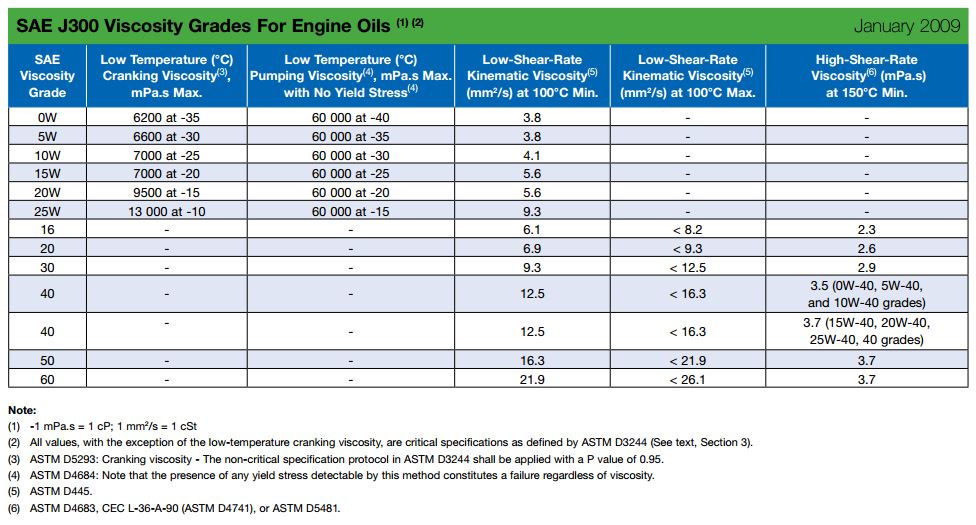
For example, the 10cSt product (10cSt @ 100C, 66cSt @ 40C, MRV 36,650cP @ -40C, CCS of 8,840cP @ -30C) meets the requirements for both the 10W and the SAE 30 designation as per this table:
So an oil could be blended using just that base oil with no VII's and be a 10w30. A combination of these types of base oils can be used to meet other intended viscosity spreads with very little VII being added.
great info, thanks.