Do Harmonic Balancers Wear Out?

Status
Not open for further replies.
Joined
Dec 2, 2005
Messages
1,545
Location
Kennett Square, PA
Re 1999 Toyota Avalon V6 with 140k Miles

They are designed to last the life of a car but I am not sure Toyota engineers design a car to last 19 years. In looking at my notes, when I replaced timing belt at 85k miles in 2008, I used the starter bump to loosen crank bolt. The car started and ran fine except it had a noticeable low frequency rumble or roar when it first revved up. In fact, I may have posted here about it. I wonder if I damaged the balancer and it may now be the cause of the vibration I feel in my steering wheel when stopped in reverse or drive?

What is the best way to check the harmonic balancer? Visual and/or wobble? Thanks.
 
Yes they can. I had an old Chrysler slant six that the weight shifted on it; also, a 1998 Mustang GT that had pieces of rubber or plastic coming off it.
 
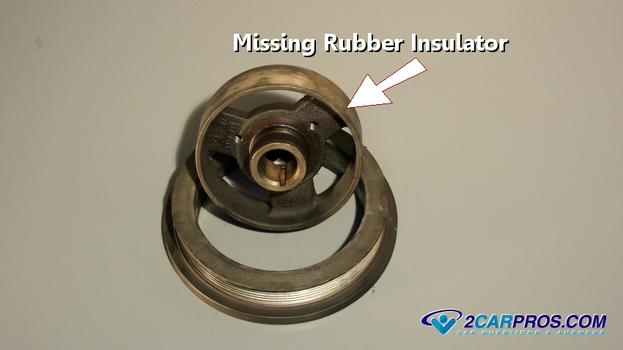
The rubber insulator can fail and start falling out, timing ring(weight) can slip and a groove can be worn into the sleeve where the front seal contacts, that's how they fail. I can't see how your actions to loosen the crank bolt could have damaged the balancer. I have done that many times successfully.I have found when timing belts are too tight, they can cause a rumble or roaring sound.
 
Last edited:
The OEM units are metal bonded by vulcanized rubber (synthetic rubber, but that's just a longer lasting version of the real stuff). It's the rubber that fails over time, so it's a replacement part (although probably a one-time replacement over the life of the engine).

You can buy aftermarket balancers that work on a different principle (active harmonic balancing) but they are expensive. Generally a high performance part as when you increase RPM beyond OEM levels the stock units begin to become ineffective. Not worth buying unless you know you need one.
 
Originally Posted By: Lubener
The rubber insulator can fail and start falling out, timing ring(weight) can slip and a groove can be worn into the sleeve where the front seal contacts, that's how they fail. I can't see how your actions to loosen the crank bolt could have damaged the balancer. I have done that many times successfully.I have found when timing belts are too tight, they can cause a rumble or roaring sound.


I have a hydraulic tensioner so I can not adjust belt tension. I just looked at my balancer. To the naked eye it has zero wobble, even when I snap the throttle. Looks like I am barking up another wrong tree.
 
This was a common failure for Mercedes in the earlier 2000s, so it can happen. They do wear out, although its hard to pinpoint exactly that that is the problem unless you actually see its out of round.
 
It happens on the 6.2 & 6.5 GM diesel engines quite often-I put a Dorman replacement one on the GMC in my sig about 4 years ago, been good so far. Not a bad idea to check them at oil changes, etc. when you're under there-might save a broken crankshaft (or on the 6.2/6.5, slow down the inevitable crank failure).
 
Yes, they do fail. Toyota had a recall on some of their V/6 vehicles for this very thing, I got one on my Sienna (which has the same engine). If I were you I would check to see if your Avalon is covered by this.
 
Last edited:
My 1985 Corvette's original bonded rubber damper failed. The inertia ring rotated relative to the hub and began walking backwards. When I first noticed it, it had walked about 1/8". I replaced it with a Fluidamper, which uses a high viscosity silicone fluid to dampen the rotation of a massive inertia ring contained within a housing.
 
It happened to my friends 2000 Camry above 300K miles, the odo gave up after 200k.

It is a relatively cheap part, however, it is not easy to change without proper tooling or tricks, though.
But you did it before using the bump method.
 
Last edited:
Years ago ('64 Corvair) I had the weight ring walk away from the engine. You could easily see the rubber insulator out of place too.

Gotta check mine today.
 
Failure was a common cause of end-of-life of Chevettes, because it wrecked the crankshaft. A co-worker's died at about 100k, shortly after he bragged on the car's reliability.
 
It may have a TDC mark on the outer ring (I have no idea I am not that familiar with this engine to say), if it does you could put it TDC and check if #1 piston is at TDC or you may be able to see it by the timing marks.
Otherwise visually and try to move it, if you can move it its done. Don't overlook this a slipped damper ring can eventually take the engine main bearings out.
 
Yes:
broken-balancer.jpg
 
Status
Not open for further replies.
Back
Top Bottom