BMW 135i oil issue

Status
Not open for further replies.
Originally Posted By: ARCOgraphite
Originally Posted By: bruno
Interesting that the Mobil spec sheet says nothing about ACE 3 and only lists diesel specs .

My point is why play games when the appropriate oil is available ?
I think Bruno is trying in a round-a-bout way to point to the nasty Mg ADDS in MOST diesel formulations that tend to end up on the valves and CC as deposit hot spots. I have not looked at a Mobil 1 Turbo Diesel Truck VOA for Mg salts. Best bet is a SM oil majority group V base so you'll have good inherent lubricity and boundary lubrication in the basestock, and less need for highish Ca detergents and Zn EP and other metals that will end up in the worng places.


ARCO graphite, do you think Mg can be one of the factors in how bad valve deposits are in DI engines? Would Mg be part of the crankcase evacuation gases that make their way to the intake valves via the PCV system.

I am very interested in this topic and if it can be shown that high Mg is a factor in valve deposits in DI engines, that would be very valuable to a lot of DI owners. Any links or leads to more info? Thanks!
 
Originally Posted By: ARCOgraphite
I think Bruno is trying in a round-a-bout way to point to the nasty Mg ADDS in MOST diesel formulations that tend to end up on the valves and CC as deposit hot spots. I have not looked at a Mobil 1 Turbo Diesel Truck VOA for Mg salts. Best bet is a SM oil majority group V base so you'll have good inherent lubricity and boundary lubrication in the basestock, and less need for highish Ca detergents and Zn EP and other metals that will end up in the worng places.

Mobil 1 Turbo Diesel Truck 5w40 in CJ-4 version meets API SM and has 1.0% sulfated ash. That's a typical amount for typical API SM motor oils intended mostly/only for gasoline engines.
 
Originally Posted By: JAG
Bruno, that is more than enough nonsense for one thread and I have no patience for it.

I agree with your reasoning JAG, but I do think he makes a good point. You are taking a gamble by using a non-spec oil, albeit a fairly safe one in this case.

EDIT: Sorry, didn't see the rest of the posts...
 
Last edited:
Originally Posted By: saaber1

ARCO graphite, do you think Mg can be one of the factors in how bad valve deposits are in DI engines?

if it can be shown that high Mg is a factor in valve deposits in DI engines, that would be very valuable to a lot of DI owners.


And *if* this was true could a used oil analysis showing 'high' Mg be indicative of valve deposits?

(It was my impression that up till now used oil analysis didn't provide any 'warning', any clues that deposits were occurring).
 
Last edited:
Originally Posted By: ARCOgraphite
Best bet is a SM oil majority group V base


Sorry as I am sure this is well known but which SM oils are majority group V base?
 
Originally Posted By: 21Rouge
Originally Posted By: ARCOgraphite
Best bet is a SM oil majority group V base


Sorry as I am sure this is well known but which SM oils are majority group V base?


There are none that I'm aware of.

Even Red Line likely contains much less than 50% POE.
 
Originally Posted By: 21Rouge
Originally Posted By: CATERHAM
Sorry as I am sure this is well known but which SM oils are majority group V base?


There are none that I'm aware of.

Even Red Line likely contains much less than 50% POE.

As far as I know, you wouldn't even want a majority Group V base for most apps. You'd end up with a very expensive oil that performs very well with a very short drain interval...
 
Informative thread. I'm also interested in the twin turbo BMW engines as I'm in the market for the F10 5er when it comes out next spring.

BTW, if you've ever looked at the PCV schematics for late model BMW inline 6's, you'll see that the PVC system is routed past and drains into the oil dipstick tube before it heads back to the intake. As such, it automatically incorporates a self-draining "catch can" from the factory.
 
Originally Posted By: JAG


When I was at BMW service last weekend, I saw they offer a valve cleaning procedure and it costs $150. They showed before and after pictures and the results were dramatic (of course...it's an advertisement, but I'm sure it is true). Eventually I'll probably need to have that done. I'll check out the BG video you posted.


Is that just a treatment of Ventil Sauber through the intake? I'm interested in knowing.
 
Originally Posted By: Jim 5
Informative thread. I'm also interested in the twin turbo BMW engines as I'm in the market for the F10 5er when it comes out next spring.

BTW, if you've ever looked at the PCV schematics for late model BMW inline 6's, you'll see that the PVC system is routed past and drains into the oil dipstick tube before it heads back to the intake. As such, it automatically incorporates a self-draining "catch can" from the factory.


Dont believe the N54 has a dipstick...
 
Originally Posted By: JHZR2
Originally Posted By: Jim 5
Informative thread. I'm also interested in the twin turbo BMW engines as I'm in the market for the F10 5er when it comes out next spring.

BTW, if you've ever looked at the PCV schematics for late model BMW inline 6's, you'll see that the PVC system is routed past and drains into the oil dipstick tube before it heads back to the intake. As such, it automatically incorporates a self-draining "catch can" from the factory.


Dont believe the N54 has a dipstick...


Right. I wonder if they still have a drain-to-sump PVC routing. I haven't looked at schematics for really late model dipstickless BMW's. Good point though.
 
Originally Posted By: Jim 5
Originally Posted By: JAG


When I was at BMW service last weekend, I saw they offer a valve cleaning procedure and it costs $150. They showed before and after pictures and the results were dramatic (of course...it's an advertisement, but I'm sure it is true). Eventually I'll probably need to have that done. I'll check out the BG video you posted.


Is that just a treatment of Ventil Sauber through the intake? I'm interested in knowing.

The ad didn't say what the method was. It said their are pamphlets that provide more details but the dealership didn't seem to have them.
 
Originally Posted By: Jim 5
As such, it automatically incorporates a self-draining "catch can" from the factory.

So do VW and Audi, and it does not stop the valve deposits. We see deposits at only 2k, 5k, and pretty bad by 25k on some cars. 50k seems to be the point where a lot of people feel they really have to remove the intake manifold and clean things up. Here is audi's triple-cyclonic oil separator via Rl_RS4. It is my understanding that for the photos of valve deposits at 2k I posted above, that car had this oil separator.

triplecyclonic.jpg
 
Also I wanted to pass along a quote from someone who works at a BMW dealership and has been tracking VW/AUDI/BMW deposits FWIW:

"BMW is having big problems with the 335, 135, 760 DI engines as well. I was talking with a BMW high up rep the other day and he went on to say..................."even the BMW induction chemicals misted pre TB will do little to nothing when DI motors have 50K". They are pulling intake manifolds and scrubbing until blue in the face. He also went on to say bmw is going to start suggesting 15K induction services from new on all DI cars."

To me, this reinforces what I have been saying above, unless you have a permanent fix where pcv gunk cannot get back into the intake tract at all (an inline catch can IS NOT a permanent fix), then it is important to start a preventative regimen as early as possible (see above list for items that can be done).
 
Originally Posted By: saaber1
ARCO graphite, do you think Mg can be one of the factors in how bad valve deposits are in DI engines? Would Mg be part of the crankcase evacuation gases that make their way to the intake valves via the PCV system.

I think he is barking up the wrong tree by especially singling out negatives of MG detergents because those negatives are not unique to them.

This thread has a dual focus which is justified, IMO. The focus started on internal-to-engine varnish but intake deposits are equally worth discussing.
I found a very interesting link discussing Audi DI engine deposit issues. I am going to see how to take advantage of its recommendations.
http://vehicleserviceprofits.com/Documents/Audi Report.ppt
 
Originally Posted By: JAG
Originally Posted By: saaber1
ARCO graphite, do you think Mg can be one of the factors in how bad valve deposits are in DI engines? Would Mg be part of the crankcase evacuation gases that make their way to the intake valves via the PCV system.

I think he is barking up the wrong tree by especially singling out negatives of MG detergents because those negatives are not unique to them.

This thread has a dual focus which is justified, IMO. The focus started on internal-to-engine varnish but intake deposits are equally worth discussing.
I found a very interesting link discussing Audi DI engine deposit issues. I am going to see how to take advantage of its recommendations.
http://vehicleserviceprofits.com/Documents/Audi Report.ppt


JAG, I need to read the rest of that presentation but the first slide is composed of only incorrect assumptions, or what they call "facts". These are not facts and they are also incorrect:

"Audi direct injected engine deposits overview of facts:

Audi valve deposit issues are predominantly in Northern winter areas like Illinois"

I disagree with this. The reported problems do not support this.

"Within Illinois, the problems are more pronounced in urban market than in rural market indicating potential differences in fuel (Chicago receives EPA mandated seasonal gas), or in driving patterns"

Really?

"Opinion of area Audi technicians indicates that the problems seem more pronounced with customers that drive fewer miles (rarely driven at highway speeds)"

This is not supported at ALL by the evidence!

"Many valve deposits are not hardened carbon deposits, but more typically softer deposits consistent with oil finding its way into the intake"

This is incorrect. Tons of experiences with people cleaning these. Why does a person have to use a walnut gun if it is soft. They have to soak the deposits for a long time in GM top clean just to have a chance at getting them off.

I'm not trying to be negative and appreciate seeing any info. on this subject, but those assumptions are wrong.
 
Originally Posted By: Jim 5
Saaber1,

In your experience does venting the PCV system to the atmosphere set any DTCs?

I don't know of any BMW systems running atmospheric so you'd have to look at the individual setup and/or try it to see if it would. I don't watch the BMW boards closely however so their may well be some out there.

For the VW/Audi 2.0 FSI engine, there are many cars running the bypass to exhaust setup, "race" catch can (which is a catch can that vents to the atmosphere instead of returning to the intake), and a few running a simple tube to atmosphere (what I've been calling "down tube" or "road tube"). No reported DTCs on any of these cars that I am aware of. The only negatives I have heard of are:

1) For race can, nasty smell (that particular can vents the gases into the engine compartment and they therefore can get sucked into the cabin). Note that "down tube" that exits beneath the car shouldn't have this issue.

2) One person who was running a Mann/Provent catch can and venting to the atmosphere reported a drop in low end power. I don't know if it was due to his particular setup, but it is worth noting and watching for in other setups. That is the only instance of this that I have heard of.

My philosophy has been to mimic the stock system as closely as possible (which includes maintaining vacuum pull of crankcase gases) and just have the pcv gunk going somewhere other than to the intake. Some possible ways to do this would be to route to exhaust (I like that because it is simple https://bobistheoilguy.com/forums/threads/pcv-bypass-for-vw-2-0-fsi-description-diy-long.107405/) or an electric vacuum pump and dumping to atmosphere.

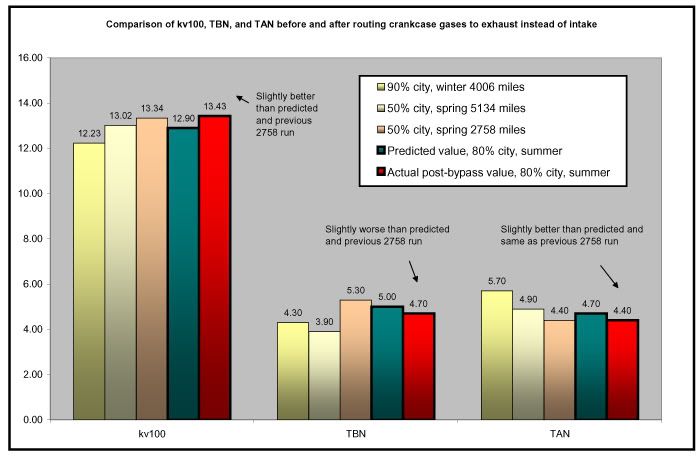
I have about 2800 miles on the setup which dumps pcv gunk into the exhaust. Normally by around 1500 miles after "seafoaming" I start to feel a little rough idle and have "stumbling starts". These are common symptoms for the 2.0 FSI and left untreated they get worse and worse until you have misfiring/loss of coil packs etc.

For example here are the valves of a car with factory recommended maintenance and good oil at 100k (not my car). Note that this car had mostly all highway miles (contrast to presentation above which incorrectly states that car with highway miles have less deposits, also note that vw patent says high rpms and light loads produce the most pcv glop)

glivalves.jpg


Since the bypass to exhaust, I have had zero stumbling starts and idle has been smooth as silk. It also appears that the bypass is having no negative effect on oil but that is based on only one post-bypass UOA. Re: DTCs, note that crankcase gases enter exhaust post-cat and post 02 sensor.


redlineuoagraph3.jpg


For fun also check out this video of this beautifully clean BMW direct injection spraying in the cylinder. What a precise spray that is and imagine the effects on the car's performance if 50k worth of PCV goo is dumped in there over time.

http://www.youtube.com/watch?v=HHqrP18GCL4
 
Thank you JAG and saaber for the information and discussion in this thread. Ive been following since you started up. My Speed6 DI now has almost 24K, thankfully with NO reduction in fuel economy or performance. I am mistified by this and can only attribute my fortune to my commute being mostly highway at speeds in excess of 60 mph for at least 30 minutes, usually 40-60. Either that or Im the MZR does not notice the impact of the design flaw until later in life. My wear metals, for what the UOA is worth to detect wear, have been lower than most as well. Im starting to think that this issue will not be resolved with oil and intake cleanings alone, but an out of warranty modification such as the venting to atmoshere or a recall to install a beefier pcv system.
 
I would also like to thank JAG and saaber for the great discussion in this thread. We just placed an order for a 2010 750Li with the new twin turbo DI V8 and I'm worried that this engine will have the same issues. I'm wondering what I can do to help with the deposits while the car is under the dealership maintenance program. They probably won't allow me to use my own oil, and I don't want to play with the PCV system while the engine is under warranty. Would using Redline in between the dealership scheduled oil changes help at all? (draining the BMW oil half way through the interval?)
 
Status
Not open for further replies.
Back
Top Bottom