Radiators keeps leaking (multiple replacements)

Status
Not open for further replies.
I do two things to prevent seepage anywhere in the cooling system.

First, I run a lower pressure radiator cap (like 10 instead of 13 or 10-12 instead of 16) if one is available for my particular vehicle, you might have to search a little. My vehicles never overheat from the lower pressure and it is a lot easier on all the components.

Second, I run Barr's Leaks pellets in every vehicle I own as a preventive measure. It stops tiny seepage leaks before you notice them. It has NEVER clogged any of my radiators or caused any other adverse effects.
 
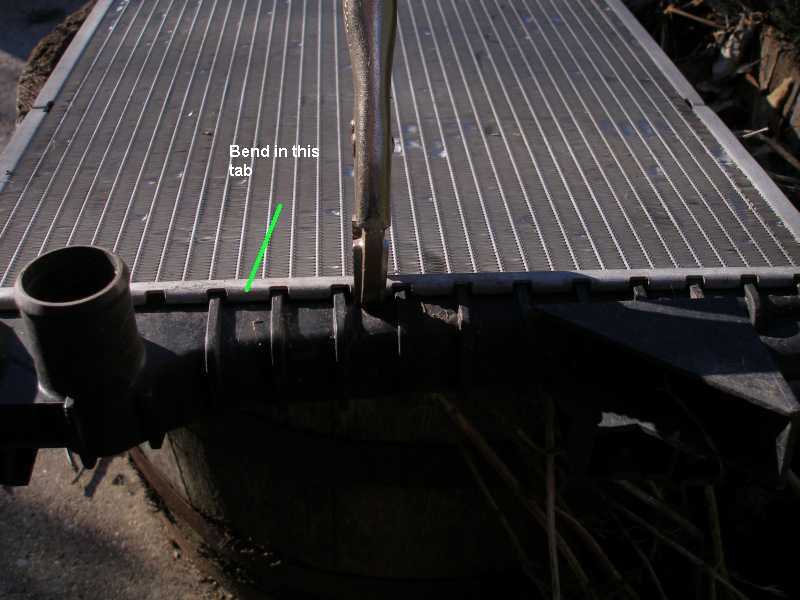
Most of the crimped radiators I've seen can benifit from recrimping. They eds pf the radiator are against a flexible foam and if the crimp is not good enough they leak.

You can use a standard vise grips to recrimp them. On Fords I do this with a new radiator before installing. Just do not over crimp.

radiator-crimp-1.jpg


radiator-crimp.jpg


radiator-crimp-w-hi-lite.jpg
 
I believe I found the answer!

My Mityvac cooling system tester arrived today, turns out it has a cap tester adapter too, so I was able to test the cap. It worked perfectly, letting out pressure right at 16lbs on the dot. I was able to use the tester pressurize the radiator a bit. Before I did that, I refilled the radiator with distilled water to help see where the water exits.

Turns out, I was wrong that the coolant was escaping from the seam under the fan mounting tab. With it full of water and slightly pressurized, I could see a stream of water coming out the front of the radiator, in the fin section.

1zr14zl.jpg


Also, you can see the AC condenser right underneath, with the corner of the bracket right about where the water is shooting out.

a5f2ud.jpg


Looks like there was a prior accident. The condenser was bowed inwards similar to the original radiator. The mounting brackets were pressing on the fin and hitting it, over time, it broke through.

What I'm not sure of still is how the fluid got to the top of the radiator. I suppose with it splashing forward, it could blow upwards while at speed.

For now, I had some Quiksteel and patched up the front. I have a new radiator on order, but I thought this would be a fun trial. I kneaded some up and flattened it right over where the water was coming out. I used my hand pump and pulled about 10psi vacuum to try draw the putty into the hole. It still leaked down to about 7psi then held, so it's holding something... Any bets on how long it'll last?
 
Sometimes if one of the hoses is on the short side it can stress the radiator or the heater core. I once had a bad engine mount which caused the engine to rock thus pulling on the radiator.
 
Last edited:
Originally Posted By: another Todd
I do two things to prevent seepage anywhere in the cooling system.

First, I run a lower pressure radiator cap (like 10 instead of 13 or 10-12 instead of 16) if one is available for my particular vehicle, you might have to search a little. My vehicles never overheat from the lower pressure and it is a lot easier on all the components.

Second, I run Barr's Leaks pellets in every vehicle I own as a preventive measure. It stops tiny seepage leaks before you notice them. It has NEVER clogged any of my radiators or caused any other adverse effects.


Bad advice overall. Lower pressure lowers boiling point. Bars pellets can clog up the small water passages, especially in the heater core. If you drive in areas where it is not consistantly hot, you may get away with these "band aid" techniques.
 
Last edited:
Originally Posted By: Lubener
Originally Posted By: another Todd
I do two things to prevent seepage anywhere in the cooling system.

First, I run a lower pressure radiator cap (like 10 instead of 13 or 10-12 instead of 16) if one is available for my particular vehicle, you might have to search a little. My vehicles never overheat from the lower pressure and it is a lot easier on all the components.

Second, I run Barr's Leaks pellets in every vehicle I own as a preventive measure. It stops tiny seepage leaks before you notice them. It has NEVER clogged any of my radiators or caused any other adverse effects.


Bad advice overall. Lower pressure lowers boiling point. Bars pellets can clog up the small water passages, especially in the heater core. If you drive in areas where it is not consistantly hot, you may get away with these "band aid" techniques.


I'm 56 and I've been doing it since my early 20's when I worked as a mechanic. NEVER have I had any issue with any of my cars over the years, or customers cars back then. No plugged waterways, no boiling over coolant, nothing, except leak free service.
 
Last edited:
Originally Posted By: another Todd
I'm 56 and I've been doing it since my early 20's when I worked as a mechanic. NEVER have I had any issue with any of my cars over the years, or customers cars back then. No plugged waterways, no boiling over coolant, nothing, except leak free service.


The fact that you bother to service the coolant system is the reason you've had no problems.

You can't change the laws of physics, though. You are still lowering the heat transfer capacity of the system.
 
Originally Posted By: EdwardC
I believe I found the answer!

My Mityvac cooling system tester arrived today, turns out it has a cap tester adapter too, so I was able to test the cap. It worked perfectly, letting out pressure right at 16lbs on the dot. I was able to use the tester pressurize the radiator a bit. Before I did that, I refilled the radiator with distilled water to help see where the water exits.

Turns out, I was wrong that the coolant was escaping from the seam under the fan mounting tab. With it full of water and slightly pressurized, I could see a stream of water coming out the front of the radiator, in the fin section.

Looks like there was a prior accident. The condenser was bowed inwards similar to the original radiator. The mounting brackets were pressing on the fin and hitting it, over time, it broke through.


This is very common when the front bumper cover gets even a minor hit.
On this Honda (my current project) it had a small coolant leak, look familiar?

SAM_1495_zpsy6v2obsv.jpg


The culprit..

SAM_1498_zpswgwhh0cp.jpg


Make sure the brackets are not twisted! As soon as i started tightening it the thing was heading right back into the fins.
Check the clearance and make sure the radiator is free to move in the mounts. The clamps you got are great, i only use those or OE spring type.
Plastic hose connections will leak when those cheap screw clamps get cold (NE winter) and loose tension, repeated tightening only damages the hose.
Those things are one of the worst automotive products ever foisted on the public, they should be melted down.

I know i should paint the bracket but its going on the block or to the auction depending on how i feel about it once i start driving it. Its not a keeper for me.

BTW the new radiator is OE.

 
Status
Not open for further replies.
Back
Top Bottom